AI Agent Development Company
Build AI agents that can understand context, retrieve information, use approved tools, make decisions, and complete multi-step tasks inside your business workflows. Axora combines AI engineering, full-stack development, integrations, security, evaluation, and cloud infrastructure to turn agent ideas into dependable software.
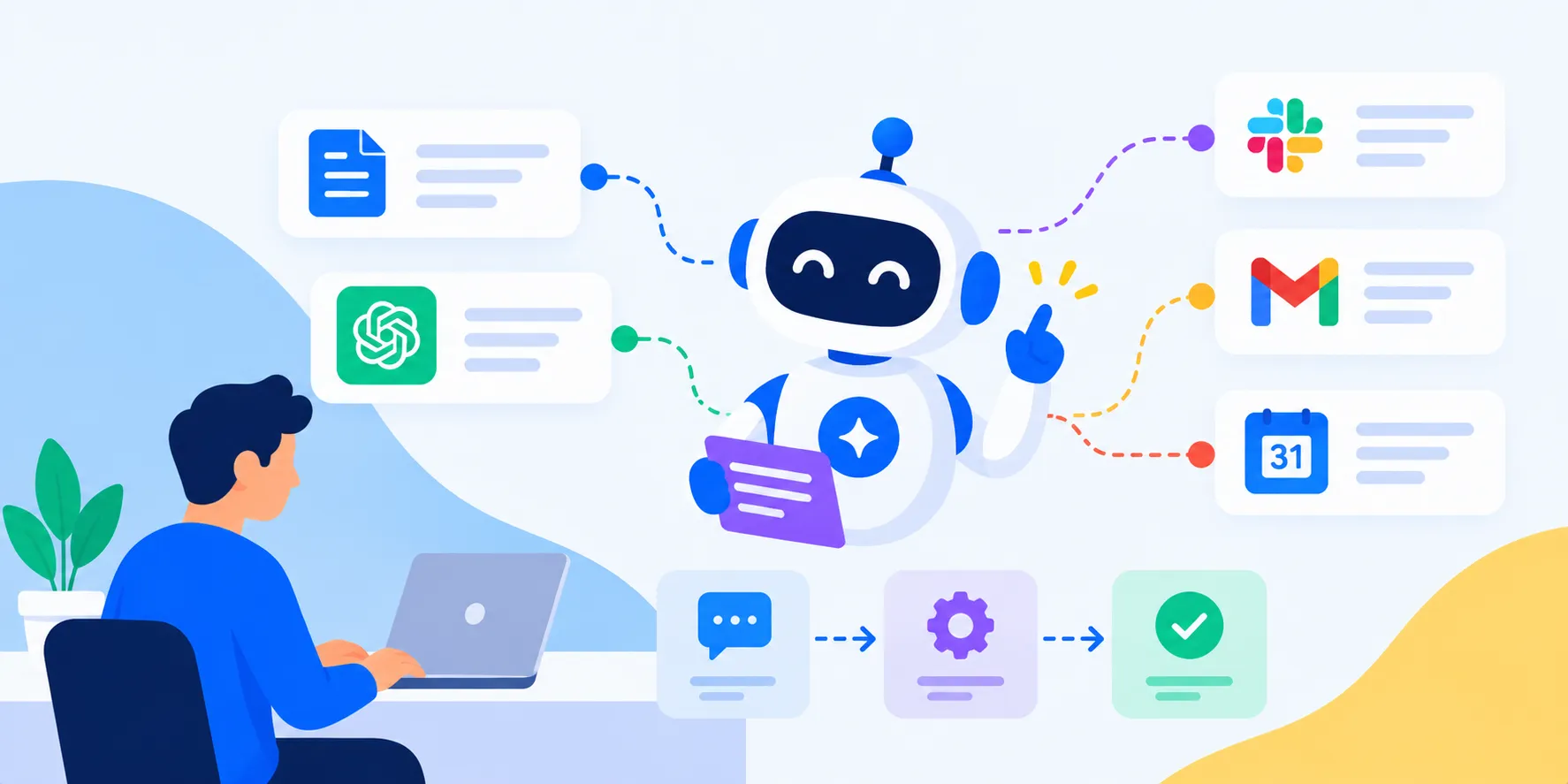
AI Agent Development Beyond Chatbots
An AI agent is useful when it can do more than answer a question. Depending on the workflow, an agent can understand a goal, gather context, decide what action is needed, use approved tools, verify results, and continue until the task is complete or a person needs to take over.
Our AI agent development services focus on practical business workflows rather than open-ended autonomy. That can include sales research, customer support, document processing, operations, internal knowledge, scheduling, data analysis, lead qualification, commerce assistance, or software workflows.
The agent is only one part of the product. A production system also needs authentication, permissions, tool boundaries, APIs, state management, retrieval, observability, evaluation, error handling, auditability, and a user experience that makes the agent's work understandable.
We design the level of autonomy around the risk and value of the task. Some workflows need full automation, others need an approval before an action, and some should remain human-led with the agent acting as a copilot.
Who We Build AI Agents For
SaaS Companies
Embed agents into products so users can search, analyze, configure, operate and complete tasks without navigating every screen manually.
Enterprise Teams
Build internal agents that work with approved company knowledge and business systems while respecting permissions and governance.
Customer Support Teams
Automate triage, knowledge retrieval, response drafting, case updates and controlled actions while escalating complex situations.
Sales Teams
Support lead research, qualification, account preparation, follow-ups, CRM updates and sales intelligence.
Operations Teams
Automate repetitive multi-step work across documents, APIs, approvals, reporting and business systems.
AI Product Startups
Turn an agent concept into an MVP and scalable product foundation with the right balance of autonomy and control.
AI Agent Development Services We Offer
End-to-end AI agent development services covering strategy, agent architecture, tools, knowledge, integrations, evaluation and production operations.
Custom AI Agent Development
Build task-focused AI agents around your business process, users, data, systems and measurable outcomes.
AI Agent Consulting & Strategy
Identify suitable agent opportunities, map workflows, assess feasibility, define autonomy boundaries and plan the first release.
AI Agent MVP Development
Build a focused agent MVP to validate the workflow, tool usage and user experience before expanding automation.
Enterprise AI Agent Development
Create secure agents for internal operations with permissions, audit trails, enterprise integrations and governance.
LLM Agent Development
Develop agents with LLM reasoning, context management, structured outputs, tool selection and controlled execution.
AI Workflow Automation
Connect agents to repeatable business processes where they can gather information, make bounded decisions and complete actions.
AI Agent Integration Services
Connect agents to CRM, ERP, support, communication, commerce, databases, custom APIs and cloud services.
RAG-Powered AI Agents
Give agents secure access to company documents, knowledge bases and business data through retrieval and permission-aware context.
AI Customer Service Agents
Build agents for support triage, knowledge answers, conversation summaries, case actions and human escalation.
AI Sales Agents
Automate research, qualification, CRM workflows, account preparation and controlled sales assistance.
Multi-Agent Systems
Use multiple specialized agents when separating responsibilities improves the workflow; avoid multi-agent complexity when one agent is sufficient.
Agent Evaluation & Guardrails
Test tool selection, task completion, retrieval, safety, failure handling and escalation with representative scenarios.
AI Agent Modernization
Improve existing agents with better orchestration, tools, memory, evaluation, security, observability and cost control.
AI Agent Maintenance & Optimization
Continuously improve agent quality, reliability, latency, cost, integrations and workflows after launch.
What AI Agents Can Do
Agents are most useful when they have a clear goal and controlled access to the information and tools required to complete it.
Understand User Intent
Interpret natural-language goals and identify the information or actions required to complete a task.
Retrieve Knowledge
Search approved documents, databases and knowledge systems to gather relevant context before acting.
Use Business Tools
Call APIs and business functions such as CRM updates, ticket actions, searches, calculations and notifications.
Plan Multi-Step Work
Break a task into bounded steps and execute them while tracking state and intermediate results.
Analyze Information
Compare documents, summarize records, identify patterns and produce decision-support outputs.
Draft and Communicate
Prepare emails, reports, responses and other outputs using approved context and templates.
Monitor and Escalate
Detect uncertainty, failure or sensitive situations and route work to the right person.
Complete Controlled Actions
Perform approved actions only within explicit permissions, validation rules and operational boundaries.
AI Agent Architecture: Model, Tools, State and Control
A production AI agent is not simply a prompt wrapped around an LLM. The agent sits inside an application architecture that manages goals, context, state, tool access, business rules, permissions and execution.
A typical architecture can include a user interface, application API, agent orchestration layer, model provider, retrieval service, tool registry, business APIs, databases, queues, state storage and observability. Each layer has a clear responsibility so agent behavior can be tested and changed without destabilizing the rest of the product.
The orchestration layer determines what the agent is allowed to do. Tool definitions describe available actions, input schemas validate requests, permissions restrict access, and application logic verifies important operations before they reach production systems.
Tool Calling and API Integration for AI Agents
Tools turn an AI agent from a conversational interface into a system that can perform useful work. A tool can expose a search function, CRM action, database query, calculator, document operation, communication action, scheduling function or custom business API.
We design tools with narrow responsibilities and explicit input and output contracts. The agent should not receive unrestricted access to an entire database or application. It should receive only the functions required for the task.
Tool results can also be validated before the agent continues. For actions that change customer records, send communications, move money, modify orders or trigger other consequential operations, the workflow can require confirmation or human approval.
RAG-Powered Agents and Business Knowledge
Agents often need information that is private, current or specific to an organization. Retrieval-augmented generation allows the agent to search approved information before deciding what to do or what to tell the user.
A production knowledge layer can include document ingestion, parsing, metadata, embeddings, vector or hybrid search, reranking, access filters, citations and retrieval evaluation. The agent then receives relevant context instead of relying only on the model's built-in knowledge.
For multi-tenant products, retrieval must enforce tenant and user permissions. Knowledge access should be treated as a security boundary, not simply as a search feature.
Agent Memory and State Management
Agents need the right context for the current task, but storing everything as permanent memory is rarely a good design. We separate short-lived task state from information that genuinely needs to persist.
Task state can track the current goal, completed actions, tool results and pending approvals. Persistent context can include user preferences or business information only when the product has a clear reason to retain it and the appropriate privacy controls.
Good state management also makes agent behavior easier to debug. Teams can understand what information was available, which tools were called and where a task stopped when something goes wrong.
AI Agent Workflow Patterns
Copilot Pattern
The agent assists a human by retrieving context, suggesting actions or drafting outputs while the user remains in control.
Human-in-the-Loop
The agent performs preparation and low-risk steps but requests approval before important actions.
Task Automation
The agent completes a well-defined workflow automatically when the actions and boundaries are predictable.
Research Agent
The agent gathers information from approved sources, synthesizes findings and produces a structured result.
Support Agent
The agent understands a customer issue, retrieves knowledge, drafts or performs allowed actions, and escalates when needed.
Multi-Agent Workflow
Specialized agents collaborate on larger tasks when separation improves reliability and maintainability.
When Multi-Agent Architecture Makes Sense
Multi-agent systems can be useful when a workflow naturally contains distinct responsibilities, such as research, analysis, validation and execution. Separate agents can have different tools, instructions and permissions.
However, adding more agents also adds coordination complexity, latency, cost and additional failure points. We do not recommend multi-agent architecture simply because it is technically interesting.
The preferred starting point is the simplest architecture that can reliably complete the task. A single well-designed agent with clear tools and state is often easier to test and operate than a network of agents.
AI Agent Security, Permissions and Guardrails
Agent security is especially important because an agent may have the ability to act on behalf of a user. The system must control what the agent can read, what it can change, which tools it can call and when a human must approve an action.
We design around authentication, role-based permissions, tenant isolation, least-privilege tools, input validation, output validation, secrets management, audit trails, rate limits and controlled execution environments.
Guardrails can also address prompt injection, malicious content in retrieved documents, unsafe tool calls, sensitive information exposure and unexpected agent loops. High-impact workflows can require explicit approval before execution.
AI Agent Evaluation and Testing
Agent testing must evaluate the complete task, not just whether the model generated a good sentence. We test whether the agent understood the goal, selected appropriate tools, used the correct information, completed the required steps and stopped or escalated when appropriate.
Representative evaluation scenarios can measure task completion, tool-call accuracy, retrieval quality, factuality, safety, failure recovery, latency and cost. Regression tests help catch behavior changes when prompts, models, tools or knowledge sources are updated.
Production feedback can become part of the evaluation loop. Failed tasks, human corrections, rejected actions and escalation patterns show where the agent needs better instructions, tools, data or workflow design.
AI Agent Integrations
Connect agents to the systems where your teams already work.
CRM Systems
Search accounts, qualify leads, update records, summarize activity and prepare sales workflows.
ERP & Operations
Retrieve operational information, prepare reports, manage approved workflows and assist with exceptions.
Helpdesk & Support
Retrieve knowledge, classify cases, draft replies, update tickets and escalate complex requests.
Communication Platforms
Connect agents to email, chat, WhatsApp and other communication channels with controlled permissions.
Commerce Systems
Assist with product discovery, customer questions, order workflows and content operations.
Custom APIs & Databases
Connect agents to proprietary services, databases, queues and business-specific functions.
AI Agent Use Cases
Customer Support Automation
Triage requests, retrieve answers, draft responses, update tickets and escalate cases.
Sales Qualification
Research leads, enrich account context, qualify opportunities and prepare CRM updates.
Enterprise Knowledge Agent
Search internal knowledge and provide grounded answers based on approved company information.
Document Workflow Agent
Read documents, extract information, validate results and route tasks for review.
Operations Agent
Coordinate repetitive multi-step work across APIs, business systems and approvals.
Research Agent
Gather information from approved sources and produce structured research summaries.
SaaS Product Agent
Let users interact with product data and actions through natural language inside a SaaS application.
Internal Productivity Agent
Help teams prepare reports, analyze information, draft communication and complete recurring tasks.
Industries We Support
SaaS & Software
Product copilots, support agents, knowledge assistants and workflow automation.
Retail & E-commerce
Shopping assistance, customer service, product knowledge and order workflows.
Finance & Fintech
Document workflows, customer assistance and controlled decision-support processes.
Healthcare
Administrative and knowledge workflows with appropriate privacy and human-review controls.
Logistics & Operations
Exception handling, documentation, support and operational coordination.
Professional Services
Research, document analysis, proposals, knowledge and client-service workflows.
Manufacturing
Technical knowledge, documentation, operations assistance and workflow coordination.
Education
Knowledge assistants, student support, content workflows and administration.
Our AI Agent Development Process
01. Workflow Discovery — Understand the user's goal, current process, systems involved, pain points and measurable outcome.
02. Agent Suitability Assessment — Decide whether an agent, copilot, deterministic automation or hybrid approach is appropriate.
03. Autonomy Mapping — Define what the agent can read, decide, recommend and execute, including approval boundaries.
04. Data & Knowledge Assessment — Identify required information sources, data quality, permissions, freshness and retrieval requirements.
05. Tool & API Design — Define narrow, validated tools with explicit inputs, outputs, permissions and failure behavior.
06. Agent Architecture — Design model selection, orchestration, state, retrieval, tools, APIs, databases and observability.
07. UX & Human Control — Design conversations, task status, approvals, citations, editing, errors and escalation.
08. Agent MVP Development — Build the smallest useful workflow and validate it against realistic scenarios.
09. Evaluation & Testing — Measure task completion, tool use, retrieval, safety, reliability, latency and cost.
10. Security & Production Hardening — Add access controls, auditability, rate limits, secrets management, monitoring and operational safeguards.
11. Production Launch — Release the agent with controlled permissions, monitoring and feedback collection.
12. Continuous Optimization — Improve prompts, tools, models, retrieval, workflows and cost based on real outcomes.
AI Agent Technology Stack
Models: OpenAI, Anthropic, Google Gemini, open-weight models and task-specific AI models selected according to the workflow.
Agent Application Layer: Python, FastAPI, Node.js, TypeScript, React, Next.js, REST APIs, GraphQL, background workers and event-driven services.
Agent Infrastructure: Tool calling, structured outputs, orchestration layers, queues, state stores, retrieval pipelines and workflow services.
Data & Knowledge: PostgreSQL, MongoDB, Redis, object storage, vector search, pgvector, hybrid retrieval and document processing.
Cloud & Operations: AWS, Google Cloud, Docker, CI/CD, monitoring, logging, tracing, autoscaling and secrets management.
Quality: Evaluation datasets, task-level regression tests, tool-call validation, prompt/version management, feedback loops and cost tracking.
AI Agent Modernization
Early agents often start as simple prototypes and become difficult to maintain when more tools, users and workflows are added. Common problems include unclear tool permissions, unreliable task completion, uncontrolled loops, high model costs and no systematic evaluation.
AI agent modernization can restructure orchestration, improve state management, tighten tool boundaries, add retrieval, introduce evaluation, improve observability and make model changes safer.
We focus on the highest-impact architectural problems first rather than rebuilding an agent simply for the sake of using a newer framework.
Scaling AI Agents Reliably
Agent scale involves more than handling concurrent requests. Multi-step workflows can generate several model calls, retrieval operations and API actions for a single user task, so latency and cost can grow quickly.
We can use caching, asynchronous jobs, queues, streaming where appropriate, model routing, tool optimization, request limits and controlled concurrency to keep agent workloads practical.
Operational monitoring can track task completion, tool failures, latency, model usage, cost, escalations and other workflow-specific indicators so teams can see where the agent needs improvement.
AI Agent Engagement Models
AI Agent Discovery
Map the workflow, assess agent suitability, define autonomy boundaries and produce a practical technical roadmap.
AI Agent MVP
Build a focused agent workflow to validate the core task, tools and user experience.
End-to-End Agent Development
Build the agent, product interface, integrations, data layer, infrastructure, evaluation and launch workflow.
AI Engineering Team Extension
Add AI and full-stack engineering capacity to an existing team building agent features.
Agent Modernization
Improve an existing agent's orchestration, tools, evaluation, security, performance and operating cost.
Continuous Agent Engineering
Iterate after launch through workflow improvements, integrations, evaluation and operational optimization.
When AI Agent Development Makes Sense
AI agents are a strong fit when a task requires interpreting natural language, gathering information, choosing among several actions, using multiple systems or completing a sequence of steps.
Agents are particularly valuable when employees repeatedly move between systems, search for information, prepare documents, update records, triage requests or coordinate operational work.
An agent is not automatically the best answer. If a fixed workflow, API integration or deterministic automation can complete the task more reliably, that may be the better choice. We use agents where flexibility and contextual decision-making create real value.
Why Build Your AI Agents With Axora?
AI agents combine AI engineering with application engineering. Axora works across both, allowing the agent to be connected to the real product, APIs, databases, cloud infrastructure and user experience rather than remaining an isolated AI experiment.
Our engineering capabilities span React and Next.js, Node.js and Python, APIs, databases, cloud infrastructure, queues, storage, integrations and AI/ML systems. This makes it possible to build both the intelligence layer and the software around it.
We prioritize controlled autonomy, evaluation, security, observability and maintainability. The goal is an agent that can do useful work while remaining understandable and manageable by the business.
Our AI Agent Engineering Approach
Start With the Task
Define the business outcome before deciding whether an agent is actually needed.
Give Agents Narrow Tools
Expose only the actions required for the workflow with explicit schemas and permissions.
Ground Important Decisions
Give the agent reliable context through approved knowledge and permission-aware retrieval.
Keep Humans in Control
Require approval or escalation for actions where errors have meaningful consequences.
Evaluate the Whole Task
Measure whether the agent completes the workflow correctly, not just whether the response sounds good.
Optimize From Production Data
Use task outcomes, failures, cost, latency and user feedback to improve the system.
Related Services
Services to Support Your AI Agent

API Development Services
Build secure, scalable, and high-performance Web APIs, custom microservices integrations, and RESTful structures. Enterprise API development company delivering premium connector solutions.
Learn more
Cloud & DevOps Automation
Automate delivery with Kubernetes, Terraform, and GitOps. Improve reliability, time-to-restore, and cloud spend with SRE and FinOps.
Learn moreFrom Our Blog
AI & Agent Engineering Insights
From AI to Super Intelligence (SI): What America’s 2026 Shift Means for Business
America’s 2026 shift from AI toward Super Intelligence (SI) signals a deeper business transition: from AI assistants and chatbots to agents, intelligent workflows, enterprise automation and software built around increasingly capable reasoning systems.
Read articleHow AI Is Transforming Modern Software Development in 2025
AI now powers every stage of the software lifecycle—from product engineering and QA to cloud automation and CRM intelligence—helping teams ship faster and smarter.
Read articleFrequently Asked Questions
Have a Workflow an AI Agent Could Handle?
Let's identify the right level of autonomy, define the tools and build a practical path from AI agent idea to production.
Ready to Transform Your Business?
Get started with our intelligent digital solutions. Our team is ready to help you unlock the power of AI-driven technology.
Send us a message
Fill out the form below and we'll get back to you within 24 hours
Contact Information
Reach out to us through any of these channels