Cloud DevOps Automation
Automate delivery with Kubernetes, Terraform, and GitOps. Improve reliability, time-to-restore, and cloud spend with SRE and FinOps.
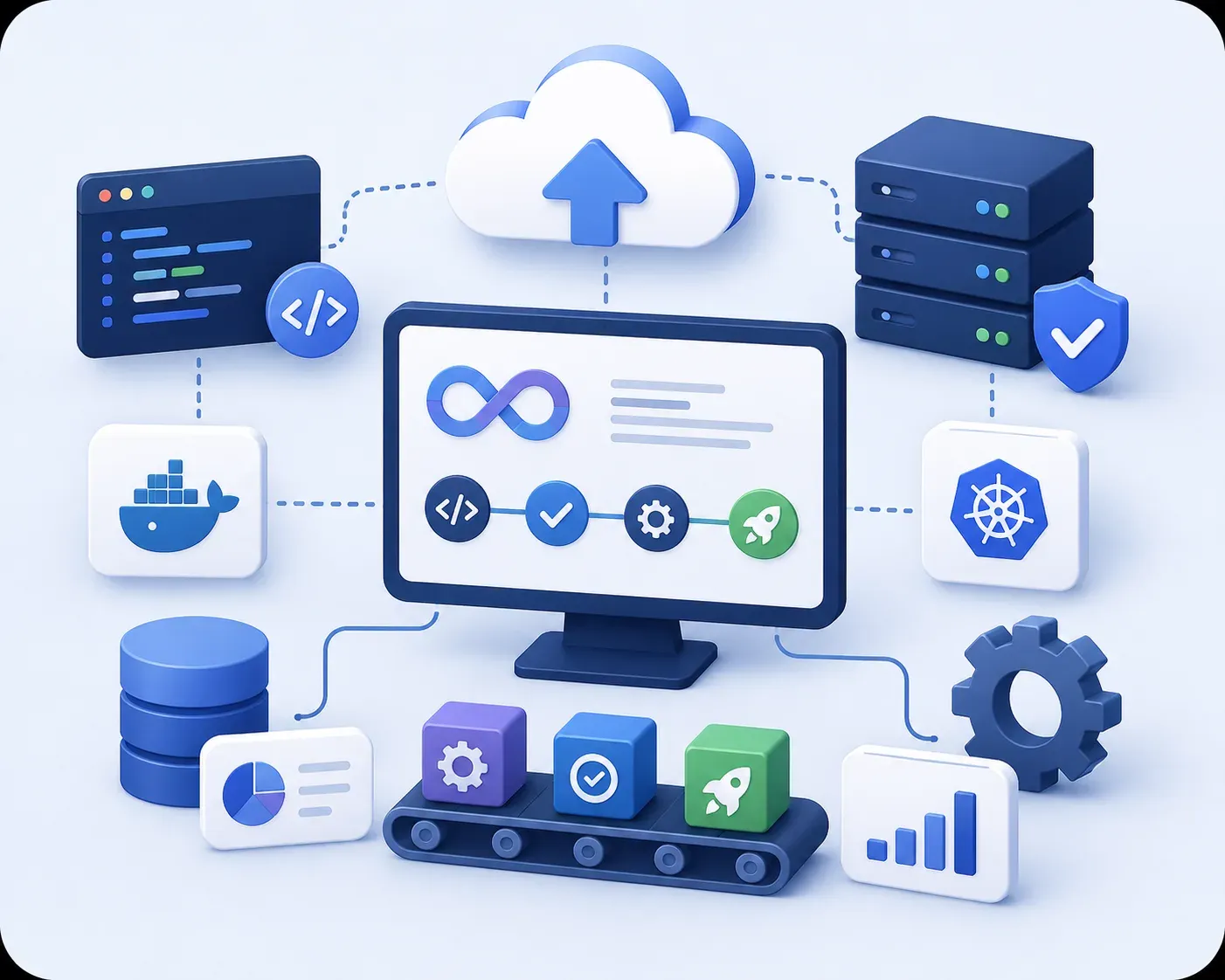
What We Build
Key Benefits
We design, build, and deploy production-grade software engineered specifically to achieve your core business outcomes.
Shorter lead time for changes
Higher deployment frequency
Lower change failure rate
Common Scenarios
Use Cases
Example applications and functional implementations.
Platform engineering
Observability and cost optimization
Zero-downtime migrations
Platform as a Product
We build internal platforms that treat developers as customers—golden paths, templates, and self-serve infra.
Observability & Reliability
SLOs, error budgets, tracing, and incident response drive predictable delivery and uptime.
CI/CD & Release Automation
We standardize pipelines with trunk-based development, automated tests, security scans, and progressive delivery.
Blue/green and canary strategies minimize risk while maintaining delivery speed.
GitOps & IaC
Declarative infrastructure (Terraform, Helm, Kustomize) with Git as the source of truth improves auditability and repeatability.
Automated drift detection and policy-as-code prevent misconfigurations in production.
Platform Engineering
We create golden paths, reusable templates, and self-service portals to reduce cognitive load on teams.
Developer portals centralize documentation, runbooks, and service catalogs for discoverability.
FinOps & Cost Controls
Unit economics dashboards track cost by service, environment, and tenant to guide rightsizing and commitments.
Autoscaling policies, demand shaping, and efficient resource classes keep spend predictable.
Security & Compliance
Shift-left security integrates SAST/DAST, SBOMs, and vulnerability scanning into pipelines.
Secrets management, network policies, and hardened images reduce attack surface across environments.
Development Scoping Matrix
We structure project backlogs cleanly to differentiate high-value core workflows from nice-to-have features.
| Feature Block | User Value | Validation Urgency | Complexity | Sprint Priority |
|---|---|---|---|---|
| Terraform IaC Server Provisioning | High | High | Low | Build Now |
| GitHub Actions CI/CD Linting & Build Gates | High | High | Low | Build Now |
| Prometheus Metrics & Slack Alert Setup | High | High | Medium | Build Now |
| Docker Container Configs for Microservices | Medium | Medium | Low | Build Now |
| Kubernetes Auto-Scaler Scaling Rules | Medium | Unknown | High | Validate First |
| Multi-Region Active-Active DB Replication | Medium | Low | High | Build Later |
| Complex Service Mesh (Istio) Integration | Low | Low | High | Build Later |
Active Highlight: Terraform IaC Server Provisioning
We prioritize these components based on their impact on user workflow success. Core user-facing flows are locked for Sprint 1, while advanced models or customizations are scheduled for secondary sprints.
Our Agile Delivery Lifecycle
From research workshops to CI/CD production releases, we follow a rigorous process pipeline to guarantee code quality.
Discovery Scoping
Define user personas, core business outcomes, system integrations, and align roadmaps with stakeolders.
Architecture Design
Design high-fidelity wireframes, mapping entity relation databases and secure API routing schemes.
Agile Sprints
Execute development sprints with daily commits, code hygiene linters, and incremental build verification.
CI/CD & Deploy
Containerize microservices with Docker, run automated unit tests, and deploy to staging/production clouds.
Core Technologies We Support
We build using highly robust, scalable, and modern technologies to ensure fast query latency and simple scale.
Targets
Success Metrics We Target
We focus on high-impact KPIs to connect engineering output directly to business revenue and efficiency gains.
Deployment Frequency (Goal: Daily)
How often the engineering team deploys working code changes successfully to production.
Lead Time for Changes (Goal: <24h)
Average duration from code commit to successful release in the production cluster.
Mean Time to Restore (Goal: <1h)
Average duration to resolve server incidents or recover from production service outages.
Change Failure Rate (Goal: <5%)
The percentage of releases requiring hotfixes or rollbacks in the cluster.
Post-Launch Iteration Loop
Releasing to production is only the beginning. User telemetry maps our secondary development roadmaps:
Metrics Pass: Automate & Scale
If production metrics pass target constraints, we begin capacity scaling. This involves configuring auto-scalers in Kubernetes, tuning database indexing patterns, and optimizing content delivery cache configurations.
UX Friction: Core Web Vitals Audit
If page dropout rates increase, we audit server latency logs. We optimize Next.js rendering pathways, reduce JS package bundles, and simplify client registration inputs.
Feature Dominates: Clean Backlog
If telemetry logs show user engagement focuses heavily on a single modular area, we adapt. We reposition that core module at the center of the UX, trimming away secondary non-value interfaces.
Low Activity: Scenarios Audit
If user activity levels drop, we halt new programming. We schedule qualitative stakeholder interviews to re-verify operational requirements and adjust scoping assumptions.
Frequently Asked Questions
Ready to Transform Your Business?
Get started with our intelligent digital solutions. Our team is ready to help you unlock the power of AI-driven technology.
Send us a message
Fill out the form below and we'll get back to you within 24 hours
Contact Information
Reach out to us through any of these channels