AI Product Development Company
Build, launch, and scale AI products that solve real business problems—not just impressive prototypes. Axora combines product strategy, full-stack engineering, LLMs, RAG, AI integrations, evaluation, security, and cloud infrastructure to turn AI opportunities into dependable software.
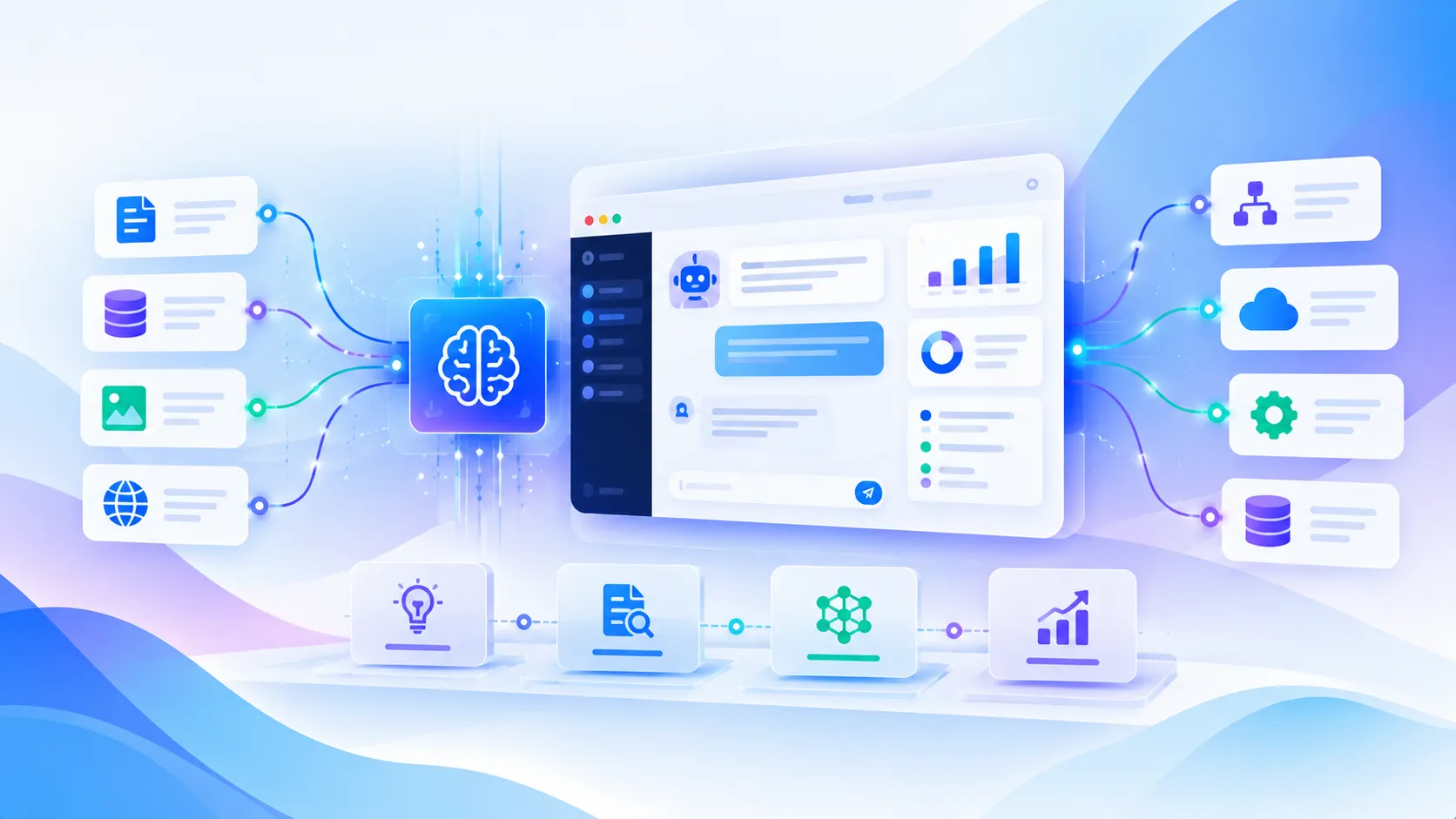
AI Product Development Built Around Business Value
AI product development is not simply connecting an application to an LLM API. A production AI product has to understand the user's context, work with reliable data, fit into existing workflows, provide useful responses or decisions, protect sensitive information, and remain predictable as models, data, and usage change.
Our AI product development services help startups, SaaS companies, enterprises, and established software teams move from an AI opportunity to a usable product. That can mean creating an AI-native product from scratch, adding intelligence to an existing application, building a focused AI MVP, or modernizing an existing AI capability that has outgrown its prototype architecture.
We combine product engineering with AI engineering. The product layer includes interfaces, accounts, permissions, workflows, APIs, integrations, billing, administration, analytics, and cloud infrastructure. The AI layer can include LLMs, retrieval, embeddings, classification, recommendations, computer vision, document intelligence, structured extraction, or predictive capabilities depending on the problem.
The goal is a product that users can trust and your team can operate. We design for measurable outcomes, controlled AI behavior, secure data access, clear ownership, and a path from the first useful release to long-term product growth.
Who We Build AI Products For
AI creates the most value when it is connected to a clear workflow, valuable data, and a measurable business outcome.
AI-First Startups
Turn a validated product idea into an AI-native MVP and a production architecture that can grow with customers.
SaaS Companies
Add copilots, intelligent search, automation, recommendations, document intelligence, or AI workflows to an existing SaaS product.
Enterprise Teams
Build secure AI applications connected to internal knowledge, business systems, permissions, approvals, and operational workflows.
Product & Innovation Teams
Validate high-value AI use cases without building a permanent internal AI engineering team before the opportunity is proven.
Operations-Heavy Businesses
Use AI to classify, summarize, extract, search, recommend, route, and automate repetitive knowledge work.
Existing Software Businesses
Modernize an application by introducing AI capabilities where they improve user experience or business efficiency.
AI Product Development Services We Offer
A complete set of AI product development services covering discovery, product engineering, AI capabilities, productionization, and continuous improvement.
Custom AI Product Development
Design and build bespoke AI-powered products around your users, workflows, data, business model, and product roadmap.
AI Product Consulting & Strategy
Identify practical AI opportunities, define success metrics, assess data readiness, and choose an architecture before major build investment.
AI MVP Development
Build a focused AI MVP that tests the most important product hypothesis without creating unnecessary technical debt.
AI Application Development
Develop complete applications with AI capabilities, product UX, backend services, databases, APIs, authentication, and administration.
Generative AI Product Development
Build products around generation, summarization, drafting, transformation, conversational experiences, and content workflows.
LLM Application Development
Create reliable LLM-powered applications with model routing, structured outputs, tool use, context management, and application-level controls.
RAG & Knowledge Applications
Connect AI products to private documents, databases, knowledge bases, and business data using retrieval, permissions, citations, and evaluation.
AI Integration Services
Add AI capabilities to existing SaaS, CRM, ERP, commerce, support, communication, and internal business applications.
AI Automation & Workflow Development
Embed AI into repeatable business workflows with approvals, human review, API actions, routing, and auditability.
AI Assistant & Copilot Development
Build contextual assistants that help users search, analyze, create, navigate, and complete tasks inside the product.
AI Model Integration & Fine-Tuning
Evaluate hosted or self-managed models and use fine-tuning only when product requirements justify the additional complexity.
AI Product Modernization
Improve an existing AI product by restructuring its architecture, retrieval, prompts, model layer, UX, security, evaluation, and infrastructure.
AI Quality, Evaluation & Monitoring
Create evaluation datasets, regression tests, quality metrics, tracing, feedback loops, and production monitoring for AI behavior.
AI Product Maintenance & Optimization
Continuously improve quality, cost, latency, reliability, model selection, data freshness, and product capabilities after launch.
AI Capabilities We Can Build Into Your Product
The right AI capability depends on the user's problem. We select technology based on the outcome rather than forcing every product into a chatbot pattern.
Conversational AI
Context-aware assistants and conversational interfaces for customer support, internal knowledge, onboarding, sales, and product workflows.
Intelligent Search
Semantic and hybrid search across product data, documents, knowledge bases, and structured business information.
Document Intelligence
Extract, classify, summarize, compare, validate, and route information from invoices, contracts, forms, reports, and other documents.
Recommendations & Personalization
Use behavioral, contextual, and business signals to personalize content, products, actions, or next-best recommendations.
Classification & Prediction
Automate categorization, prioritization, risk scoring, forecasting, anomaly detection, and other decision-support workflows.
Computer Vision
Add image understanding, visual search, inspection, OCR, classification, and image-based workflows where visual data is central.
AI Content Workflows
Generate, transform, summarize, translate, review, and enrich content while keeping human controls where quality matters.
Workflow Copilots
Give users AI assistance inside CRM, ERP, support, commerce, operations, and other business applications.
AI Product Architecture: More Than the Model
A reliable AI product separates the model from the rest of the application. The product interface communicates with application services, which manage authentication, business rules, permissions, data access, orchestration, and integrations. AI services then handle model requests, retrieval, tools, structured outputs, safety controls, and evaluation.
For knowledge-grounded products, the architecture can include document ingestion, parsing, chunking, embeddings, vector or hybrid search, metadata filters, permission-aware retrieval, reranking, context construction, generation, citations, and feedback collection. Each layer has a measurable job and can be improved without rewriting the entire product.
This modular approach also reduces dependency on a single model provider. Model adapters and configuration layers make it possible to evaluate different models for quality, latency, privacy, context limits, and cost before changing the production experience.
RAG and Knowledge-Grounded AI Products
Retrieval-augmented generation is useful when an AI product needs to answer from information that is private, frequently changing, domain-specific, or too large to rely on a model's built-in knowledge. We design retrieval around the actual questions users ask rather than treating a vector database as the entire solution.
Our RAG approach can include source ingestion, document parsing, metadata, chunking strategies, embeddings, hybrid retrieval, reranking, access controls, freshness policies, citations, context limits, and retrieval evaluation. For multi-tenant products, tenant boundaries and document permissions are considered at the retrieval layer rather than added as an afterthought.
The result should be a knowledge experience that users can verify. When appropriate, responses can show sources, explain uncertainty, request clarification, or route sensitive cases to a person instead of confidently producing an unsupported answer.
LLM Application Development With Practical Controls
LLM application development works best when the model is treated as one component inside a larger software system. We design prompts, context, structured outputs, tool calls, retries, validation, permissions, fallbacks, and business rules around the model rather than allowing free-form generation to control the entire workflow.
Depending on the product, we can integrate commercial or open models and compare them using representative tasks. Model selection considers response quality, context handling, latency, privacy, availability, operational cost, and the ability to meet your product's requirements.
Where deterministic software is better than AI, we keep it deterministic. AI should handle the parts where interpretation, generation, classification, or reasoning creates meaningful value.
Data Readiness and AI Knowledge Foundations
AI quality is strongly influenced by the quality and accessibility of the data behind the product. Before implementation, we assess where useful information lives, who owns it, how often it changes, how it is structured, and which users should be allowed to access it.
Depending on the product, data work may include ingestion pipelines, normalization, metadata, document processing, deduplication, access controls, embeddings, labeling, feature preparation, feedback capture, and data quality checks. We design these foundations so they support the product instead of becoming a disconnected data project.
For AI products that learn from user interactions, we also consider feedback and data flywheels: which user actions indicate quality, which corrections can improve future behavior, and how feedback can be collected without creating privacy or governance problems.
AI Evaluation, Testing and Guardrails
Traditional software tests are not enough for AI products because an application can be technically available while producing poor answers. We create representative evaluation sets and test the behaviors that matter to the product, such as factuality, relevance, retrieval quality, structured-output validity, safety, refusal behavior, latency, and cost.
Guardrails can include input validation, prompt-injection defenses, sensitive-data handling, output validation, allowed-tool boundaries, rate limits, confidence thresholds, human review, and escalation paths. The exact controls depend on the risk of the product and the actions the AI can take.
Evaluation should continue after launch. Model updates, prompt changes, new documents, and changes in user behavior can affect quality, so production feedback and regression testing become part of the product lifecycle.
Security, Privacy and Responsible AI
AI products often process customer conversations, internal documents, business records, or other sensitive information. Security therefore has to cover the complete application and AI pipeline—not just the model API.
We design around authentication, role-based access, tenant isolation where applicable, encrypted data flows, secrets management, API controls, audit trails, logging boundaries, data retention, and least-privilege access. Retrieval systems must enforce the same permissions users have in the source systems.
Responsible AI also means deciding where a person should remain in the loop. High-impact decisions, uncertain outputs, financial actions, customer commitments, or irreversible operations can use approval workflows rather than allowing an AI system to act without supervision.
AI Integrations and Product Connectivity
AI becomes more useful when it can access the systems and information already used by the business.
CRM & Sales Systems
Connect customer context, lead information, sales activity, and account data to AI-assisted workflows.
ERP & Operations
Bring operational data into search, analysis, document workflows, forecasting, and controlled automation.
Communication Platforms
Connect AI capabilities to chat, email, WhatsApp, support, and other customer communication channels.
Cloud & Data Platforms
Integrate object storage, databases, queues, analytics systems, vector stores, and cloud AI services.
Payments & Commerce
Use AI for product discovery, support, content, personalization, and other commerce experiences while keeping sensitive transactions controlled.
Custom APIs
Connect models and AI workflows to proprietary APIs, internal services, third-party platforms, and business rules.
AI Product Use Cases
AI Customer Support
Assist agents, answer customer questions from approved knowledge, summarize conversations, and route complex cases.
Enterprise Knowledge
Give employees secure access to policies, documents, procedures, product information, and internal knowledge.
Intelligent Document Processing
Turn unstructured documents into validated structured information and review workflows.
AI Sales & Marketing
Support lead research, content workflows, personalization, qualification, and sales enablement.
AI-Powered SaaS
Embed copilots, search, recommendations, summaries, automation, and decision support directly into SaaS products.
Operations Intelligence
Improve reporting, triage, forecasting, exception handling, and repetitive knowledge work.
Visual AI Products
Build image search, inspection, classification, OCR, and visual analysis workflows.
Internal AI Tools
Create focused tools that help teams research, draft, analyze, classify, and complete recurring work faster.
Industries We Support
The AI capability changes by industry, but the engineering principle stays the same: connect AI to a meaningful workflow and measurable outcome.
SaaS & Software
AI-native products, embedded copilots, intelligent search, support automation, and product intelligence.
Retail & E-commerce
Product discovery, customer support, personalization, content operations, and commerce intelligence.
Healthcare
Administrative and knowledge workflows designed with appropriate privacy, review, and governance controls.
Finance & Fintech
Document workflows, support, analysis, risk-oriented decision support, and controlled automation.
Logistics & Operations
Exception management, document processing, forecasting, support, and operational intelligence.
Professional Services
Knowledge systems, research assistants, document analysis, drafting, and workflow automation.
Manufacturing
Visual inspection, knowledge access, predictive workflows, and operational decision support.
Education
Knowledge assistants, content workflows, learner support, search, and administrative automation.
Our AI Product Development Process
01. Product Discovery — Define the user problem, business objective, target users, existing workflow, constraints, and measurable success criteria.
02. AI Opportunity Mapping — Separate tasks that benefit from AI from tasks better handled by deterministic software, then prioritize the highest-value opportunities.
03. Data & Feasibility Assessment — Review available data, privacy requirements, knowledge sources, integrations, model constraints, and operational risks.
04. Product & AI Architecture — Design the product experience, backend, data layer, model layer, retrieval architecture, integrations, permissions, and infrastructure.
05. AI Model Strategy — Evaluate model providers and approaches based on quality, latency, cost, context, privacy, and product requirements.
06. UX & Interaction Design — Design AI interactions, feedback states, citations, confidence handling, editing, approval, fallback, and human handoff.
07. AI MVP Development — Build the smallest useful product around the core workflow while keeping the architecture capable of production growth.
08. Data, RAG & Integration Engineering — Build ingestion, retrieval, APIs, business integrations, permissions, structured outputs, and workflow orchestration.
09. Evaluation & Quality Engineering — Establish representative test cases and evaluate accuracy, retrieval, safety, latency, cost, and failure modes.
10. Security & Production Hardening — Apply access controls, data protection, observability, rate limits, error handling, deployment controls, and operational safeguards.
11. Production Launch — Deploy the product, monitor real usage, collect feedback, and establish a controlled release process for model and application changes.
12. Continuous AI Optimization — Improve prompts, retrieval, models, UX, cost, latency, data quality, and product workflows using production evidence.
AI Product Technology Stack
AI Models: OpenAI, Anthropic, Google Gemini, open-weight models, and task-specific ML models selected according to product requirements.
AI Application Layer: Python, FastAPI, Node.js, TypeScript, React, Next.js, REST APIs, GraphQL, background workers, queues, and event-driven services.
AI & Retrieval: Embeddings, vector databases, pgvector, hybrid search, reranking, retrieval pipelines, structured outputs, tool calling, and model orchestration.
Data & Storage: PostgreSQL, MongoDB, Redis, object storage, analytics systems, document stores, and purpose-built data pipelines.
Cloud & Operations: AWS, Google Cloud, Docker, CI/CD, monitoring, logging, tracing, autoscaling, secrets management, and production deployment workflows.
AI Quality: Evaluation datasets, regression tests, prompt/version management, tracing, feedback loops, quality monitoring, cost tracking, and controlled rollouts.
AI Product Modernization
Many AI products begin as prototypes and become difficult to maintain when usage grows. Prompts may be scattered through the codebase, retrieval may not respect permissions, model calls may be expensive, and there may be no reliable way to measure whether a change improved the experience.
AI product modernization addresses those problems without automatically replacing the whole product. We can restructure model integrations, separate business logic from AI orchestration, improve retrieval, add evaluation, introduce observability, improve security, optimize infrastructure, and create a clearer path for future model changes.
Modernization is especially useful when an existing AI feature is valuable but has become expensive, unreliable, slow, difficult to test, or tightly coupled to one provider.
Designing AI Products for Scale
Production scale is not only about handling more requests. AI products must balance model capacity, concurrency, context size, retrieval load, data growth, latency, cost, and quality. Architecture decisions should reflect expected traffic and the business value of each request.
We use practical techniques such as caching, asynchronous processing, batching, streaming where appropriate, model routing, request limits, queue-based workloads, retrieval optimization, and autoscaling. Expensive models can be reserved for tasks where their additional quality is justified.
Operational dashboards can track usage, response latency, token or inference cost, error rates, retrieval behavior, user feedback, and other product-specific indicators so the team can make decisions from evidence.
AI Product Engagement Models
AI Product Discovery
A focused engagement to evaluate the opportunity, data, architecture, AI approach, risks, and MVP scope before full development.
AI MVP Development
A product-focused build for validating the core AI workflow with real users and a credible path to production.
End-to-End AI Product Development
A complete engagement covering product engineering, AI capabilities, integrations, infrastructure, launch, and ongoing optimization.
AI Engineering Team Extension
Add experienced AI and full-stack engineers to an existing product team for a defined roadmap or ongoing development.
AI Modernization
Improve an existing AI product's architecture, reliability, evaluation, security, performance, and operating cost.
Continuous AI Product Engineering
Keep improving the product after launch through model evaluation, feature development, optimization, monitoring, and support.
When AI Product Development Makes Sense
AI product development is a strong fit when a meaningful part of the user experience depends on understanding language, documents, images, patterns, recommendations, predictions, or large amounts of information.
It is particularly valuable when your business has proprietary knowledge, repetitive knowledge work, high volumes of unstructured information, customer-support complexity, or an existing software product where intelligent assistance can improve the user's ability to complete tasks.
AI should not be added simply because it is fashionable. If a normal search filter, workflow rule, database query, or deterministic automation solves the problem more reliably and cheaply, that may be the better product decision. Our role is to help choose the right level of AI—not to force AI into every feature.
Why Build Your AI Product With Axora?
AI product development sits at the intersection of product thinking, software engineering, data, and AI. Axora approaches these as one engineering problem instead of handing a prototype to one team and production engineering to another.
Our team works across React and Next.js product interfaces, Node.js and Python backend systems, APIs, PostgreSQL and MongoDB, cloud infrastructure, queues, storage, integrations, and AI/ML technologies. That full-stack capability matters because the model is only one part of the final product.
We also focus on practical production concerns: permissions, evaluation, observability, cost, latency, security, maintainability, and the ability to change models or AI techniques as the product evolves.
The result is an AI product architecture designed around your business rather than a generic AI demo.
Our AI Product Engineering Approach
We use the same engineering discipline across the product layer and the AI layer.
Start With the Workflow
Understand what the user needs to accomplish and where AI can create measurable improvement before choosing a model.
Build the Product Around the AI
Design the complete experience, not just the prompt: permissions, context, editing, feedback, integrations, and fallbacks.
Evaluate Before Optimizing
Use representative tasks and measurable evaluation criteria instead of relying on a few impressive demo conversations.
Keep Architecture Flexible
Separate model providers, retrieval, business logic, and product UX so the system can evolve without a complete rewrite.
Treat Security as a Product Requirement
Protect private data, enforce permissions, control tool access, and keep sensitive workflows auditable.
Improve From Production Evidence
Use user feedback, quality metrics, cost, latency, and real usage patterns to guide the next product iteration.
Related Services
Services to Support Your AI Product

AI Product Engineering
Design and ship AI-first products using LLMs, computer vision, and predictive analytics—productionized with secure, observable, and scalable pipelines.
Learn more
API Development Services
Build secure, scalable, and high-performance Web APIs, custom microservices integrations, and RESTful structures. Enterprise API development company delivering premium connector solutions.
Learn more
Cloud & DevOps Automation
Automate delivery with Kubernetes, Terraform, and GitOps. Improve reliability, time-to-restore, and cloud spend with SRE and FinOps.
Learn more
SaaS Development Company
Build, launch, modernize, and scale SaaS products with multi-tenant architecture, product-focused workflows, subscription billing, integrations, security, cloud infrastructure, and engineering foundations built for recurring software businesses.
Learn moreFrom Our Blog
AI & Product Engineering Insights
From AI to Super Intelligence (SI): What America’s 2026 Shift Means for Business
America’s 2026 shift from AI toward Super Intelligence (SI) signals a deeper business transition: from AI assistants and chatbots to agents, intelligent workflows, enterprise automation and software built around increasingly capable reasoning systems.
Read articleHow AI Is Transforming Modern Software Development in 2025
AI now powers every stage of the software lifecycle—from product engineering and QA to cloud automation and CRM intelligence—helping teams ship faster and smarter.
Read articleAI SaaS Solutions: How Intelligent Software Is Transforming Modern Business
AI SaaS solutions are changing how businesses automate work, understand data, support customers, and scale operations. This guide explains how AI-powered SaaS products work, where businesses can use them, what to consider before building one, and how a custom AI SaaS product can become a long-term business asset.
Read articleFrequently Asked Questions
Have an AI Product Idea?
Let's turn the idea into a practical product roadmap, AI architecture, and production plan.
Ready to Transform Your Business?
Get started with our intelligent digital solutions. Our team is ready to help you unlock the power of AI-driven technology.
Send us a message
Fill out the form below and we'll get back to you within 24 hours
Contact Information
Reach out to us through any of these channels