Data Engineering Company
Build reliable data foundations that connect your business systems, move and transform information, improve data quality, and make trusted data available for analytics, reporting, products, automation, and AI.
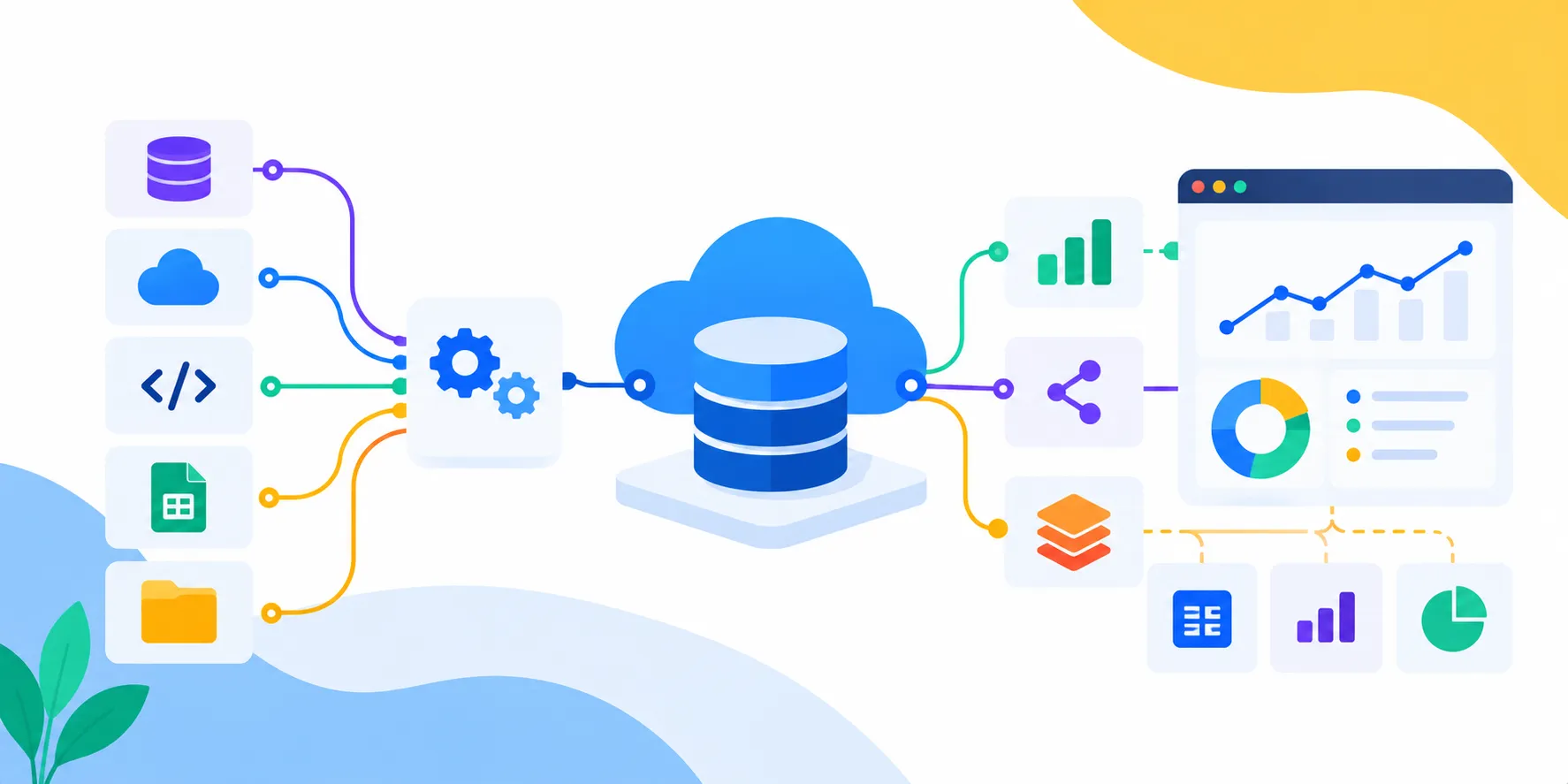
Data Engineering That Creates a Reliable Data Foundation
Businesses often have plenty of data but struggle to use it consistently. Customer information may live in a CRM, transactions in an application database, marketing activity across advertising platforms, operational records in an ERP, and important business files in spreadsheets or cloud storage.
Our data engineering services connect these sources into dependable pipelines and data platforms. We design how data is collected, validated, transformed, stored and served so teams can work from information they can trust.
The goal is not simply to move data. A well-engineered data platform gives analytics teams dependable datasets, gives product teams accessible data services, gives leadership consistent metrics, and gives AI initiatives the clean and governed foundation they require.
We work on new data platforms as well as legacy environments where brittle scripts, manual exports, duplicated datasets, slow reports or unclear ownership are holding the business back.
Who We Help With Data Engineering
Growing SaaS Companies
Unify product, customer, billing and operational data as the product and customer base grow.
Data-Driven Enterprises
Modernize fragmented data environments and establish governed platforms for reporting and decision-making.
E-commerce & Retail Teams
Connect storefront, orders, inventory, customer, marketing and fulfillment data.
Operations Teams
Create reliable data flows from operational systems into reporting and automation workflows.
Analytics & BI Teams
Build the pipelines, models and warehouse foundations required for dependable dashboards and metrics.
AI Product Teams
Prepare structured, accessible and permission-aware data foundations for AI and machine learning applications.
Data Engineering Services We Offer
End-to-end data engineering services covering architecture, ingestion, transformation, storage, integration, quality, governance and ongoing operations.
Data Engineering Consulting
Assess your current environment, define data priorities, select an appropriate architecture and create an implementation roadmap.
Data Pipeline Development
Build reliable pipelines for APIs, databases, applications, files, SaaS platforms and event streams.
ETL Development
Extract, transform and load data into trusted destinations with validation, scheduling and error handling.
ELT Development
Load raw data into cloud platforms and manage scalable transformations closer to the analytical destination.
Data Warehouse Development
Design analytical warehouses with appropriate schemas, models, performance controls and governance.
Data Lake & Lakehouse Development
Build flexible storage and processing foundations for structured, semi-structured and large-scale datasets.
Cloud Data Engineering
Design data platforms on AWS, Microsoft Azure or Google Cloud around scale, security and operating cost.
Data Integration Services
Unify CRM, ERP, SaaS, databases, APIs, files and other sources into consistent business data flows.
Real-Time Data Engineering
Build event-driven and streaming pipelines for use cases that require fresher operational or analytical data.
Data Migration & Modernization
Move legacy data systems and brittle pipelines toward maintainable modern architectures.
Data Quality & Observability
Add validation, freshness checks, monitoring, lineage and alerting so teams know when data cannot be trusted.
Data Platform Maintenance
Improve pipeline reliability, performance, cost, documentation and operational health after launch.
Data Sources We Can Connect
Application Databases
Relational and document databases that hold transactional and operational information.
SaaS Platforms
CRM, ERP, support, marketing, finance, commerce and productivity systems.
APIs
REST, GraphQL and partner APIs for extracting or synchronizing business data.
Files & Documents
CSV, Excel, JSON, XML, cloud storage and recurring file-based data feeds.
Event Streams
Application events, telemetry, messaging systems and other continuously generated data.
Legacy Systems
Older databases and applications that need controlled extraction or modernization.
Data Pipeline Development for Reliable ETL and ELT
A data pipeline should make the movement of information predictable. We design ingestion, transformation and delivery workflows with clear dependencies, retry behavior, validation and monitoring.
ETL can be appropriate when data needs substantial processing before it reaches the destination. ELT is often useful with scalable cloud warehouses where raw data can be loaded first and transformed using warehouse-native processing.
We choose the approach based on data volume, freshness, source limitations, transformation complexity, destination capabilities and the team's ability to operate the platform. The architecture should fit the business rather than follow a fashionable tool choice.
Data Warehouse Development
A data warehouse provides a structured analytical foundation for reporting and business intelligence. We design data models around the questions the business needs to answer rather than simply copying operational tables into another database.
Depending on requirements, the architecture may use dimensional models, fact and dimension tables, curated analytical layers, semantic models and incremental transformation strategies. Performance and cost are considered alongside usability.
Common platforms include Snowflake, BigQuery, Amazon Redshift, Azure Synapse and PostgreSQL-based analytical environments. The right choice depends on data volume, query patterns, existing cloud infrastructure, governance needs and team expertise.
Data Lake and Lakehouse Architecture
Data lakes provide flexible storage for large volumes of structured and semi-structured information. Lakehouse architectures add stronger analytical structure, transaction support, governance and query capabilities while retaining flexible storage patterns.
We can design lake and lakehouse layers for raw ingestion, standardized data, curated datasets and downstream analytical or machine learning workloads. Storage and processing are separated where the workload benefits from that model.
Lakehouse architecture is especially useful when one platform needs to support analytics, large-scale processing and AI or machine learning workloads without maintaining disconnected copies of the same data.
Batch and Real-Time Data Processing
Scheduled Batch Pipelines
Process data at predictable intervals for reporting, reconciliation, operational analytics and recurring workflows.
Event-Driven Pipelines
React to application or business events as they occur rather than waiting for a scheduled batch.
Change Data Capture
Capture changes from source databases and move relevant updates into downstream systems.
Stream Processing
Process continuous event streams for use cases that depend on low-latency data.
Incremental Processing
Process only new or changed records where appropriate to reduce unnecessary computation.
Data Synchronization
Keep analytical and operational destinations aligned through controlled synchronization workflows.
Data Quality, Validation and Observability
Reliable data engineering requires more than successful pipeline execution. A pipeline can complete without errors while still producing incomplete, duplicated, stale or incorrect data.
We build checks around completeness, uniqueness, validity, freshness, schema changes and business rules where they matter. Critical datasets can have explicit quality expectations and alerts when those expectations are not met.
Observability gives teams visibility into pipeline failures, processing delays, source changes, data freshness, volume anomalies and downstream impact. This turns data maintenance from reactive troubleshooting into an operational discipline.
Data Governance, Security and Access Control
Data platforms often combine customer, financial, operational and product information, so access should be designed into the architecture rather than added later.
We can implement role-based access, environment separation, encryption, secrets management, auditability, tenant-aware data boundaries, controlled service accounts and appropriate retention policies. Sensitive fields can be protected through masking or restricted access patterns where required.
Governance also includes ownership, metadata, lineage and documentation. Teams should be able to understand where important metrics come from and which systems depend on them.
Data Integration and Data Unification
Data integration brings information from different systems into a consistent analytical or operational view. The hard part is often not connectivity but differences in identifiers, schemas, definitions, update frequencies and data quality.
We handle mapping, normalization, deduplication, schema harmonization and business rules so that the same customer, product, transaction or event can be interpreted consistently across sources.
For businesses with many SaaS systems, this can replace manual exports and spreadsheet consolidation with repeatable pipelines that refresh according to actual business requirements.
Data Engineering for Analytics, BI and AI
Analytics and AI are only as reliable as the data foundations behind them. Data engineering prepares the ingestion, transformation, storage, quality and access layers that downstream systems depend on.
For BI, this means dependable datasets and consistent metrics. For AI, it can also mean document and event pipelines, feature-ready datasets, embeddings, vector indexes, permission-aware retrieval and data services that keep AI applications connected to current information.
We design the data layer with its downstream use in mind so the platform can evolve instead of requiring a new pipeline for every analytics or AI initiative.
Data Platform Architecture
A typical data platform may include source systems, ingestion services, raw storage, transformation workflows, curated datasets, a warehouse or lakehouse, quality checks, orchestration, metadata, governance and analytics or application consumers.
Architecture varies by workload. A smaller organization may benefit from a focused warehouse and a few well-managed pipelines, while a larger environment may need separate ingestion, processing, storage, governance and serving layers.
We aim for clear boundaries and operational simplicity. Every additional platform component introduces cost and maintenance, so architecture decisions should be justified by data volume, freshness, reliability, security or business requirements.
Data Migration and Legacy Modernization
Legacy data environments often contain valuable information but depend on fragile scripts, outdated databases, manual exports or systems that are difficult to scale. Modernization does not always require replacing everything at once.
We can assess dependencies, map source and destination structures, build controlled migration pipelines, validate historical data and move workloads in stages where appropriate.
The result can be a more maintainable cloud data platform while preserving the business information and reporting continuity the organization depends on.
Data Engineering Use Cases
Unified Business Reporting
Bring finance, sales, marketing and operational information together for consistent reporting.
Customer 360 Data
Combine customer interactions, transactions, support and product activity into a unified view.
Product Analytics
Process product events and behavioral data for usage, retention and feature analysis.
Marketing Data Pipelines
Connect advertising, campaign, CRM and web analytics data for measurement and attribution.
Operational Analytics
Make current operational data available for monitoring, forecasting and process improvement.
AI-Ready Data Foundation
Prepare structured and unstructured information for AI applications and machine learning workflows.
Data Warehouse Consolidation
Replace disconnected reporting databases and manual extracts with a governed analytical platform.
Real-Time Monitoring
Stream important events into operational dashboards and alerting systems.
Industries We Support
SaaS & Technology
Product events, customer data, subscription analytics and AI-ready application data.
Retail & E-commerce
Orders, inventory, customer, marketing and fulfillment data pipelines.
Finance & Fintech
Transaction, customer, reporting and operational data with strong governance requirements.
Healthcare
Structured data integration and analytics foundations with appropriate access controls.
Logistics
Shipment, fleet, warehouse and operational event processing.
Manufacturing
Production, machine, supply chain and quality data pipelines.
Professional Services
Project, finance, customer and resource data consolidation.
Education
Student, course, engagement and institutional data platforms.
Our Data Engineering Process
01. Data Discovery — Identify business goals, source systems, stakeholders, critical datasets and current reporting problems.
02. Current-State Assessment — Review architecture, pipeline reliability, data quality, dependencies, security and operational constraints.
03. Data Architecture — Define the target ingestion, storage, transformation, serving and governance layers.
04. Source & Schema Mapping — Document source structures, identifiers, relationships, refresh requirements and transformation rules.
05. Platform Selection — Choose cloud services, warehouse, lakehouse, orchestration and processing technologies according to workload requirements.
06. Pipeline Design — Define batch, incremental, CDC or streaming patterns, retries, dependencies and failure handling.
07. Data Modeling — Create analytical and curated models that reflect the metrics and questions the business needs to answer.
08. Development & Integration — Build ingestion, transformation, validation and delivery workflows and connect required systems.
09. Quality & Testing — Validate schemas, business rules, completeness, freshness, duplicates and representative historical data.
10. Security & Observability — Implement access controls, secrets, monitoring, alerting, lineage and operational visibility.
11. Production Rollout — Release pipelines in controlled stages and validate downstream reports, applications and consumers.
12. Optimization & Support — Improve performance, reliability, cloud cost, data quality and maintainability as workloads evolve.
Data Engineering Technology Stack
Languages & Processing: Python, SQL, Apache Spark and PySpark for transformation and distributed processing where required.
Orchestration & Transformation: Apache Airflow, Dagster, dbt and cloud-native workflow services selected around the team's operating model.
Warehouses & Lakehouses: Snowflake, BigQuery, Amazon Redshift, Azure Synapse, Databricks and PostgreSQL-based environments.
Streaming & Events: Apache Kafka, cloud messaging services, Pub/Sub, Kinesis and event-driven processing patterns.
Storage: Amazon S3, Google Cloud Storage, Azure Blob Storage and structured analytical storage layers.
Integration: REST and GraphQL APIs, database connectors, managed ingestion services, custom Python pipelines and CDC patterns.
Quality & Operations: Data validation, lineage, monitoring, logging, alerts, CI/CD, infrastructure automation and cost monitoring.
Scaling Data Platforms Without Losing Reliability
Data volume is only one part of scale. The number of sources, pipeline dependencies, refresh requirements, consumers and data quality expectations can create just as much operational complexity.
We design for incremental processing, partitioning, parallel workloads, appropriate storage formats, workload isolation and controlled concurrency where they provide measurable value.
Cost is considered alongside performance. Warehouse queries, storage, streaming infrastructure and repeated transformations can become expensive when a platform grows without clear workload management.
Data Engineering Engagement Models
Data Architecture & Roadmap
Assess your current data environment and define a practical target architecture and delivery plan.
Data Pipeline Project
Build or modernize a defined set of ingestion and transformation workflows.
Data Platform Development
Design and build a broader warehouse, lakehouse or cloud data platform from foundation to production.
Data Modernization
Migrate legacy pipelines and reporting foundations to a more maintainable modern architecture.
Data Engineering Team Extension
Add engineering capacity to an existing analytics or data team for ongoing platform work.
Managed Data Engineering
Continue improving pipeline reliability, quality, performance, documentation and operations after launch.
When You Need Data Engineering Services
Data engineering becomes important when teams are spending too much time collecting, cleaning or reconciling data instead of using it. Repeated spreadsheet work, inconsistent dashboards, stale reports, failed imports and disconnected systems are common signals.
It is also a priority when the business is moving to cloud analytics, consolidating systems, launching a data warehouse, introducing real-time reporting or preparing data for AI.
Not every company needs a large data platform. The right starting point may be one reliable pipeline and a focused analytical model. We scope the platform around the decisions and workflows it needs to support.
Why Build Your Data Platform With Axora?
Data engineering sits between software systems, cloud infrastructure, databases and business reporting. Axora brings those capabilities together, allowing data pipelines to be designed with the applications and systems that produce the data in mind.
Our engineering experience across Node.js, Python, PostgreSQL, MongoDB, Redis, AWS, Google Cloud, APIs, queues and application development supports end-to-end data platform work rather than isolated pipeline scripting.
We prioritize maintainability, clear ownership, data quality and practical architecture. The objective is a data foundation your team can understand, operate and extend as the business changes.
Our Data Engineering Approach
Business-First Architecture
Start from the decisions, workflows and products that need reliable data.
Reliable Pipelines
Design for retries, validation, failure handling, monitoring and clear dependencies.
Quality by Design
Treat data quality as part of the pipeline rather than a downstream reporting problem.
Cloud-Aware Engineering
Balance performance, reliability, security and infrastructure cost as the platform grows.
Operational Visibility
Give teams enough monitoring and documentation to understand pipeline health and data freshness.
Ready for Analytics and AI
Build data foundations that can support reporting today and evolving analytical or AI workloads tomorrow.
Related Services
Services to Extend Your Data Platform

API Development Services
Build secure, scalable, and high-performance Web APIs, custom microservices integrations, and RESTful structures. Enterprise API development company delivering premium connector solutions.
Learn more
Cloud & DevOps Automation
Automate delivery with Kubernetes, Terraform, and GitOps. Improve reliability, time-to-restore, and cloud spend with SRE and FinOps.
Learn moreFrom Our Blog
Data, Analytics & AI Insights
Frequently Asked Questions
Need a More Reliable Data Foundation?
Tell us where your data lives today, what is difficult to trust or maintain, and what your business needs to do with it. We can map a practical data engineering path.
Ready to Transform Your Business?
Get started with our intelligent digital solutions. Our team is ready to help you unlock the power of AI-driven technology.
Send us a message
Fill out the form below and we'll get back to you within 24 hours
Contact Information
Reach out to us through any of these channels