Full Stack Development Company
Build complete digital products with frontend, backend, APIs, databases, cloud infrastructure, security, testing, and ongoing engineering under one accountable full-stack team.
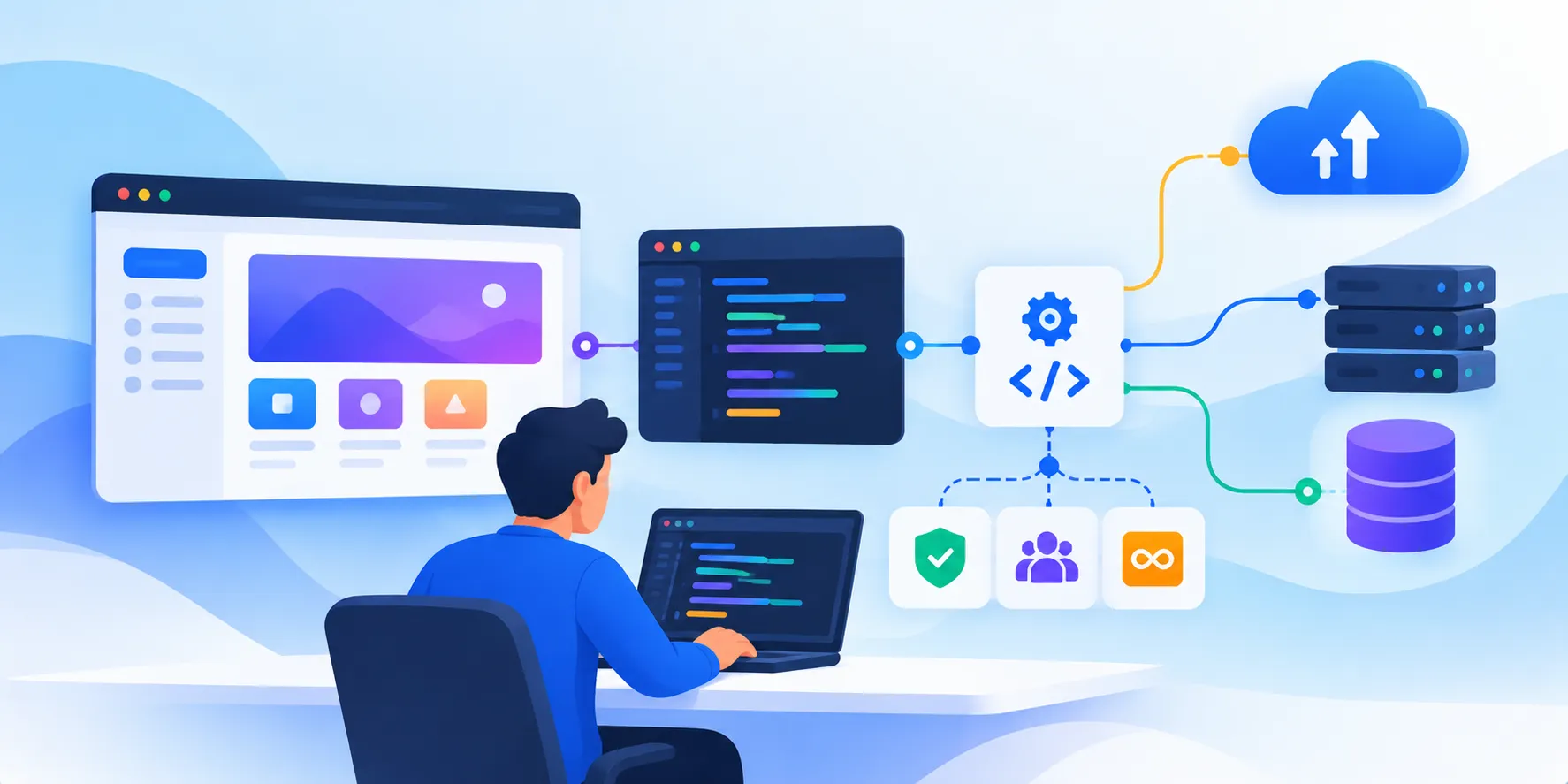
Full Stack Development Built Around the Whole Product
Full stack development means engineering the complete product rather than treating frontend, backend, database, integrations, and infrastructure as disconnected projects. When one team understands the entire system, decisions in the interface can be evaluated against API behavior, data models, security, performance, and production operations.
Our full stack development services help startups, SaaS companies, enterprises, and growing businesses build new products, extend existing platforms, modernize legacy applications, and add engineering capacity without unnecessary handoffs.
We work across frontend interfaces, server-side business logic, REST or GraphQL APIs, relational and NoSQL databases, authentication, integrations, background processing, cloud infrastructure, CI/CD, observability, testing, and security. The goal is a coherent system where every layer supports users, workflows, performance requirements, growth plans, and the operating model.
Who We Help
Full Stack Engineering for Different Product Stages
We adapt full stack engineering around the maturity, complexity, and delivery needs of the product.
- ✓Startups & FoundersTurn a product concept into a working application with focused architecture, core workflows, integrations, and room for iteration.
- ✓SaaS Product TeamsBuild multi-user platforms with roles, billing, integrations, analytics, and scalable application architecture.
- ✓Growing BusinessesReplace disconnected tools or manual workflows with custom applications that centralize data and automate operations.
- ✓Enterprise TeamsExtend systems, build internal applications, modernize legacy software, and integrate business platforms.
- ✓Digital Product CompaniesAdd frontend, backend, database, cloud, QA, or DevOps capacity around an existing roadmap.
- ✓Legacy Product OwnersIncrementally replace outdated application layers while keeping critical business workflows running.
Full Stack Development Services
Full Stack Development Services We Offer
Our full stack development services cover the complete product lifecycle from architecture and application engineering through cloud delivery and support.
Custom Full Stack Development
Build complete web and business applications around product requirements, workflows, users, data, and integrations.
Full Stack Consulting & Architecture
Define architecture, technology choices, data boundaries, APIs, infrastructure, and delivery roadmap before implementation.
Frontend Development
Create responsive, accessible interfaces with React, Next.js, TypeScript, and scalable UI architecture.
Backend Development
Build secure business logic, APIs, background jobs, integrations, and services using Node.js and appropriate technologies.
API Development & Integration
Design REST or GraphQL APIs and connect payment, CRM, ERP, commerce, communication, and third-party platforms.
Database Design & Development
Model relational or NoSQL data, indexes, transactions, migrations, caching, queues, and access patterns.
SaaS Full Stack Development
Build subscription products with multi-tenant architecture, roles, billing, integrations, and scalable infrastructure.
Enterprise Full Stack Development
Develop secure enterprise applications, portals, workflow systems, dashboards, and integrations.
Real-Time Application Development
Build chat, live dashboards, collaboration, notifications, presence, tracking, and other real-time experiences.
Cloud & DevOps Engineering
Set up environments, CI/CD, containers, cloud deployment, observability, scaling, backups, and automation.
Full Stack Modernization
Modernize frontend, backend, data, APIs, or infrastructure incrementally without forcing an unnecessary rewrite.
Full Stack Maintenance & Support
Handle defects, security updates, performance improvements, dependency upgrades, monitoring, and new features.
User Experience Layer
Frontend Engineering
We build interfaces that are responsive, accessible, maintainable, and connected cleanly to application services.
- ✓React & Next.js ApplicationsModern web applications with reusable components, routing, rendering strategies, data fetching, and scalable UI architecture.
- ✓Responsive Product InterfacesAdapt workflows and information density across desktop, tablet, and mobile devices.
- ✓Dashboards & PortalsRole-aware dashboards, customer portals, admin tools, reporting interfaces, and operational workspaces.
- ✓Complex Forms & WorkflowsMulti-step forms, approvals, validation, search, filtering, bulk actions, and state-driven workflows.
- ✓Real-Time UIConnect live data, notifications, collaboration, and streaming updates to responsive interfaces.
- ✓Frontend PerformanceOptimize rendering, assets, data fetching, caching, bundle size, and interaction responsiveness.
Application Layer
Backend Engineering and APIs
We build backend systems that keep business rules, data access, security, integrations, and operational workloads organized.
Business Logic
Translate workflows into maintainable rules, validations, permissions, calculations, and state transitions.
REST & GraphQL APIs
Design API contracts for web applications, mobile apps, integrations, internal tools, and external consumers.
Authentication & Authorization
Implement secure identity, sessions, roles, permissions, organization boundaries, and account workflows.
Background Processing
Handle queues, scheduled jobs, asynchronous workflows, notifications, imports, exports, and long-running operations.
Real-Time Services
Use WebSockets, server-sent events, or suitable messaging patterns for live application experiences.
Third-Party Integrations
Connect payments, communication, CRM, ERP, commerce, analytics, storage, and external platforms securely.
Data Layer
Database, Caching, and Data Engineering
Data architecture is designed around how the product reads, writes, searches, aggregates, and grows.
- ✓Relational Database DesignUse PostgreSQL or another relational system when transactions, relationships, consistency, and structured business data matter.
- ✓NoSQL Data ModelingUse document-oriented approaches when flexible schemas and document-shaped data are appropriate.
- ✓Redis & CachingUse caching, sessions, rate limits, queues, and temporary state where they improve system behavior.
- ✓Query & Index OptimizationImprove slow queries, indexes, pagination, and data retrieval as usage grows.
- ✓Migrations & Data ConversionPlan schema changes, legacy migrations, validation, rollback strategies, and data integrity.
- ✓Queues & Event WorkflowsUse asynchronous processing and event-driven patterns for background workloads.
Full Stack Architecture Designed Around Product Boundaries
A strong full stack architecture defines where responsibilities belong, how data moves through the system, how services communicate, and what should happen when a dependency fails.
For many products, a modular application can provide a simpler starting point than immediately introducing microservices. As traffic, teams, integrations, or independent scaling requirements grow, selected workloads can be separated into services, workers, or event-driven components.
We define boundaries around business capabilities, data ownership, authentication, integrations, background processing, deployment, observability, security, backups, recovery, and testing. The result is a product architecture that can evolve instead of becoming a constraint after the first release.
Integrations That Connect the Full Product
Modern applications rarely operate alone. A full stack product may communicate with payment gateways, CRM and ERP systems, communication platforms, analytics services, cloud storage, identity providers, commerce platforms, shipping systems, or custom APIs.
We design integrations around authentication, API contracts, retries, timeouts, rate limits, webhooks, idempotency, validation, error handling, and data ownership. Common integration areas include REST and GraphQL APIs, OAuth providers, payment systems, WhatsApp and messaging platforms, email, Shopify and commerce tools, CRM and ERP platforms, cloud storage, analytics, search, maps, and custom enterprise systems.
Security & Governance
Security Across Every Layer of the Stack
Security is designed across the browser, APIs, application services, data layer, infrastructure, dependencies, and operations.
- ✓Identity & AccessAuthentication, roles, permissions, organization boundaries, session controls, and account security.
- ✓API SecurityAuthorization, validation, rate limits, secure credentials, and request controls.
- ✓Data ProtectionProtect sensitive data in transit and at rest and avoid unnecessary exposure through APIs or logs.
- ✓Secure InfrastructureEnvironment isolation, secret management, network controls, backups, monitoring, and least-privilege access.
- ✓Dependency HygieneTrack application and infrastructure dependencies and address security updates continuously.
- ✓Auditability & MonitoringCapture meaningful security and operational events for investigation and system visibility.
Testing & Reliability
Quality Engineering for Full Stack Applications
Testing covers the complete product, not only the frontend or backend in isolation.
Unit Testing
Validate business logic, utilities, services, and isolated application behavior.
API & Integration Testing
Verify API contracts, authentication, data behavior, integrations, and failure handling.
End-to-End Testing
Test critical user journeys across browser, APIs, database, and external dependencies.
Performance Testing
Measure response times, frontend performance, concurrency, database behavior, and resource usage.
Security Testing
Identify authorization gaps, unsafe inputs, dependency risks, and common web vulnerabilities.
Regression Automation
Build repeatable checks so frequent releases do not break established workflows.
Product Use Cases
What We Build With Full Stack Engineering
Full stack development is suited to products where multiple technology layers must work together as one system.
SaaS Platforms
Multi-user software with subscriptions, organizations, roles, dashboards, integrations, and scalable infrastructure.
Business Web Applications
Custom workflows, portals, dashboards, approvals, reporting, and operational systems.
E-commerce Platforms
Catalogs, search, carts, checkout, payments, orders, accounts, inventory, and integrations.
Marketplaces
Buyer and seller workflows, listings, search, transactions, commissions, messaging, and administration.
CRM & ERP Applications
Centralized business data, workflows, automation, reporting, permissions, and integrations.
Real-Time Applications
Chat, collaboration, tracking, live dashboards, presence, notifications, and event-driven interfaces.
AI-Enabled Applications
AI assistants, automation, search, recommendations, document workflows, and production AI features.
Internal Tools & Portals
Purpose-built systems for employees, customers, partners, vendors, and operational teams.
Industry Experience
Full Stack Development Across Industries
We shape architecture around the data, workflows, users, integrations, and compliance needs of the industry.
SaaS & Technology
Product platforms, business software, collaboration, and subscription products.
Retail & E-commerce
Commerce, customer engagement, inventory, orders, payments, and omnichannel workflows.
Logistics & Transportation
Dispatch, tracking, delivery, fleet workflows, and operational visibility.
Healthcare
Patient-facing applications, portals, scheduling, communications, and secure workflows.
Financial Services
Customer portals, payment workflows, reporting, account experiences, and secure applications.
Education
Learning platforms, student services, assessments, content, and administration.
Real Estate & Construction
Listings, project workflows, documents, approvals, scheduling, and customer portals.
Professional Services
Client portals, project workflows, documents, billing, approvals, and operations.
Our Full Stack Development Process
We take responsibility for the complete product while delivering in controlled stages so architecture, UX, engineering, and business priorities stay aligned.
Product Discovery
Understand users, business goals, workflows, integrations, constraints, dependencies, and outcomes.
Requirements & Scope
Translate product goals into prioritized features, user journeys, acceptance criteria, and a realistic first release.
UX & Interface Planning
Define information architecture, responsive experiences, states, workflows, accessibility, and interactions.
Architecture & Technology Strategy
Choose frontend and backend patterns, data architecture, APIs, integrations, cloud approach, and observability.
Foundation & Environments
Set up repositories, environments, CI/CD foundations, standards, monitoring, authentication, and deployment workflows.
Frontend Development
Build interfaces, navigation, state management, forms, dashboards, responsive behavior, and user workflows.
Backend & API Development
Implement business logic, APIs, authentication, permissions, background jobs, integrations, and server-side workflows.
Database & Integration Engineering
Build data models, migrations, indexes, caching, queues, third-party integrations, webhooks, and synchronization.
Quality & Security
Run unit, integration, API, end-to-end, performance, security, accessibility, and regression testing.
Staging & User Acceptance
Deploy controlled builds, validate workflows, collect feedback, resolve issues, and confirm readiness.
Production Launch
Deploy the complete stack, verify infrastructure, monitor errors and performance, and validate integrations.
Continuous Engineering
Improve performance, security, reliability, infrastructure, product features, dependencies, and architecture over time.
Technologies We Use for Full Stack Development
Technology choices are made around product requirements rather than forcing every project into one stack.
Full Stack Modernization Without an Unnecessary Rewrite
Legacy applications often contain valuable business rules, integrations, data, and workflows that should not be discarded simply because the technology stack is old. Full stack modernization can improve the product while preserving what already works.
We assess the frontend, backend, APIs, database, integrations, infrastructure, deployment process, observability, and highest-value user journeys. We then identify which layers should be replaced, which can remain stable, and where incremental migration reduces risk.
Modernization can include frontend migration, backend restructuring, API improvements, database optimization, service extraction, cloud migration, CI/CD, security hardening, automated testing, and performance improvements. The objective is a more maintainable product, not technology change for its own sake.
Performance & Scale
Scaling Full Stack Applications for Growth
We design the application so scaling decisions can be made from actual usage patterns rather than premature complexity.
- ✓Frontend ScalabilityUse appropriate rendering, caching, asset delivery, state boundaries, and component architecture as the interface grows.
- ✓API ScalabilityOptimize request handling, caching, asynchronous workloads, connection management, and service boundaries.
- ✓Database ScalabilityImprove indexes, queries, connection handling, partitioning, or replication when scale requires them.
- ✓Background ProcessingMove expensive workloads into queues and workers so user-facing requests remain responsive.
- ✓Cloud ScalingUse suitable compute, storage, networking, containers, autoscaling, and managed services around workload requirements.
- ✓ObservabilityMonitor health, errors, latency, infrastructure, and business-critical workflows to identify bottlenecks early.
Flexible Delivery
Full Stack Development Engagement Models
Choose the model that fits your product stage, internal capability, and delivery roadmap.
End-to-End Product Development
One accountable team handles discovery, frontend, backend, data, integrations, QA, cloud, and launch.
Full Stack MVP Development
Build the essential product quickly with architecture that supports validation and growth.
Dedicated Full Stack Team
Add full stack engineers plus QA, DevOps, or product support around your existing roadmap.
Modernization & Rescue
Stabilize, modernize, test, and improve an existing application while continuing product delivery.
When Full Stack Development Is the Right Approach
Full stack development is valuable when the product depends on close coordination between interface, APIs, data, integrations, and infrastructure. One accountable team can reduce handoffs and make it easier to trace a feature from user interaction through backend logic and production behavior.
It is especially useful for SaaS products, custom web applications, marketplaces, e-commerce platforms, internal tools, portals, workflow systems, and enterprise applications where multiple layers evolve together.
A full stack approach does not mean every engineer must be an expert in every technology. For complex products, specialists can still contribute while the team maintains shared ownership of the complete system and clear boundaries.
The right engagement depends on product complexity, internal engineering capacity, release frequency, technical debt, and the amount of ownership you want from an external engineering partner.
Why Axora Infotech
Why Businesses Choose Axora for Full Stack Development
We connect product thinking with frontend, backend, data, cloud, QA, and ongoing engineering instead of treating them as separate delivery silos.
- ✓Product-First DiscoveryStart with business outcomes, users, workflows, constraints, and priorities before selecting implementation patterns.
- ✓End-to-End OwnershipKeep frontend, backend, APIs, databases, integrations, and infrastructure aligned under one delivery approach.
- ✓Practical ArchitectureChoose modular and scalable patterns based on actual requirements instead of adding complexity prematurely.
- ✓Full-Stack IntegrationConnect application engineering with cloud, DevOps, security, QA, analytics, and third-party systems.
- ✓Incremental DeliveryShip valuable workflows in stages, validate real usage, and improve the product continuously.
- ✓Long-Term EngineeringContinue with maintenance, modernization, performance, security, and new product capabilities after launch.
Full Stack Engineering From Browser to Production
A complete product is experienced in the browser or device, but its reliability depends on everything underneath it. A fast interface cannot compensate for slow APIs, poor database design, unreliable integrations, or fragile deployment workflows.
Our full stack approach connects those layers from the beginning. Product workflows are mapped to frontend experiences, backend services, data models, integrations, security controls, tests, and production monitoring.
For new products, that means establishing the right foundation without overengineering the first release. For existing applications, it means identifying the highest-impact constraints and improving them incrementally while the business continues to operate.
The result is a product that is easier to understand, safer to change, and better prepared for the next stage of growth.
Related Services
Services to Support Your Full Stack Product

API Development Services
Build secure, scalable, and high-performance Web APIs, custom microservices integrations, and RESTful structures. Enterprise API development company delivering premium connector solutions.
Learn more
Cloud & DevOps Automation
Automate delivery with Kubernetes, Terraform, and GitOps. Improve reliability, time-to-restore, and cloud spend with SRE and FinOps.
Learn more
SaaS Development Company
Build, launch, modernize, and scale SaaS products with multi-tenant architecture, product-focused workflows, subscription billing, integrations, security, cloud infrastructure, and engineering foundations built for recurring software businesses.
Learn moreFrequently Asked Questions
Ready to Transform Your Business?
Get started with our intelligent digital solutions. Our team is ready to help you unlock the power of AI-driven technology.
Send us a message
Fill out the form below and we'll get back to you within 24 hours
Contact Information
Reach out to us through any of these channels