Generative AI Development Company
Build useful generative AI products and business applications—not just chatbot demos. Axora combines LLM engineering, RAG, multimodal AI, product UX, integrations, evaluation, security, and cloud engineering to turn generative AI ideas into production software.
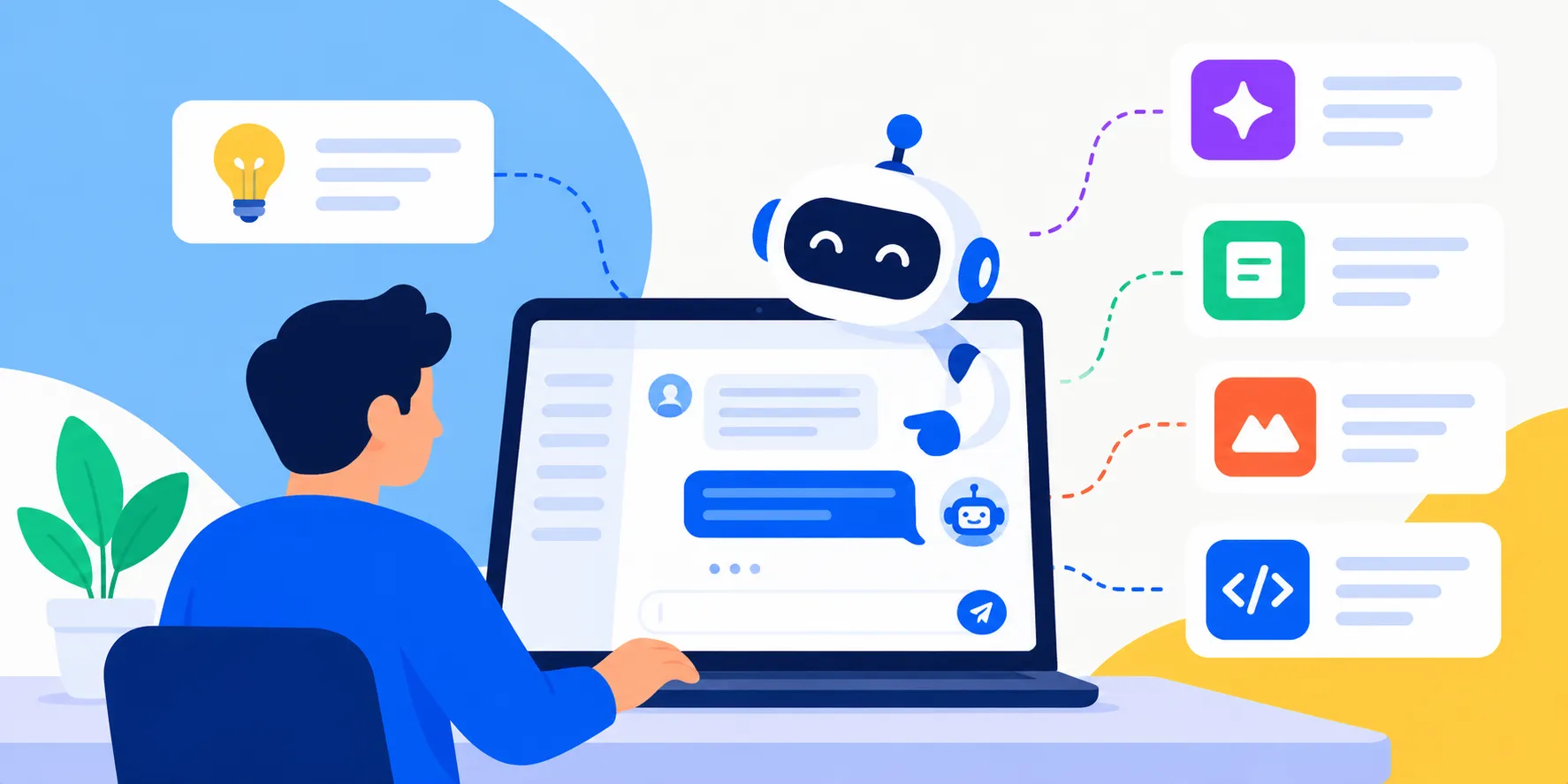
Generative AI Development Beyond the Demo
Generative AI development is more than connecting an application to an LLM API. A production generative AI system needs a useful product experience, reliable context, controlled outputs, secure data access, integrations, evaluation, monitoring, and a clear way to improve when models or user requirements change.
Our generative AI development services help businesses build applications where AI-generated text, structured information, images, documents, recommendations, summaries, code, or other content creates measurable value. We can build a new GenAI product, add generative capabilities to an existing SaaS platform, or modernize an early AI prototype that is difficult to operate.
The engineering approach depends on the job. A content generation tool may need templates, brand controls, structured outputs, editing and approvals. A knowledge assistant may need RAG, permissions, citations and retrieval evaluation. A document workflow may need extraction, validation and human review. A multimodal product may need image or document understanding alongside language generation.
The objective is dependable software around the model—not a flashy AI feature that works only in a carefully prepared demo.
Who We Build Generative AI Solutions For
AI & SaaS Startups
Turn a GenAI product concept into an MVP and production foundation without overbuilding the first release.
SaaS Product Teams
Embed copilots, content generation, intelligent search, summaries and AI-assisted workflows inside existing products.
Enterprise Teams
Connect generative AI to internal knowledge, documents, business systems, permissions and controlled workflows.
Marketing & Content Teams
Build brand-aware generation systems for campaigns, product content, reports, localization and editorial workflows.
Operations Teams
Use generative AI to summarize, classify, draft, transform and process repetitive knowledge work.
Software & Engineering Teams
Build code assistants, documentation tools, technical knowledge systems and AI-enabled development workflows.
Generative AI Development Services We Offer
End-to-end GenAI development services covering strategy, application engineering, model integration, grounding, generation, quality and production operations.
Custom Generative AI Development
Build a bespoke generative AI product around your users, data, workflow, output requirements and business model.
Generative AI Consulting & Strategy
Identify high-value use cases, assess feasibility and data readiness, compare approaches and define a practical roadmap.
Generative AI MVP Development
Validate a focused AI product hypothesis with a usable MVP before investing in a larger platform.
Generative AI Application Development
Develop complete AI applications with product UX, backend services, authentication, data, APIs, integrations and administration.
LLM Application Development
Build LLM-powered products with context management, structured outputs, tool use, validation, fallbacks and model controls.
RAG Development Services
Ground generation in private documents, databases and business knowledge with retrieval, permissions, citations and evaluation.
AI Content Generation
Create controlled workflows for articles, product descriptions, marketing copy, reports, proposals, emails and other business content.
AI Copilot Development
Embed contextual generative assistance directly into SaaS, CRM, ERP, support, commerce and internal applications.
Multimodal AI Development
Combine language with image, document, audio or other media understanding and generation for richer product workflows.
Generative AI Integration
Add GenAI capabilities to existing applications, APIs, CRM, ERP, communication platforms, data systems and workflows.
Generative AI Automation
Connect generation and reasoning capabilities to repeatable workflows with approvals, validation, APIs and human review.
AI Model Integration & Customization
Evaluate hosted and open models and consider prompting, adapters or fine-tuning only where the quality requirement justifies it.
GenAI Evaluation & Guardrails
Create representative test sets, output validation, safety controls, regression testing and monitoring for AI behavior.
Generative AI Modernization
Improve existing GenAI systems with better retrieval, prompts, architecture, observability, security, quality and cost control.
What We Can Build With Generative AI
Generative AI can power many product experiences. We choose the capability based on the workflow instead of forcing every use case into chat.
AI Content Engines
Generate and transform business content using templates, brand rules, structured formats and editorial review.
Knowledge Assistants
Answer questions from approved internal or product knowledge with retrieval, citations and permission-aware context.
Document Generation
Turn structured or unstructured business information into proposals, reports, summaries, briefs and other documents.
Document Understanding
Extract, summarize, compare and transform information from contracts, invoices, forms, manuals and reports.
AI Search Experiences
Combine semantic understanding and generation to help users discover and understand products, documents and knowledge.
Creative Generation
Build controlled workflows for image, copy, campaign and creative concept generation where the output itself creates value.
Developer Copilots
Assist with code, documentation, technical research, repository knowledge and repetitive engineering tasks.
Multilingual Generation
Generate, translate, summarize and adapt content across languages while maintaining terminology and brand controls.
Controlled Generation: Making AI Output Useful
A generative AI system should not simply produce plausible text. The output needs to match the format, tone, facts, business rules and level of control required by the workflow.
We can use prompt architecture, templates, system instructions, examples, structured outputs, schema validation, content policies, source context and post-generation checks to make outputs more consistent. Where the result is customer-facing or high-impact, an editing or approval layer can keep people in control.
For structured business workflows, generated output can be validated before it reaches downstream systems. This makes generative AI more useful than free-form chat because the application can treat the output as an input to a controlled software process.
RAG Development for Grounded Generative AI
Retrieval-augmented generation is valuable when a generative AI application needs current, private, domain-specific or permission-controlled information. Instead of expecting the model to know everything, the application retrieves relevant information and supplies it as context.
A production RAG system can include source ingestion, parsing, metadata, chunking, embeddings, vector or hybrid search, reranking, permission filtering, context construction, citations and retrieval evaluation. The right design depends on document structure, query patterns and how frequently information changes.
For multi-tenant applications, tenant and user permissions should be respected during retrieval. A good answer from the wrong customer's data is still a serious product failure, so access boundaries belong in the architecture from the beginning.
LLM Application Development With Flexible Model Strategy
LLM application development is strongest when the model is treated as a replaceable intelligence layer inside a larger application. Business logic, permissions, integrations, retrieval and validation should not depend on one model's behavior.
We can evaluate hosted and open models based on output quality, context requirements, latency, privacy, availability, licensing and cost. Some tasks may benefit from a larger model while others can use a smaller or faster model.
A modular model layer also makes it easier to test new models as capabilities improve. The goal is to keep the product adaptable rather than tying its roadmap to a single provider.
Multimodal Generative AI Development
Generative AI is no longer limited to text. Products can combine language with images, documents, audio and other media to create richer workflows.
Examples include document-to-summary workflows, visual product assistants, image-aware support, creative generation, media transformation and applications that understand multiple inputs before generating a structured result.
We design multimodal workflows around the actual user experience. That includes input validation, file handling, model selection, output controls, storage, permissions and human review where generated media or interpretation has meaningful business consequences.
Data and Knowledge Foundations for GenAI
Generative AI quality depends heavily on the information surrounding the model. Before building, we assess what data exists, where it lives, who owns it, how current it is and which users should be able to access it.
Data work can include ingestion pipelines, document processing, metadata, normalization, deduplication, embeddings, knowledge synchronization, feedback capture and data quality checks. These foundations support both RAG and other generative workflows.
We also design feedback loops where useful. User edits, accepted suggestions, rejected outputs and review decisions can provide evidence about where the product needs better prompts, retrieval, models or UX.
Generative AI Integrations
Connect GenAI to the systems where your business already works.
CRM & Sales Platforms
Generate summaries, drafts, account insights and sales assistance using controlled customer context.
ERP & Business Systems
Generate reports, explanations, document workflows and operational assistance from approved business data.
Customer Communication
Power support assistants, response drafting, conversation summaries and multilingual communication.
Commerce Platforms
Create product content, discovery experiences, personalization and customer assistance.
Cloud & Data Platforms
Connect AI workflows to databases, object storage, queues, analytics and enterprise data platforms.
Custom APIs
Connect models and generation workflows to proprietary services, business rules and third-party APIs.
Generative AI Use Cases
Customer Support Copilots
Help support teams draft responses, summarize conversations and retrieve approved answers.
Enterprise Knowledge Assistants
Let employees find and understand internal information through secure grounded generation.
Content & Marketing Platforms
Generate campaign ideas, copy, product descriptions, emails, summaries and localized content.
Report & Proposal Generation
Transform business data and source documents into structured reports, proposals and executive summaries.
AI-Powered SaaS Features
Embed generation, summarization, search, recommendations and copilots directly inside SaaS products.
Document Automation
Read source documents and generate validated downstream documents or structured records.
Developer Productivity
Create code assistance, documentation, technical search and repository-aware development workflows.
Creative & Media Workflows
Build controlled image, text and multimodal generation experiences for creative teams.
Industries We Support
SaaS & Software
GenAI copilots, knowledge features, content tools and intelligent product experiences.
Retail & E-commerce
Product content, discovery, personalization, customer assistance and commerce workflows.
Healthcare
Knowledge and administrative workflows designed with appropriate privacy and human-review controls.
Finance & Fintech
Document processing, support, analysis and controlled knowledge workflows.
Logistics & Operations
Document automation, summaries, exception workflows and operational knowledge.
Professional Services
Research, proposals, document analysis, knowledge assistants and content generation.
Manufacturing
Technical knowledge, document workflows, visual understanding and operational assistance.
Education
Learning content, knowledge assistants, summaries, tutoring support and administrative workflows.
Generative AI Evaluation, Testing and Guardrails
Traditional application tests cannot fully measure generative AI quality. A product can return a successful API response while producing an answer that is inaccurate, irrelevant, unsafe or incorrectly formatted.
We create representative evaluation cases around the product's actual tasks. Depending on the system, evaluation can cover factuality, relevance, retrieval quality, instruction following, structured-output validity, safety, multilingual quality, latency and cost.
Guardrails can include input validation, prompt-injection defenses, sensitive-data handling, output validation, tool boundaries, rate limits, refusal policies, human review and escalation. Evaluation and guardrails should evolve as the product changes.
Security, Privacy and Responsible GenAI
Generative AI products often process private documents, customer conversations, internal knowledge or business data. Security must therefore cover the complete application, data pipeline and model interaction.
We design around authentication, role-based access, tenant isolation where applicable, encrypted data flows, secrets management, least-privilege service access, audit trails, retention policies and controlled model access.
For sensitive workflows, we can keep humans in the loop. Generation should assist people where appropriate rather than silently making irreversible or high-impact decisions without review.
Our Generative AI Development Process
01. Use-Case Discovery — Define the users, workflow, business objective, desired output and measurable success criteria.
02. GenAI Opportunity Assessment — Determine whether generation, RAG, multimodal AI, deterministic software or a hybrid approach is the right fit.
03. Data & Knowledge Assessment — Review source data, quality, freshness, permissions, privacy and integration requirements.
04. Output Definition — Specify what good output looks like, including structure, tone, accuracy, constraints and review requirements.
05. Model & Architecture Selection — Compare model options, application architecture, retrieval strategy, hosting approach and operational constraints.
06. UX & Product Design — Design the AI interaction, editing, feedback, citations, loading states, fallback and human-review experience.
07. GenAI MVP Development — Build the smallest useful product around the highest-value workflow.
08. Integration & Grounding — Connect APIs, business systems, retrieval, documents, tools and approved context.
09. Evaluation & Quality Engineering — Test representative tasks for output quality, retrieval, safety, reliability, latency and cost.
10. Security & Production Hardening — Implement permissions, data protection, observability, rate limits, deployment controls and operational safeguards.
11. Production Launch — Release the application, monitor real usage and establish controlled change management.
12. Continuous Optimization — Improve prompts, models, retrieval, UX, data quality, cost and performance using production evidence.
Generative AI Technology Stack
Foundation Models: OpenAI, Anthropic, Google Gemini, Meta Llama, Mistral, other open-weight models and task-specific AI models selected according to requirements.
Application Engineering: React, Next.js, TypeScript, Node.js, Python, FastAPI, REST APIs, GraphQL, background workers, queues and event-driven services.
GenAI & Retrieval: LLM APIs, embeddings, vector search, pgvector, hybrid retrieval, reranking, structured outputs, prompt pipelines and model orchestration.
Data & Storage: PostgreSQL, MongoDB, Redis, object storage, document stores and analytics platforms.
Cloud & Infrastructure: AWS, Google Cloud, Docker, CI/CD, monitoring, logging, tracing, autoscaling and secrets management.
Quality & Operations: Evaluation datasets, regression tests, prompt/version management, tracing, user feedback, cost tracking and controlled releases.
Generative AI Modernization
Many GenAI prototypes become difficult to operate once real users arrive. Prompts may be scattered through the application, retrieval may be inconsistent, model costs may grow quickly, and teams may have no reliable way to tell whether a change improved quality.
Generative AI modernization can restructure the model layer, improve retrieval, introduce evaluation, separate business logic from AI orchestration, add observability, improve security and reduce unnecessary inference cost.
The goal is not automatically to rebuild the application. We identify the highest-impact weaknesses and modernize the parts that prevent the product from becoming reliable and maintainable.
Scaling Generative AI Products
GenAI scale involves more than request volume. Model capacity, context size, retrieval traffic, response latency, inference cost, concurrency and output quality all affect the user experience.
We can use caching, asynchronous processing, streaming where appropriate, batching, request limits, queue-based workloads, retrieval optimization and model routing to keep the product responsive and economically sustainable.
Production monitoring can track request volume, latency, errors, model usage, cost, retrieval behavior, user feedback and other quality indicators so product decisions are based on evidence.
Generative AI Engagement Models
GenAI Strategy & Discovery
Assess the opportunity, data, model options, architecture, risks and first useful use case before a larger build.
Generative AI MVP
Build a focused product slice to validate the core generation workflow with real users.
End-to-End GenAI Development
Handle product engineering, AI capabilities, integrations, infrastructure, evaluation, launch and ongoing optimization.
AI Engineering Team Extension
Add GenAI and full-stack engineering capacity to an existing product team.
GenAI Modernization
Improve an existing system's architecture, retrieval, evaluation, security, performance and operating cost.
Continuous GenAI Engineering
Iterate after launch through feature development, model evaluation, optimization and operational support.
When Generative AI Development Makes Sense
Generative AI is a strong fit when the value of your product depends on creating, transforming, summarizing, interpreting or interacting with large amounts of information.
It can be especially useful for businesses with repetitive knowledge work, large document collections, customer-support volume, content operations, complex internal knowledge or existing software where intelligent assistance can reduce friction.
Not every problem needs generative AI. If a database query, search filter, workflow rule or conventional automation produces a more reliable result, that may be the better choice. Good GenAI development starts with the business outcome, not the model.
Why Build Your Generative AI Product With Axora?
Generative AI sits at the intersection of AI engineering and product engineering. Axora works across both, so the model is designed as part of a complete application rather than as an isolated experiment.
Our engineering capabilities span React and Next.js interfaces, Node.js and Python backends, APIs, databases, cloud infrastructure, queues, storage, integrations and AI/ML systems. This helps us connect GenAI capabilities to the software users actually depend on.
We focus on practical production concerns including evaluation, permissions, security, observability, cost, latency, maintainability and model flexibility. The result is a GenAI system designed to evolve as your users and the underlying AI ecosystem change.
Our Generative AI Engineering Approach
Start With the Output
Define what the user needs to receive or accomplish before choosing prompts, models or frameworks.
Ground Where Necessary
Use trusted context, retrieval and source information when the model needs private or changing knowledge.
Constrain What Matters
Use structured outputs, validation, templates and workflow rules where free-form generation creates unnecessary risk.
Evaluate With Real Tasks
Test representative user scenarios instead of relying on a few impressive demo conversations.
Keep Models Flexible
Separate model providers and AI orchestration from core product logic so the system can evolve.
Optimize From Evidence
Use quality, cost, latency and user feedback to guide improvements after launch.
Related Services
Services to Support Your Generative AI Product

AI Product Engineering
Design and ship AI-first products using LLMs, computer vision, and predictive analytics—productionized with secure, observable, and scalable pipelines.
Learn more
API Development Services
Build secure, scalable, and high-performance Web APIs, custom microservices integrations, and RESTful structures. Enterprise API development company delivering premium connector solutions.
Learn more
Cloud & DevOps Automation
Automate delivery with Kubernetes, Terraform, and GitOps. Improve reliability, time-to-restore, and cloud spend with SRE and FinOps.
Learn moreFrom Our Blog
AI & Generative AI Insights
From AI to Super Intelligence (SI): What America’s 2026 Shift Means for Business
America’s 2026 shift from AI toward Super Intelligence (SI) signals a deeper business transition: from AI assistants and chatbots to agents, intelligent workflows, enterprise automation and software built around increasingly capable reasoning systems.
Read articleHow AI Is Transforming Modern Software Development in 2025
AI now powers every stage of the software lifecycle—from product engineering and QA to cloud automation and CRM intelligence—helping teams ship faster and smarter.
Read articleHow AI Improves SaaS Platforms in 2025
AI is reshaping SaaS platforms with automation, personalization, predictive intelligence, and smarter operations. Here’s how AI SaaS improvement is transforming modern cloud applications.
Read articleFrequently Asked Questions
Ready to Build a Production Generative AI Product?
Tell us the workflow you want to improve and we can help define the right GenAI architecture, MVP scope and production roadmap.
Ready to Transform Your Business?
Get started with our intelligent digital solutions. Our team is ready to help you unlock the power of AI-driven technology.
Send us a message
Fill out the form below and we'll get back to you within 24 hours
Contact Information
Reach out to us through any of these channels