Progressive Web App Development Company
Build fast, installable, responsive progressive web applications that combine the reach of the web with app-like experiences, offline capabilities, push notifications, secure APIs, and reliable performance across devices.
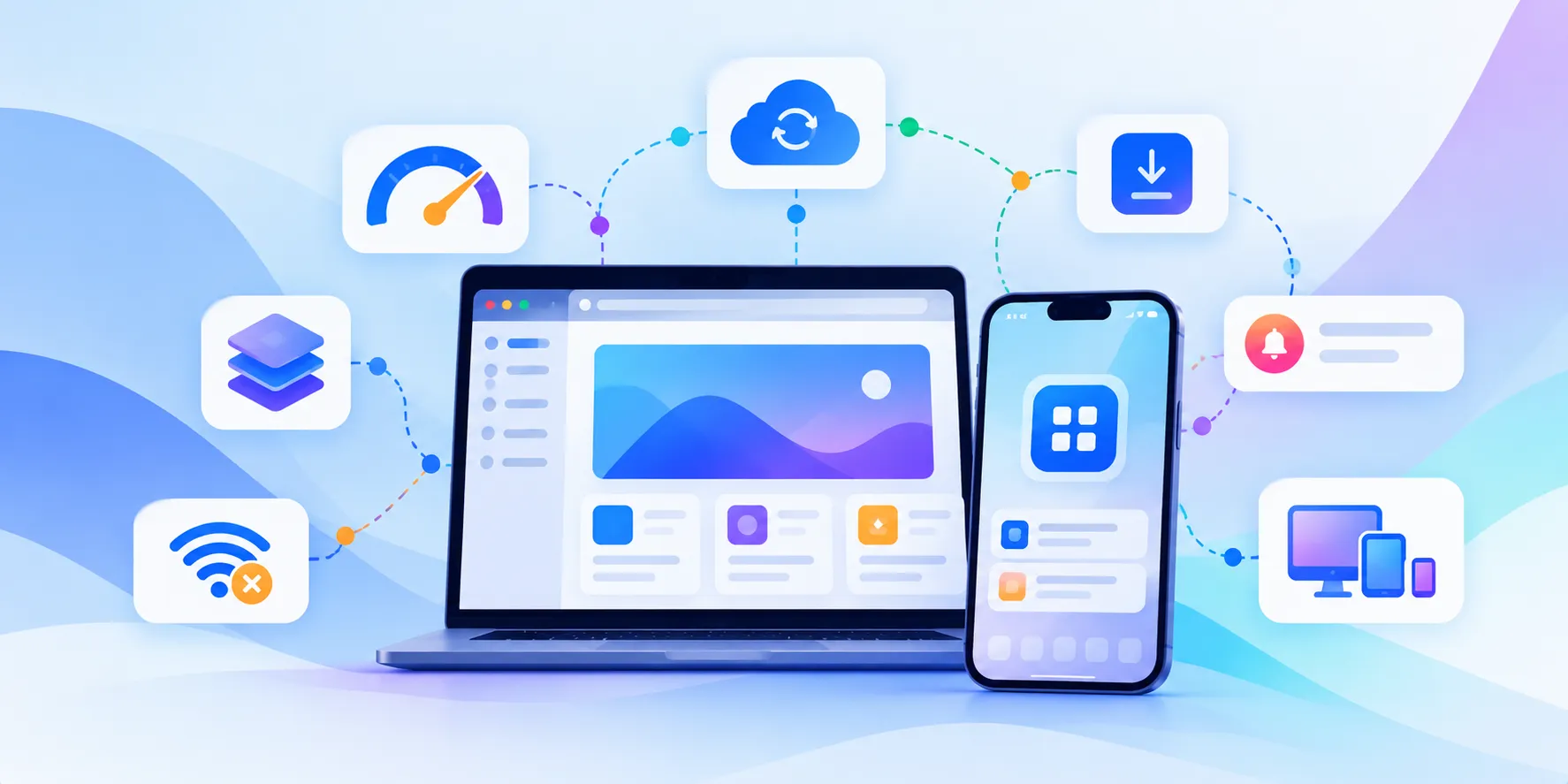
Progressive Web Applications Built Around Business Outcomes
A progressive web application can combine the reach and discoverability of the web with many behaviors users associate with installed applications. The value is not simply adding a manifest. It comes from designing fast navigation, responsive interaction, resilient data access, useful notifications, secure APIs, and a product architecture that works across devices.
Our PWA development services help startups, product companies, enterprises, retailers, service businesses, and internal teams turn web experiences into capable digital products. We build customer portals, commerce experiences, SaaS interfaces, operational applications, booking systems, field workflows, content products, and business applications where browser-first delivery makes commercial sense.
A PWA can be especially useful when SEO and shareable URLs matter, when users need quick access without an app-store download, or when one product must serve desktop, tablet, and mobile users. We also evaluate browser and platform limitations honestly rather than treating PWA as a replacement for every native mobile use case.
From discovery and responsive UX through service workers, caching, offline behavior, APIs, integrations, security, testing, deployment, analytics, and continuous improvement, we treat the PWA as a production application rather than a thin layer on top of a website.
Who We Help
PWA Development for Products, Commerce, and Business Operations
We work with teams that need an accessible, installable web product without unnecessarily maintaining separate native applications.
- ✓Startups & Product TeamsLaunch a focused product quickly, validate demand through real users, and keep the architecture ready for future expansion.
- ✓E-commerce BusinessesImprove mobile shopping with fast storefronts, installability, caching, notifications, and reliable cart and checkout journeys.
- ✓Enterprise TeamsBuild secure internal or customer-facing applications for workflows, approvals, portals, reporting, and distributed teams.
- ✓Content & Media BusinessesCreate discoverable experiences where performance, shareable URLs, repeat visits, and engagement matter.
- ✓Field & Operations TeamsSupport mobile workflows with resilient data, offline behavior, location, forms, documents, and synchronization.
- ✓Existing Web Product OwnersModernize a responsive web application with better performance, installability, offline capabilities, and application behavior.
PWA Development Services
PWA Development Services We Offer
Our progressive web app development services cover strategy, product engineering, offline behavior, integrations, modernization, quality, deployment, and ongoing optimization.
Custom PWA Development
Build a purpose-designed progressive web application around users, workflows, APIs, data, and the product roadmap.
PWA Consulting & Strategy
Assess product fit, browser capabilities, offline requirements, SEO, architecture, integrations, and delivery approach.
PWA MVP Development
Launch the essential product journey quickly while establishing a foundation for future capabilities and scale.
Enterprise PWA Development
Create secure business applications with role-based access, workflows, integrations, reporting, and resilient access.
Offline-First PWA Development
Design important workflows to remain useful with limited connectivity through local storage, caching, synchronization, and retries.
PWA UI/UX Development
Create responsive, touch-friendly interfaces across phones, tablets, and desktops.
PWA API & Backend Integration
Connect PWAs with REST or GraphQL APIs, authentication, databases, cloud services, and business systems.
PWA E-commerce Development
Build commerce experiences with product discovery, carts, checkout, accounts, orders, payments, and engagement.
PWA Modernization
Transform an existing web application into a more capable, installable, performant product without discarding valuable logic.
PWA Migration
Move legacy or responsive web experiences toward modern application architecture, caching, APIs, and progressive enhancement.
PWA Performance Engineering
Improve loading, rendering, caching, network behavior, asset delivery, and repeat-visit performance.
PWA Maintenance & Support
Handle browser changes, dependencies, defects, security updates, analytics, performance work, and continuous improvements.
Core Capabilities
What We Build Into Modern Progressive Web Applications
A production PWA combines responsive UX with application behavior, resilient data handling, APIs, security, observability, and continuous delivery.
- ✓Installable ExperiencesConfigure supported installation with manifest metadata, icons, display behavior, launch handling, and appropriate user prompts.
- ✓Service Worker ArchitectureUse service workers for appropriate caching, request handling, offline behavior, and resilient delivery.
- ✓Offline Data & SynchronizationKeep important workflows useful during connectivity interruptions with local state, queues, synchronization, and conflict-aware behavior.
- ✓Push NotificationsSupport useful notifications on compatible browsers and platforms with clear consent and relevant messaging.
- ✓Authentication & AccountsBuild secure sign-in, sessions, profiles, roles, recovery, and identity-provider integrations.
- ✓Search & Data ExperiencesDeliver fast search, filters, pagination, saved states, detail views, and responsive information architecture.
- ✓Forms & Business WorkflowsSupport approvals, submissions, checklists, data capture, validation, and status-driven processes.
- ✓Real-Time ExperiencesSupport chat, live status, collaborative workflows, activity feeds, and time-sensitive interactions.
- ✓Location & Device FeaturesUse browser-supported location, camera, media, and file capabilities where they create product value.
- ✓Analytics & ObservabilityConnect analytics, performance signals, errors, logs, and business events to understand real usage.
PWA Architecture Designed for Reliability and Scale
PWA architecture must balance browser capabilities, server responsibilities, client state, caching, data freshness, security, and deployment. We define these boundaries around the product instead of treating the service worker as the entire architecture.
A modern PWA can combine responsive UI, server-rendered or statically generated public pages, client-side application behavior, APIs, local storage, service workers, caching strategies, authentication, and observability. Each layer gets a clear responsibility so feature growth does not create unnecessary coupling.
Caching strategy is especially important. Static assets, public content, API responses, user-specific data, and transactional operations should not all be cached in the same way. We choose cache behavior around freshness, sensitivity, offline requirements, and the consequences of stale information.
The result should be a web product that loads quickly, behaves predictably across network conditions, and can grow as features, users, integrations, and operational requirements increase.
Resilient Application Behavior
Offline-First Experiences for Unreliable Connectivity
Offline support is most valuable when tied to a real workflow. We design it around what users must still be able to see, create, edit, or submit when connectivity is unavailable.
Local Data
Persist information needed for important journeys so the application does not depend on a network request for every interaction.
Queued Actions
Queue supported actions locally and process them when connectivity returns.
Synchronization
Reconcile local changes with backend data using clear rules, retries, and validation.
Conflict Handling
Define what happens when local and server versions change independently before synchronization.
Network-Aware UX
Show whether the application is online, syncing, waiting, or operating with locally available data.
Safe Transaction Boundaries
Keep sensitive or irreversible operations under server-side validation rather than pretending every action can safely happen offline.
Speed & User Experience
Performance Engineering for Progressive Web Apps
PWA performance should be measured around real user journeys, from navigation to meaningful interaction and repeat visits.
- ✓Fast Initial LoadsReduce unnecessary JavaScript, optimize assets, prioritize critical content, and choose rendering strategies around page purpose.
- ✓Responsive InteractionKeep input, navigation, filtering, search, and high-frequency interactions responsive on constrained devices.
- ✓Efficient CachingCache stable resources intelligently while avoiding stale or sensitive data being served incorrectly.
- ✓Network OptimizationReduce unnecessary requests, optimize API payloads, handle slow connections, and design graceful loading states.
- ✓Image & Media OptimizationUse appropriate media sizes, modern delivery, lazy loading, and responsive assets.
- ✓Continuous MeasurementUse real-user signals, performance monitoring, errors, and business metrics to guide improvements.
PWA Integrations and API Connectivity
Most business PWAs depend on APIs, authentication, payments, CRM or ERP platforms, commerce systems, analytics, communication tools, and cloud infrastructure. Integration quality therefore has a direct effect on reliability.
We design API contracts around authentication, validation, pagination, errors, retries, timeouts, synchronization, and data ownership. The browser application should not become responsible for business rules that belong on trusted backend services.
Common integration areas include REST and GraphQL APIs, OAuth and identity providers, payment gateways, commerce platforms, CRM and ERP systems, cloud storage, search, messaging, analytics, maps, email, and custom business APIs.
For browser capabilities such as camera, location, notifications, files, or background behavior, we evaluate support across target browsers and devices before committing to the product experience.
Security & Trust
Security for Progressive Web Applications
A PWA is still a web application and should follow strong security practices across the browser, APIs, infrastructure, authentication, and data layer.
- ✓Secure AuthenticationImplement secure login, sessions, token handling, identity providers, recovery, and appropriate expiry behavior.
- ✓Server-Side AuthorizationKeep important permissions and business rules on trusted backend services instead of relying on client checks.
- ✓Secure Data HandlingProtect sensitive information in transit and storage and never place secrets or privileged credentials in the browser.
- ✓Safe Service Worker BehaviorDesign caching and request interception so private or transactional data is not accidentally persisted or exposed.
- ✓Dependency HygieneMaintain frontend dependencies, server packages, build tooling, and third-party integrations as part of security work.
- ✓Monitoring & Incident ReadinessUse logs, error monitoring, audit signals, and operational alerts to identify and respond to issues.
What We Build
Progressive Web App Use Cases
PWAs are especially useful when a product benefits from web reach, responsive access, fast repeat visits, and app-like workflows.
E-commerce & Retail
Fast storefronts, product discovery, carts, checkout, accounts, orders, loyalty, and engagement.
SaaS & Business Platforms
Browser-first products with dashboards, workflows, notifications, roles, and installable behavior.
Customer & Partner Portals
Secure self-service portals for customers, vendors, partners, agents, and distributed relationships.
Field Operations
Forms, inspections, jobs, documents, location, photos, task updates, and offline synchronization.
Booking & On-Demand Services
Availability, booking, payments, service status, notifications, location, and communication.
Content & Media
Discoverable publishing experiences where performance, repeat visits, and shareable URLs matter.
Education Platforms
Learning, assessments, student workflows, communication, resources, and responsive access.
Internal Business Applications
Approvals, operations, reporting, employee workflows, data capture, and business tools.
Industry Applications
PWA Development Across Industries
We adapt progressive web application experiences to the workflows, users, regulations, and connectivity needs of each business.
Retail & E-commerce
Commerce, loyalty, catalog, customer engagement, orders, and store operations.
Logistics & Transportation
Delivery, dispatch, tracking, field operations, proof of delivery, and resilient workflows.
Healthcare
Patient portals, scheduling, communication, operational workflows, and secure role-based experiences.
Financial Services
Customer portals, account interfaces, dashboards, document workflows, and secure operations.
Education
Learning platforms, student services, teacher tools, content, assessments, and administration.
Real Estate
Property search, lead workflows, listings, document exchange, scheduling, and customer portals.
Travel & Hospitality
Discovery, reservations, bookings, guest communication, loyalty, and location-aware experiences.
Professional Services
Client portals, approvals, scheduling, documents, field work, and operational workflows.
Our PWA Development Process
We connect product strategy, responsive experience design, application architecture, browser capabilities, backend integration, performance, and release planning.
Product Discovery
Understand users, business goals, workflows, target devices, browser requirements, connectivity constraints, integrations, and success measures.
PWA Fit & Scope
Determine where progressive web application capabilities provide value, define the first release, identify platform limitations, and prioritize workflows.
UX & Responsive Product Design
Map journeys, information architecture, responsive states, mobile interactions, accessibility, installation, and offline scenarios.
Architecture & API Planning
Define frontend boundaries, backend services, data flow, authentication, caching, synchronization, API contracts, and infrastructure.
Application Foundation
Set up the web application, environments, build pipeline, routing, design system, state management, observability, and deployment foundations.
Core Feature Development
Build priority workflows incrementally, connecting UI, business logic, APIs, data handling, permissions, and responsive behavior.
Progressive Capabilities
Implement installability, service workers, caching, offline behavior, notifications, device capabilities, and background features where supported.
Integrations & Data
Connect authentication, payments, CRM, ERP, commerce, analytics, messaging, storage, search, and other systems.
Quality & Performance
Test browsers, devices, network conditions, accessibility, security, caching, offline flows, performance, and critical journeys.
Staging & User Acceptance
Release controlled builds to stakeholders, validate workflows, collect feedback, resolve defects, and verify production readiness.
Production Launch
Deploy the application, validate infrastructure, monitor errors and performance, verify installation behavior, and watch important journeys.
Continuous Optimization
Use analytics, performance signals, feedback, browser changes, security updates, and product priorities to guide future releases.
Technologies We Use for PWA Development
We select the web stack around product requirements, SEO needs, performance targets, integration complexity, team capability, and maintainability.
PWA Modernization and Migration
Many businesses already have responsive web applications but still experience slow mobile journeys, repeated network requests, weak offline behavior, inconsistent responsive states, or architecture that makes product changes expensive. PWA modernization can improve these areas without requiring a full rewrite.
We assess the existing frontend, APIs, caching behavior, deployment model, analytics, browser support, and user journeys before defining a migration path. Work can include responsive redesign, frontend modernization, service worker adoption, caching improvements, API restructuring, local data support, performance optimization, security updates, and stronger testing.
For larger applications, modernization can happen incrementally. Stable areas can continue operating while selected workflows move to the new architecture, allowing the business to keep shipping and validating improvements.
PWA, SEO, and Discoverability
A major advantage of a web-first product is that important public experiences can remain accessible through URLs and search engines when the architecture is designed correctly. Progressive behavior should enhance the web experience rather than hide important content behind client-only interactions.
For public-facing PWAs, we consider crawlable routes, semantic content, metadata, structured data where appropriate, server-side or static rendering when beneficial, canonical URLs, performance, internal linking, and graceful behavior when JavaScript is unavailable.
The SEO strategy depends on the product. A private customer portal does not need to expose authenticated content to search engines, while commerce or content products may depend heavily on discoverable public pages. We design that boundary deliberately.
Flexible Delivery
Ways We Can Work With Your Team
Choose a delivery model based on your product stage, internal team, and roadmap.
End-to-End PWA Development
From discovery and responsive UX through progressive capabilities, integrations, QA, deployment, and optimization.
PWA MVP Development
Build a focused first release that validates the core journey without overbuilding unproven features.
Dedicated PWA Team
Add frontend, backend, QA, DevOps, or product engineering capacity around an existing roadmap.
PWA Modernization & Rescue
Improve an existing web product's performance, architecture, resilience, security, and application behavior while continuing feature delivery.
When Progressive Web App Development Makes Sense
PWA development is a strong fit when broad web reach, shareable URLs, responsive access, fast repeat visits, and app-like behavior are important. It can reduce friction for users who do not want to find and install a traditional mobile application before completing a task.
It is particularly useful for commerce, content, customer portals, SaaS products, field workflows, and business applications where browser access is already central to the product. A single responsive product can also simplify delivery across desktop, tablet, and mobile.
A PWA is not automatically the right answer for products that require deep native device capabilities, extensive background processing, specialized hardware, or platform-specific experiences that browsers cannot reliably provide. Native mobile or a hybrid strategy may be more appropriate in those cases.
The right decision depends on users, workflows, platform capabilities, SEO requirements, offline needs, distribution strategy, performance expectations, and long-term product economics.
Why Axora Infotech
A Product-Minded Approach to PWA Development
We treat the progressive web application as a real product connected to APIs, data, infrastructure, analytics, security, and business workflows.
- ✓Product-First DiscoveryStart with users, business outcomes, workflows, connectivity needs, and distribution goals before choosing technical patterns.
- ✓Full-Stack IntegrationFrontend, APIs, databases, cloud infrastructure, authentication, payments, analytics, and business systems are planned together.
- ✓Practical Progressive EnhancementAdd offline, installation, notifications, and device capabilities where they create measurable product value.
- ✓Performance-Aware EngineeringLoading, rendering, caching, network behavior, and repeat-visit performance are treated as product requirements.
- ✓Incremental DeliveryDeliver important workflows in stages so teams can validate real usage before expanding the product.
- ✓Post-Launch OwnershipContinue with browser updates, performance improvements, security, analytics, maintenance, and new capabilities.
From Web Experience to Production Application
A strong progressive web application is not simply a website with a manifest and service worker. It is a product designed around how users move between devices, networks, sessions, and workflows.
For a new product, we focus on the core journey, distribution model, performance expectations, and progressive capabilities that actually matter. For an existing web product, we identify the highest-impact problems and modernize them incrementally rather than adding complexity for its own sake.
Our approach connects frontend engineering with backend APIs, data, cloud infrastructure, quality engineering, analytics, security, and continuous delivery. That helps the PWA remain useful to users and manageable for the business as the product grows.
Related Services
Services to Support Your PWA

API Development Services
Build secure, scalable, and high-performance Web APIs, custom microservices integrations, and RESTful structures. Enterprise API development company delivering premium connector solutions.
Learn more
Cloud & DevOps Automation
Automate delivery with Kubernetes, Terraform, and GitOps. Improve reliability, time-to-restore, and cloud spend with SRE and FinOps.
Learn moreFrequently Asked Questions
Ready to Transform Your Business?
Get started with our intelligent digital solutions. Our team is ready to help you unlock the power of AI-driven technology.
Send us a message
Fill out the form below and we'll get back to you within 24 hours
Contact Information
Reach out to us through any of these channels