Web Application Development Company
Build secure, scalable web applications around your workflows, users, data, and growth plans—from customer portals and internal business apps to SaaS platforms, dashboards, marketplaces, and enterprise web systems.
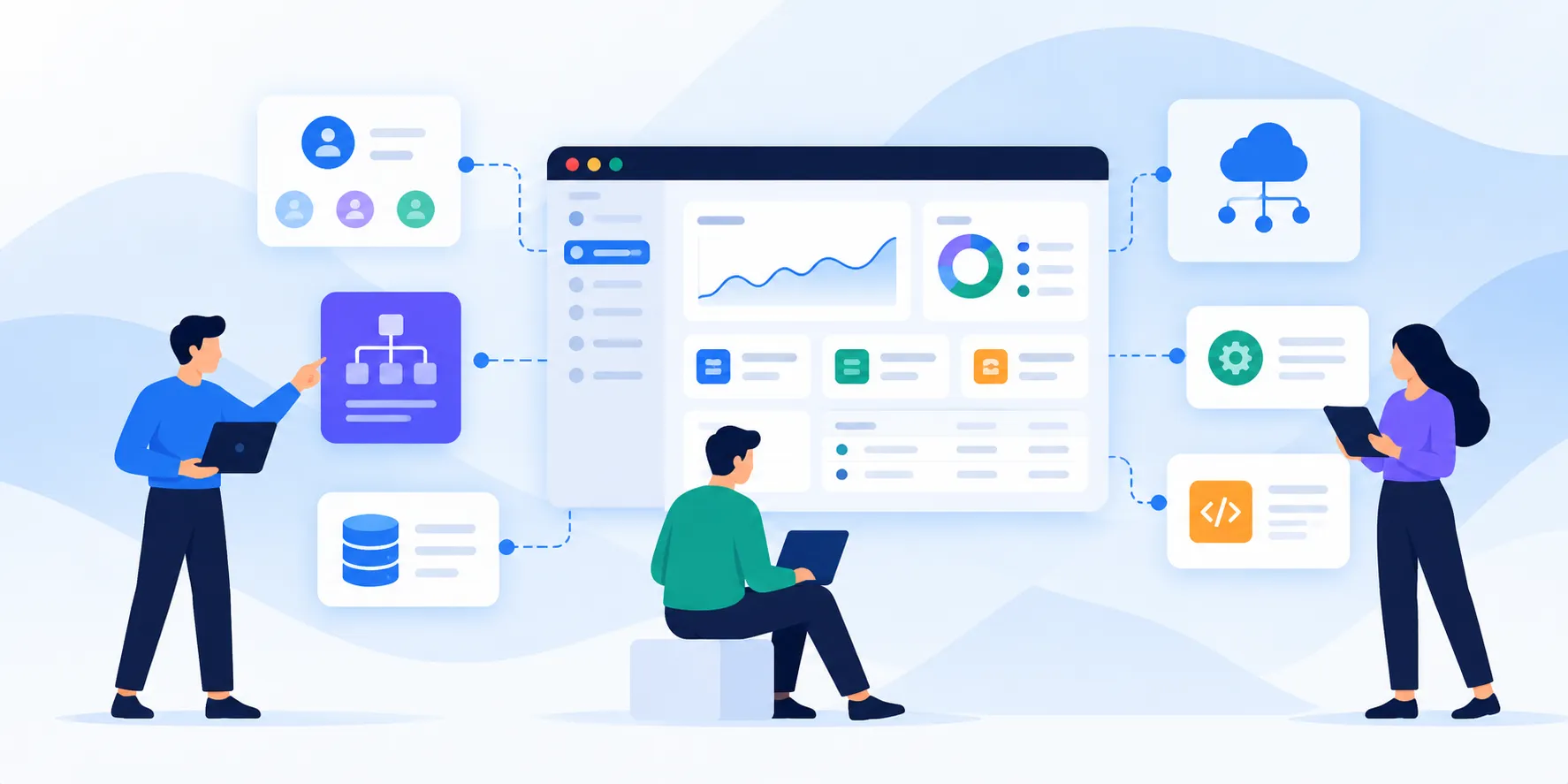
Web Applications Built Around How Your Business Works
A modern web application is more than a collection of browser screens. It is a working software system where users, business rules, data, permissions, workflows, integrations, and reporting come together to help people complete real tasks.
Our web application development services are designed for businesses that need more than a marketing website or an off-the-shelf tool can provide. We build customer-facing platforms, employee applications, partner portals, SaaS products, dashboards, workflow systems, marketplaces, and enterprise applications around the way the organization actually operates.
The right architecture depends on the product. Some applications benefit from a modular monolith, while others need service-oriented or event-driven components. We choose the approach based on business complexity, expected usage, integration requirements, security, team capability, and the long-term roadmap rather than forcing every project into the same architecture.
From discovery and UX through development, testing, deployment, and ongoing improvement, the goal is a web application that is useful on day one and maintainable as the business changes.
Who We Help
Web Applications for Growing Products and Operations
We work with teams that need a dependable browser-based application to serve customers, coordinate employees, connect business systems, or create a new digital product.
- ✓Startups & Product TeamsTurn a product idea, validated concept, or MVP into a production-ready web application with a foundation for future features and users.
- ✓Growing BusinessesReplace spreadsheets, email-based coordination, and disconnected tools with a centralized application for everyday operations.
- ✓Enterprise TeamsBuild secure internal platforms, portals, workflow applications, and connected business systems with appropriate roles and governance.
- ✓Digital Product CompaniesExtend or modernize SaaS products, customer platforms, marketplaces, and other web-based products that need reliable engineering.
- ✓Legacy Application OwnersImprove an existing application through incremental modernization, re-platforming, re-architecture, or targeted feature replacement.
- ✓Organizations Connecting SystemsCreate the web application layer that brings together CRM, ERP, accounting, payments, logistics, communication, and other platforms.
Web Application Development Services
Web Application Services We Offer
Our web app development services cover the lifecycle from strategy and application design to engineering, integration, modernization, and long-term support.
Custom Web Application Development
Design and build browser-based software around your users, workflows, data structures, business rules, and product roadmap.
Web App Consulting & Strategy
Clarify requirements, prioritize features, assess build-versus-buy decisions, and define an architecture and delivery roadmap.
Enterprise Web Application Development
Build secure business applications, operations platforms, portals, and internal systems with roles, integrations, auditability, and scale in mind.
SaaS Application Development
Develop multi-user and multi-tenant web products with accounts, subscriptions, integrations, permissions, and scalable foundations.
Web Portal Development
Create customer, partner, vendor, employee, and B2B portals for requests, documents, orders, support, approvals, and status visibility.
Internal Business Applications
Replace fragmented spreadsheets and manual coordination with role-based tools for operations, finance, sales, service, and management.
Workflow & Process Applications
Digitize approvals, task routing, notifications, status transitions, scheduling, exception handling, and repeatable business processes.
API & Backend Development
Build application backends, APIs, authentication, data services, background jobs, and business logic that support the web experience.
Web Application Integration
Connect applications with CRM, ERP, payments, accounting, logistics, messaging, identity, analytics, and third-party APIs.
Web Application Modernization
Improve aging applications through UI modernization, re-architecture, cloud migration, performance work, or component replacement.
Web Application Migration
Move applications, databases, users, and integrations to a new platform or architecture while planning validation and continuity.
Performance & Scalability Engineering
Improve response times, database behavior, caching, background processing, capacity, and reliability as usage grows.
Core Capabilities
What We Build Into a Modern Web Application
A strong web application connects its user experience to dependable business logic, data, security, and operations.
- ✓Authentication & User AccountsSecure sign-up, login, password recovery, sessions, account management, and identity flows.
- ✓Roles & PermissionsControl what customers, employees, partners, managers, and administrators can view or do.
- ✓Dashboards & WorkspacesGive each user the information, actions, queues, KPIs, and shortcuts relevant to their role.
- ✓Search & Data ViewsSupport search, filtering, sorting, pagination, saved views, exports, and clear information hierarchy.
- ✓Workflow & ApprovalsModel states, approvals, assignments, escalations, notifications, and handoffs.
- ✓Documents & FilesSupport uploads, controlled access, metadata, storage workflows, downloads, and auditability.
- ✓Notifications & CommunicationUse email, SMS, WhatsApp, push, or in-app alerts for important events.
- ✓Reporting & AnalyticsTurn operational data into dashboards, reports, KPIs, exports, and management views.
- ✓Admin & ConfigurationManage users, content, settings, workflows, integrations, and application behavior.
- ✓Real-Time FeaturesSupport live updates, activity feeds, collaboration, status changes, and time-sensitive experiences.
Web Application Architecture That Can Evolve
A web application's architecture should reflect the product's actual needs. We separate presentation, application logic, data access, integrations, and infrastructure responsibilities so the system can be understood and changed without unnecessary coupling.
For many business applications, a well-structured modular architecture provides a practical balance between development speed and long-term maintainability. For products with demanding workloads or independently scaling capabilities, selected services can be separated around clear boundaries.
We consider asynchronous processing, caching, queues, scheduled jobs, file storage, search, observability, and database design when they solve a real requirement. Architecture decisions are based on traffic, data volume, consistency, integration behavior, security, and operational ownership.
The objective is not technical complexity. It is a foundation that remains understandable while giving the product room to grow.
Workflow Automation Inside Web Applications
Many web applications exist because a business process is difficult to manage manually. The application should capture the workflow, not simply digitize the same collection of forms and spreadsheets.
We model states, approvals, assignments, notifications, deadlines, exceptions, and downstream actions so work can move from one stage to the next with less manual coordination. Examples include lead qualification, order approval, vendor onboarding, service requests, document reviews, bookings, claims, and fulfillment.
Background jobs and event-driven processing can handle notifications, imports, exports, synchronization, report generation, and integration processing without blocking the user interface.
Good automation also includes visibility: users should understand what happened, what is waiting, who owns the next step, and where an exception needs attention.
Integrations, APIs, and Connected Business Systems
Most useful web applications exchange information with systems that already exist. A customer portal may need CRM data, an operations platform may need ERP and accounting information, and a SaaS product may need payments, email, identity, analytics, or communication services.
We design integration boundaries around the data that needs to move, the source of truth, synchronization frequency, failure handling, authentication, and ownership. APIs and webhooks are used where appropriate, while queues and scheduled processing can handle asynchronous workloads.
Integration engineering also includes validation, retries, idempotency, logging, monitoring, and reconciliation. A successful API response does not automatically mean two systems now have consistent business data.
Security & Governance
Security Built Into the Application Lifecycle
Security requirements vary by product and industry, but access control and data protection should be considered from discovery through production operations.
- ✓Identity & Access ControlDesign authentication, session management, roles, permissions, and privileged access around actual responsibilities.
- ✓Data ProtectionProtect sensitive information through appropriate encryption, transport security, storage controls, and careful data handling.
- ✓API SecurityApply authentication, authorization, validation, rate controls, and secure integration practices to application interfaces.
- ✓AuditabilityTrack important changes, approvals, administrative actions, and security-relevant events when required.
- ✓Secure Development & TestingInclude security-focused reviews and testing alongside functional quality rather than waiting until the end.
- ✓Operational ControlsConsider secrets, backups, logging, monitoring, infrastructure access, incident handling, and release controls.
Performance & Reliability
Web Applications Designed for Real Usage
Performance combines frontend behavior, backend processing, database queries, network usage, infrastructure, and product decisions.
Fast User Interfaces
Optimize rendering, data fetching, assets, navigation, and interaction patterns.
Efficient Data Access
Use appropriate indexing, query patterns, pagination, caching, and data structures.
Background Processing
Move imports, exports, notifications, synchronization, and heavy jobs away from interactive requests.
Observability
Use logs, metrics, tracing, health checks, and monitoring to understand production behavior.
Scalable Infrastructure
Design deployment around traffic, availability requirements, growth patterns, and operational ownership.
Common Web Application Use Cases
What Businesses Use Web Applications For
A custom web application can become the operating layer for a customer experience, internal process, digital product, or connected workflow.
- ✓Customer & Partner PortalsGive customers, vendors, distributors, or partners secure access to requests, orders, documents, payments, support, and status.
- ✓Internal Operations PlatformsCentralize workflows for operations, finance, HR, service teams, sales, logistics, administration, and management.
- ✓SaaS ProductsLaunch subscription software with accounts, permissions, multi-tenancy, integrations, billing, reporting, and product workflows.
- ✓Booking & Scheduling SystemsManage availability, appointments, resources, registrations, reminders, payments, and follow-up.
- ✓E-commerce & B2B CommerceSupport catalogs, pricing, orders, customer accounts, inventory connections, payments, and purchasing flows.
- ✓Workflow & Approval PlatformsDigitize requests, reviews, approvals, escalations, task ownership, documents, and audit trails.
- ✓Dashboards & AnalyticsBring operational and business data into role-specific dashboards, reports, KPIs, and decision interfaces.
- ✓Marketplaces & Multi-Sided PlatformsConnect different user groups through listings, transactions, communication, matching, payments, and administration.
Industry Applications
Web Applications Across Industries
The application architecture changes with the business model, but the need is often the same: connect people, processes, data, and systems.
SaaS & Technology
Product platforms, admin systems, customer workspaces, integrations, subscriptions, and operational tooling.
Fintech & Financial Services
Controlled workflows, customer portals, transactions, reporting, permissions, and financial integrations.
Healthcare
Portals, scheduling, operational systems, records workflows, communication, and role-based access.
Logistics & Transportation
Orders, dispatch, fleet workflows, tracking, documents, customer communication, and operational dashboards.
Retail & E-commerce
Catalog, customer, order, inventory, promotion, marketplace, and B2B commerce workflows.
Education
Student, teacher, administrator, enrollment, learning, communication, reporting, and operational platforms.
Real Estate & Construction
Properties, projects, leads, documents, approvals, vendors, customers, schedules, and reporting.
Professional Services
Clients, projects, resources, billing, documents, service delivery, approvals, and management reporting.
Modernizing an Existing Web Application
A full rewrite is not always the safest way to improve an existing web application. Legacy systems often contain valuable business rules, integrations, historical data, and workflows that the organization still depends on.
Our web application modernization approach starts with the current architecture, pain points, operational risks, data dependencies, and business priorities. From there, we can define an incremental path such as UI modernization, API extraction, database improvements, cloud migration, modularization, performance optimization, or replacement of selected components.
Where appropriate, new capabilities can be introduced alongside the existing system so the business can validate changes before retiring older components. This reduces the pressure to replace everything at once.
Web Application Migration Without Losing Business Continuity
Web application migration can involve database migration, infrastructure changes, authentication, file storage, integrations, environment configuration, background jobs, domains, and production cutover—not just moving code.
We define what needs to move, what can be improved during migration, how data will be validated, and how the application will be rolled out. Testing migration scripts and rehearsing the cutover can reduce production risk.
For larger applications, migration can be phased so critical business operations continue while new components are introduced and validated.
Our Web Application Development Process
We use a structured delivery process that keeps business goals, user needs, engineering decisions, and release priorities connected.
Discovery & Business Analysis
Understand the business problem, users, processes, existing systems, constraints, and success measures.
Requirements & Scope
Translate needs into roles, workflows, capabilities, integrations, non-functional requirements, priorities, and a realistic first release.
UX & Product Design
Map user journeys, information architecture, screens, states, forms, dashboards, responsive behavior, and interaction patterns.
Architecture & Data Design
Define application boundaries, data models, APIs, authentication, integrations, infrastructure, background processing, and scalability.
Application Foundation
Set up frontend, backend, database, environments, standards, authentication foundations, and deployment workflow.
Feature Development
Build priority workflows in focused increments, connecting UX with business rules, APIs, data, permissions, and integrations.
Integration & Automation
Connect external systems and automate notifications, synchronization, background jobs, approvals, and other manual processes.
Quality Engineering
Validate functional behavior, edge cases, permissions, integrations, responsiveness, performance, security, and regression risk.
User Acceptance & Refinement
Test real business scenarios with stakeholders, resolve gaps, refine workflows, and confirm acceptance criteria.
Production Deployment
Prepare production infrastructure, configuration, data, monitoring, backups, release procedures, and controlled go-live.
Launch & Stabilization
Monitor the application after release, resolve early issues, validate critical workflows, and support operational handoff.
Continuous Improvement
Use feedback, analytics, operational data, and new requirements to prioritize future features and optimization.
Technologies We Use for Web Application Development
Technology choices are made around requirements, integrations, performance, maintainability, and long-term ownership.
Flexible Delivery
Ways We Can Work With Your Team
Choose a delivery model based on product stage, internal engineering capacity, and required ownership.
End-to-End Web App Development
Take the application from discovery through design, engineering, QA, deployment, and post-launch improvement.
MVP & New Product Build
Start with a focused release that validates the core product while keeping the architecture ready for the next stage.
Dedicated Web Engineering Team
Add frontend, backend, QA, DevOps, or product engineering capacity around your existing team and roadmap.
Modernization & Rescue
Improve an existing application through architecture, performance, testing, migration, or targeted rebuilding.
When Custom Web Application Development Makes Sense
Custom web application development makes sense when software must support workflows, user roles, integrations, or business rules that generic tools cannot handle well.
It is also worth considering when teams maintain spreadsheets, disconnected SaaS tools, manual approvals, duplicate data entry, or email-based processes. A well-designed application can become a shared operating layer instead of another isolated tool.
For digital products, custom web application development provides control over the customer experience, product roadmap, data model, integrations, pricing capabilities, and technical direction.
That does not mean every problem requires custom software. Where an established platform can solve the requirement reliably and economically, integrating or configuring it may be better. The right approach starts with the business outcome.
Why Axora Infotech
A Product-Minded Approach to Web Application Development
We combine product thinking with full-stack engineering so the application is designed around business outcomes rather than only technical deliverables.
- ✓Business-First DiscoveryUnderstand workflows, users, constraints, and outcomes before expanding the technical scope.
- ✓Full-Stack OwnershipFrontend, backend, database, APIs, integrations, and deployment decisions stay connected.
- ✓Practical ArchitectureChoose architecture based on workload, integrations, security, maintainability, and growth.
- ✓Incremental DeliveryRelease priority workflows in stages so stakeholders can validate real software early.
- ✓Integration ExperienceDesign applications that work with CRM, ERP, communication, payment, cloud, and other systems.
- ✓Long-Term MaintainabilityUse testing, observability, documentation, and clear boundaries to support the application after launch.
From Web App Idea to Production Software
A successful web application is measured by what users can accomplish with it, not by how many technologies appear in its architecture. We focus on turning business requirements into clear workflows, reliable software, and a foundation that can evolve.
For a new product, that means separating must-have capabilities from future ideas and establishing a release path that can be validated early. For an existing application, it means identifying the constraints actually holding the business back and improving them in a controlled sequence.
Our engineering approach brings frontend, backend, data, integrations, quality, cloud infrastructure, and post-launch improvement into the same delivery conversation.
Related Services
Services to Support Your Web Application

API Development Services
Build secure, scalable, and high-performance Web APIs, custom microservices integrations, and RESTful structures. Enterprise API development company delivering premium connector solutions.
Learn more
Enterprise Web Applications
Engineering modern, secure, and accessible web applications using Next.js, micro frontends, design systems, and API-first back-ends.
Learn more
Custom Software Development
Build scalable, secure, and reliable custom software solutions tailored to your unique business workflows and operational goals.
Learn more
SaaS Development Company
Build, launch, modernize, and scale SaaS products with multi-tenant architecture, product-focused workflows, subscription billing, integrations, security, cloud infrastructure, and engineering foundations built for recurring software businesses.
Learn moreFrom Our Blog
Web Application Development Insights
Top Custom Software Development Companies in 2026: Services, Pricing & Buyer’s Guide
Compare 10 custom software development companies in 2026, their services, engagement models, pricing factors, and what to verify before hiring a software development partner.
Read articleReact vs Next.js: Architecture, Performance, SEO, and When to Choose Each
A practical comparison of React and Next.js covering architecture, performance, SEO, scalability, developer experience, and enterprise SaaS applications.
Read articleNode.js vs NestJS: Architecture, Performance, and When to Choose Each
A practical comparison of Node.js and NestJS covering architecture, performance, scalability, developer experience, and enterprise application design.
Read articleFrequently Asked Questions
Ready to Transform Your Business?
Get started with our intelligent digital solutions. Our team is ready to help you unlock the power of AI-driven technology.
Send us a message
Fill out the form below and we'll get back to you within 24 hours
Contact Information
Reach out to us through any of these channels