Cloud Services Company
Design, migrate, secure, optimize, and operate cloud environments across AWS, Azure, Google Cloud, and hybrid infrastructure with architecture, automation, DevOps, cost control, resilience, and managed cloud services.
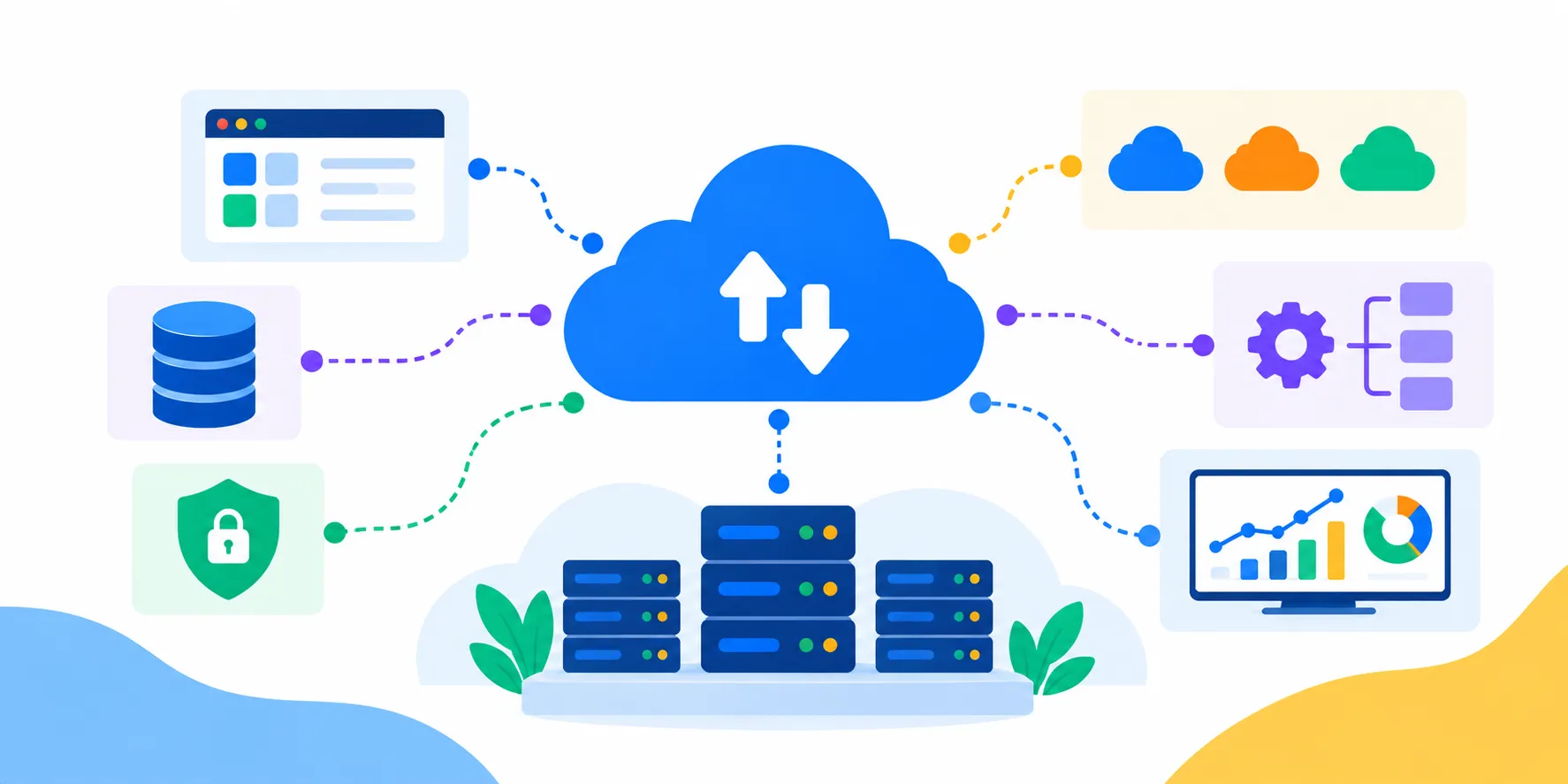
Cloud Services That Go Beyond Moving Servers
Cloud adoption is not simply a hosting decision. The right cloud architecture should make software easier to release, scale, monitor, secure, recover, and operate while keeping infrastructure costs connected to business value.
Our cloud services cover strategy, architecture, infrastructure design, migration, modernization, DevOps automation, security, observability, disaster recovery, cost optimization, and ongoing cloud operations. We work with AWS, Microsoft Azure, Google Cloud, and hybrid environments based on the workload rather than forcing every business into the same platform.
For a new product, that can mean designing a cloud-native foundation from the beginning. For an existing system, it may mean modernizing workloads gradually, removing infrastructure bottlenecks, improving deployment automation, or moving selected systems from on-premises environments into the cloud.
Who We Help
Cloud Services for Different Business Stages
We adapt cloud architecture and operations to the workload, team maturity, compliance needs, and growth expectations of each business.
- ✓Startups & SaaS CompaniesBuild production-ready cloud foundations that support fast releases, secure customer data, scalable application architecture, and predictable operations.
- ✓Growing Digital BusinessesModernize infrastructure, automate deployment, improve observability, and prepare applications for increasing traffic and usage.
- ✓EnterprisesPlan migrations, hybrid environments, governance, security, identity, resilience, and cloud operating models across complex estates.
- ✓Product TeamsGive engineering teams reusable infrastructure, environments, CI/CD, monitoring, and cloud patterns without slowing product delivery.
- ✓Data & AI TeamsCreate cloud foundations for data platforms, analytics, machine learning, generative AI, and high-volume processing workloads.
- ✓Teams Leaving Legacy InfrastructureAssess legacy workloads and choose what to rehost, replatform, refactor, retire, or retain based on business value and technical risk.
Cloud Computing Services
Cloud Services We Offer
From cloud strategy to day-to-day operations, our cloud services cover the lifecycle around your applications, data, infrastructure, and engineering teams.
Cloud Consulting & Strategy
Assess workloads, define cloud goals, compare platforms, prioritize initiatives, and create a practical cloud roadmap.
Cloud Architecture & Design
Design secure, scalable, observable architectures for applications, APIs, data platforms, SaaS products, and enterprise workloads.
Cloud Migration Services
Plan and execute workload migrations using rehost, replatform, refactor, rebuild, retire, or retain strategies where appropriate.
Cloud Modernization Services
Modernize legacy applications and infrastructure with containers, managed services, serverless patterns, automation, and cloud-native architecture.
Cloud Infrastructure Services
Build networking, compute, storage, identity, environments, load balancing, backups, and foundational infrastructure.
Managed Cloud Services
Monitor, maintain, secure, optimize, troubleshoot, and continuously improve production cloud environments.
Cloud DevOps & Automation
Implement CI/CD, infrastructure as code, automated environments, release workflows, deployment controls, and operational automation.
Cloud Security Services
Strengthen identity, access, network controls, secrets, logging, vulnerability management, and security posture.
Cloud Cost Optimization
Improve visibility, rightsizing, resource utilization, tagging, budgets, storage, and workload economics through FinOps practices.
Cloud Disaster Recovery & Backup
Design recovery strategies, backup policies, replication, recovery objectives, and tested restoration procedures.
Cloud Observability & Monitoring
Build metrics, logs, traces, alerts, dashboards, health checks, and incident visibility across infrastructure and applications.
Hybrid & Multi-Cloud Services
Connect and govern workloads across cloud providers, private infrastructure, and on-premises systems when the architecture requires it.
Cloud Kubernetes & Containers
Containerize applications and design managed Kubernetes or container platforms where orchestration provides clear operational value.
Cloud Maintenance & Support
Provide ongoing improvements, incident support, upgrades, security maintenance, capacity planning, and infrastructure optimization.
Cloud Platforms
AWS, Azure, and Google Cloud Services
We choose the platform around your application, data, identity, team skills, regulatory requirements, and long-term operating model.
AWS Cloud Services
Design and operate AWS environments across compute, storage, databases, networking, containers, serverless, security, monitoring, and automation.
Microsoft Azure Services
Build Azure environments for applications, APIs, databases, identity, networking, hybrid workloads, DevOps, and enterprise integrations.
Google Cloud Services
Use Google Cloud for application workloads, data platforms, analytics, Kubernetes, AI/ML, storage, networking, and managed services.
Hybrid Cloud
Connect cloud and on-premises environments when legacy systems, data residency, latency, or operational requirements make hybrid architecture appropriate.
Multi-Cloud
Manage workloads across multiple providers when there is a clear business, technical, resilience, or platform-specific reason to do so.
Cloud-Agnostic Architecture
Use portable architecture patterns where they improve flexibility without introducing unnecessary complexity or cost.
Cloud Architecture Designed Around Your Workloads
Cloud architecture should reflect how an application is used, released, scaled, secured, and recovered. A simple internal application may need a very different architecture from a multi-tenant SaaS platform, real-time system, data pipeline, or AI workload.
We design boundaries between applications, APIs, databases, queues, storage, networking, identity, observability, and infrastructure automation. Where managed cloud services reduce operational burden, we use them. Where a workload needs more control, we design the appropriate infrastructure boundaries.
The goal is a cloud environment that is understandable and maintainable by the engineering team—not an unnecessarily complex diagram full of services that provide little business value.
Migration Strategy
Cloud Migration Without a One-Size-Fits-All Approach
Every workload should have its own migration path based on business criticality, technical debt, dependencies, downtime tolerance, and expected return.
Rehost
Move workloads with limited changes when speed and continuity matter more than immediate modernization.
Replatform
Move to managed cloud services with targeted changes that reduce operational overhead without a complete rebuild.
Refactor
Change application architecture to take advantage of cloud-native patterns, scalability, resilience, and managed services.
Rebuild
Replace systems where legacy constraints make incremental migration less valuable than a new architecture.
Retain
Keep workloads where migration is not currently justified by cost, risk, dependencies, or business priorities.
Retire
Remove redundant systems and workloads instead of paying to migrate infrastructure the business no longer needs.
Infrastructure Foundation
Cloud Infrastructure Services
Build repeatable environments that give application teams a dependable foundation for development and production.
- ✓NetworkingDesign VPC/VNet structures, subnets, routing, load balancing, private connectivity, gateways, and network segmentation.
- ✓ComputeSelect and configure virtual machines, managed compute, containers, serverless workloads, and autoscaling patterns.
- ✓StorageDesign object, block, file, and archival storage around performance, availability, lifecycle, and cost requirements.
- ✓Managed DatabasesUse managed relational, NoSQL, cache, and database services where they improve reliability and reduce operational work.
- ✓Identity & AccessImplement least-privilege access, service identities, roles, policies, secrets, and environment separation.
- ✓Environment ManagementCreate consistent development, staging, and production environments with repeatable infrastructure and controlled changes.
Automation
Cloud DevOps and Infrastructure Automation
Cloud infrastructure becomes easier to operate when environments and releases are repeatable instead of manually configured.
Infrastructure as Code
Define infrastructure through version-controlled configuration so environments can be reviewed, reproduced, and changed consistently.
CI/CD Pipelines
Automate build, test, security checks, deployment, approvals, rollback, and release workflows.
Environment Automation
Create repeatable development, testing, staging, and production environments without manual configuration drift.
Containerization
Package applications consistently and use containers where portability, isolation, or deployment flexibility provides value.
Kubernetes
Design and operate Kubernetes environments when workload complexity and scale justify orchestration.
Release Automation
Make releases safer through deployment strategies, health checks, approvals, rollback paths, and controlled change management.
Security by Design
Cloud Security and Governance
Security controls should be part of cloud architecture and operations rather than added after infrastructure is already in production.
- ✓Identity & Least PrivilegeReduce unnecessary access through role design, service identities, permission boundaries, and environment separation.
- ✓Network SecurityUse segmentation, private networking, firewalls, security groups, gateways, and controlled ingress and egress.
- ✓Secrets ManagementProtect API keys, credentials, certificates, and sensitive configuration using appropriate managed secret stores.
- ✓Logging & AuditCapture useful security and operational events to support investigation, governance, and troubleshooting.
- ✓Vulnerability ManagementIdentify outdated components, exposed services, risky configurations, and infrastructure vulnerabilities.
- ✓GovernanceCreate tagging, ownership, environment, access, backup, and change policies that keep cloud usage manageable.
Cloud Economics
Cloud Cost Optimization and FinOps
Cloud cost optimization is an ongoing operating discipline, not a one-time cleanup of the monthly bill.
Cost Visibility
Organize spend by application, environment, team, project, service, or business owner so costs have context.
Rightsizing
Identify oversized or underused resources and adjust capacity around actual workload patterns.
Idle Resource Cleanup
Find unused compute, storage, snapshots, addresses, environments, and other resources that create unnecessary spend.
Budgets & Alerts
Set practical budgets and alerts so teams see unusual spend before it becomes a month-end surprise.
Architecture Efficiency
Review workload design, managed services, storage, caching, scaling, and data transfer choices for cost efficiency.
Continuous Optimization
Track changes in usage and pricing and revisit cloud economics as workloads evolve.
Operations
Cloud Monitoring, Observability, and Reliability
Production cloud environments need visibility into infrastructure health, application behavior, performance, and failures.
Infrastructure Monitoring
Track compute, storage, databases, networking, containers, queues, and other infrastructure signals.
Application Monitoring
Monitor application health, errors, latency, throughput, availability, and key service indicators.
Centralized Logging
Bring useful logs together for troubleshooting, security investigation, and operational analysis.
Distributed Tracing
Trace requests across APIs, services, queues, and databases to find latency and failure points.
Alerting
Create actionable alerts around service health, capacity, failures, security signals, and business-critical conditions.
Incident Readiness
Define escalation, runbooks, health checks, recovery actions, and post-incident improvement workflows.
Backup, Disaster Recovery, and Business Continuity
Cloud availability does not automatically equal business continuity. A resilient environment needs recovery objectives, backup policies, dependency mapping, restoration procedures, and testing.
We design backup and disaster recovery strategies around recovery point objectives, recovery time objectives, data criticality, application dependencies, regional requirements, and acceptable business disruption. Depending on the workload, this can include automated backups, replication, multi-zone architecture, cross-region recovery, immutable storage, or documented manual recovery procedures.
Most importantly, recovery should be tested. A backup that has never been restored should not be treated as proof that the business can recover.
Cloud Modernization for Legacy Applications
Moving an old application to a cloud server without addressing its architecture may change the hosting location without solving the underlying operational problems. Cloud modernization looks at the application, infrastructure, data, deployment process, and dependencies together.
We identify modernization opportunities such as containerization, managed databases, API boundaries, asynchronous processing, caching, autoscaling, infrastructure as code, automated delivery, improved observability, and managed cloud services.
The modernization path can be incremental. Critical systems can continue operating while selected components are improved, reducing the risk of a disruptive rewrite.
What We Help You Achieve
Cloud Services Use Cases
Cloud architecture should solve a concrete business or engineering problem.
Launch a New SaaS Product
Create secure, scalable cloud infrastructure for a new SaaS application with automated deployments and production visibility.
Scale an Existing Application
Improve capacity, autoscaling, caching, databases, queues, and architecture as traffic and usage grow.
Move from On-Premises to Cloud
Assess dependencies, prioritize workloads, plan migration waves, and reduce migration risk.
Reduce Cloud Spend
Identify inefficient resources and architecture patterns and establish ongoing cost visibility and optimization.
Improve Deployment Speed
Automate infrastructure and CI/CD so teams can release more consistently with less manual intervention.
Strengthen Reliability
Improve monitoring, backups, recovery, scaling, redundancy, incident response, and operational readiness.
Prepare for AI & Data Workloads
Build cloud foundations for analytics, machine learning, generative AI, data engineering, and high-volume processing.
Operate a Growing Cloud Estate
Add monitoring, governance, security, optimization, maintenance, and ongoing cloud engineering capacity.
Industry Cloud Needs
Cloud Services Across Industries
Architecture and governance should reflect the workload and operating model of each industry.
SaaS & Technology
Multi-tenant applications, APIs, data platforms, CI/CD, observability, scaling, and cloud-native infrastructure.
E-commerce & Retail
Traffic scaling, commerce APIs, payments, catalogs, customer data, analytics, caching, and resilient checkout flows.
Manufacturing
ERP-connected systems, operations, IoT data, analytics, integration, hybrid infrastructure, and resilient applications.
Logistics
Real-time tracking, fleet systems, APIs, event processing, operational dashboards, and scalable cloud infrastructure.
Healthcare
Secure applications, data protection, controlled access, integration, availability, and auditable cloud operations.
Financial Services
Security, resilience, auditability, data controls, integration, monitoring, and carefully governed cloud adoption.
Professional Services
Client portals, business applications, collaboration systems, reporting, integrations, and scalable infrastructure.
Education
Digital learning platforms, portals, content delivery, analytics, integrations, and scalable application infrastructure.
Our Cloud Services Delivery Process
We move from business requirements to architecture, implementation, migration, security, validation, and ongoing operations.
Cloud Discovery
Understand business goals, applications, infrastructure, users, data, dependencies, operational pain points, and constraints.
Workload Assessment
Inventory workloads, dependencies, performance needs, security requirements, availability expectations, and migration readiness.
Cloud Strategy
Choose appropriate cloud platforms, migration priorities, operating model, architecture direction, and investment priorities.
Architecture Design
Design networking, compute, storage, databases, identity, security, observability, backup, scaling, and application boundaries.
Migration & Modernization Plan
Select rehost, replatform, refactor, rebuild, retain, or retire paths and organize work into manageable waves.
Infrastructure Foundation
Build environments, networking, access, foundational services, infrastructure as code, and deployment controls.
Application & Data Migration
Move workloads, data, integrations, and dependencies while validating performance, availability, and business workflows.
Automation & DevOps
Implement CI/CD, automated environments, release workflows, infrastructure automation, and operational controls.
Security & Reliability Validation
Test permissions, network controls, backups, recovery, monitoring, alerts, performance, and failure scenarios.
Production Cutover
Execute the production transition with checkpoints, rollback planning, monitoring, and stakeholder communication.
Optimization
Review performance, utilization, cloud spend, reliability, security posture, and operational workflows after launch.
Managed Cloud Improvement
Continue monitoring, maintenance, modernization, cost optimization, security improvements, and capacity planning as the environment evolves.
Cloud Technology Stack
We select cloud services and tools based on workload requirements rather than forcing a fixed stack.
Flexible Delivery
Cloud Services Engagement Models
Choose the level of cloud support that fits your current infrastructure and internal engineering capacity.
Cloud Assessment & Strategy
A focused assessment of your current environment, architecture, risks, costs, and modernization opportunities.
Cloud Migration Project
A defined migration engagement covering planning, infrastructure, workload movement, validation, and cutover.
Cloud Engineering Team
Add cloud, DevOps, infrastructure, security, and reliability capacity around your existing product team.
Managed Cloud Operations
Ongoing monitoring, maintenance, security, optimization, incident support, and infrastructure improvement.
When Cloud Services Are the Right Investment
Cloud services are valuable when infrastructure is becoming a constraint on product delivery, reliability, scalability, security, or cost visibility. The trigger may be rapid growth, frequent deployment problems, legacy infrastructure, rising hosting spend, operational incidents, or a planned migration.
Cloud adoption is not automatically the right answer for every workload. Some systems may be better retained temporarily, and some applications need modernization before moving. A useful cloud strategy starts with workload economics, business priorities, dependencies, security, recovery requirements, and the team's ability to operate the resulting environment.
The right objective is therefore not 'move everything to the cloud.' It is to create an infrastructure operating model that makes the business more resilient, scalable, secure, and efficient.
Why Axora Infotech
Why Businesses Choose Axora for Cloud Services
We connect cloud infrastructure with application development, data engineering, AI, APIs, and DevOps so cloud decisions support the software running on top of them.
- ✓Application-Aware Cloud EngineeringWe understand the application, APIs, databases, queues, integrations, and workflows that depend on the infrastructure.
- ✓Practical ArchitectureUse the simplest architecture that meets scalability, security, reliability, performance, and growth requirements.
- ✓Automation FirstReduce manual infrastructure work through infrastructure as code, CI/CD, repeatable environments, and operational automation.
- ✓Security & ReliabilityBuild access control, monitoring, backups, recovery, and operational safeguards into the cloud foundation.
- ✓Cost AwarenessConsider infrastructure economics alongside architecture so cloud growth does not become uncontrolled cloud spend.
- ✓Continuous ImprovementTreat cloud as an evolving engineering capability with regular optimization, modernization, and capacity planning.
Cloud Infrastructure as Part of the Product
Cloud infrastructure should support the product rather than become a separate technical island. Application architecture, data engineering, APIs, security, deployment, observability, and infrastructure decisions affect one another.
That is why our cloud services approach starts with workload behavior and business requirements. A SaaS platform may need tenant-aware architecture and autoscaling; a data platform may need high-throughput storage and processing; an AI product may need specialized compute and cost controls; an enterprise system may need hybrid connectivity and stronger governance.
By keeping these relationships visible, we can build cloud environments that are easier for engineering teams to understand, operate, and evolve.
Related Services
Services to Strengthen Your Cloud Environment

SaaS Development Company
Build, launch, modernize, and scale SaaS products with multi-tenant architecture, product-focused workflows, subscription billing, integrations, security, cloud infrastructure, and engineering foundations built for recurring software businesses.
Learn more
Data Engineering Company
Build reliable data pipelines, warehouses, lakehouses, integrations, streaming systems, and governed data platforms that turn fragmented business data into trusted foundations for analytics, reporting, automation, and AI.
Learn more
API Development Services
Build secure, scalable, and high-performance Web APIs, custom microservices integrations, and RESTful structures. Enterprise API development company delivering premium connector solutions.
Learn more
Business Intelligence Company
Turn fragmented business data into trusted KPIs, interactive dashboards, governed reporting, self-service BI, and decision systems that help leadership and teams act with confidence.
Learn moreFrom Our Blog
Cloud, Data & Engineering Insights
Frequently Asked Questions
Ready to Transform Your Business?
Get started with our intelligent digital solutions. Our team is ready to help you unlock the power of AI-driven technology.
Send us a message
Fill out the form below and we'll get back to you within 24 hours
Contact Information
Reach out to us through any of these channels