E-commerce Development Company
Build, modernize, and scale high-performance e-commerce platforms for B2C, B2B, D2C, and marketplace businesses with custom storefronts, commerce platforms, payments, catalog and inventory systems, integrations, SEO, and conversion-focused experiences.
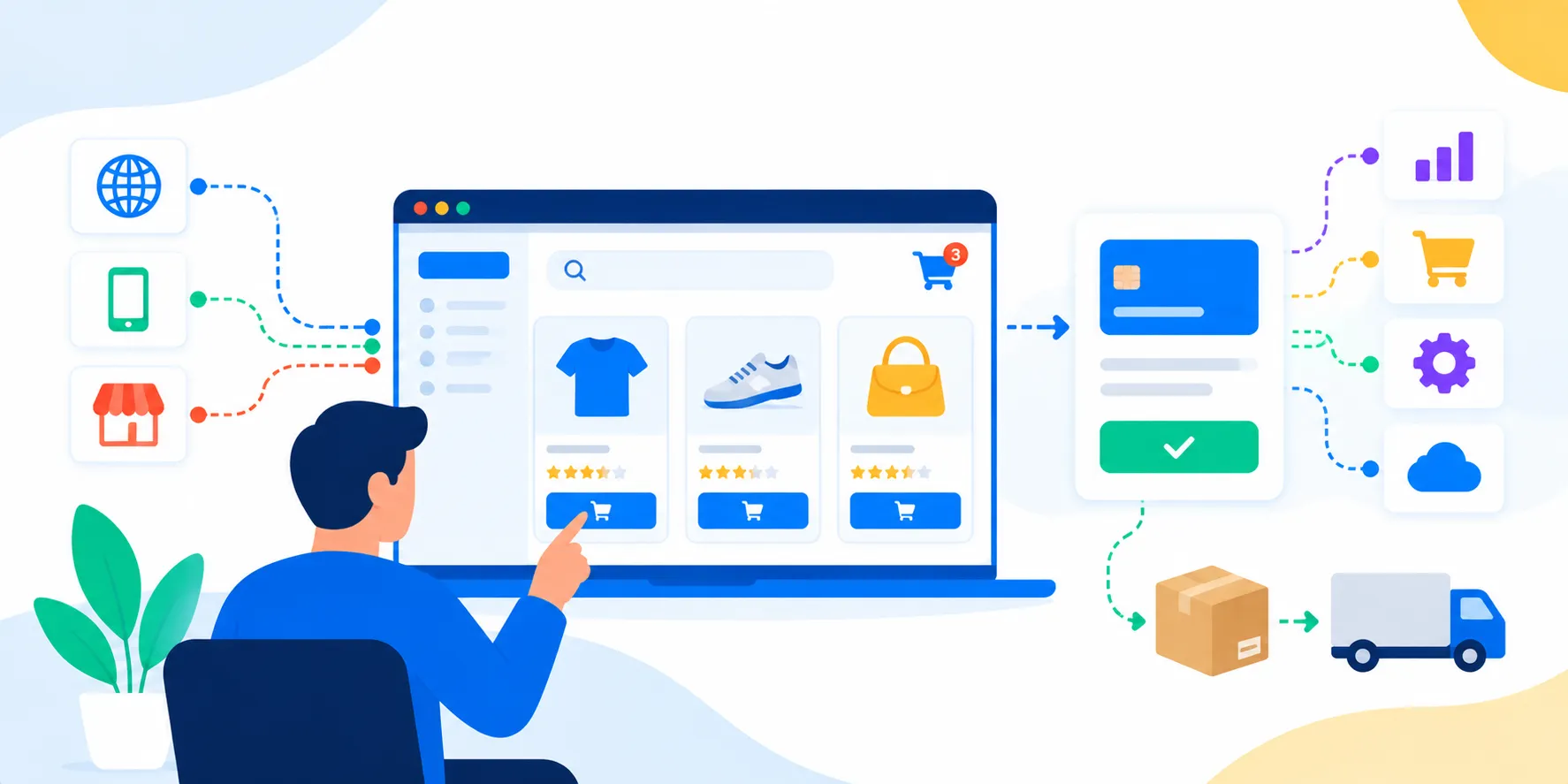
E-commerce Development Built Around How You Sell
E-commerce is not only a storefront. A reliable commerce platform connects product discovery, catalog data, pricing, cart, checkout, payments, inventory, orders, fulfillment, customer accounts, marketing, analytics, and the business systems behind them.
Our e-commerce development services are designed around the selling model first. A growing D2C brand may need a faster storefront and better checkout. A B2B distributor may need account-specific pricing, bulk ordering, credit limits, approvals, and ERP integration. A marketplace needs seller onboarding, commissions, catalog controls, and operational tooling.
We help businesses choose the lightest architecture that fits their requirements—whether that means improving Shopify or WooCommerce, building a headless storefront, replatforming to another commerce engine, or developing custom commerce software when standard platforms cannot support the business model.
Commerce Business Models
Who Our E-commerce Development Services Help
We adapt the platform, architecture, and workflows to the way each business sells.
- ✓D2C & Consumer BrandsBuild fast branded storefronts, conversion-focused checkout, subscriptions, retention flows, and connected fulfillment.
- ✓B2B & WholesaleSupport company accounts, catalogs, tiered pricing, quotes, approvals, bulk orders, credit terms, and ERP workflows.
- ✓Retail & OmnichannelConnect online commerce with stores, inventory, POS, fulfillment, customer data, and multiple sales channels.
- ✓Manufacturers & DistributorsCreate product catalogs, account pricing, dealer portals, order workflows, inventory synchronization, and integrations.
- ✓Marketplace OperatorsBuild multi-vendor commerce with seller onboarding, commissions, catalog management, payments, and operations.
- ✓Growing Commerce TeamsModernize slow storefronts, replace fragile integrations, improve conversion, or move beyond platform limitations.
End-to-End Commerce Capabilities
E-commerce Development Services We Offer
From storefronts and commerce engines to payments, integrations, migration, and ongoing optimization.
Custom E-commerce Development
Build commerce applications around unique catalog, pricing, checkout, workflow, and operational requirements.
E-commerce Consulting & Strategy
Evaluate business requirements, platform options, architecture, integrations, data, and growth priorities before implementation.
Shopify Development
Customize Shopify storefronts, themes, apps, APIs, checkout experiences, integrations, and Shopify Plus workflows.
WooCommerce Development
Build and customize WooCommerce stores, extensions, integrations, catalog workflows, and WordPress commerce experiences.
Magento / Adobe Commerce Development
Develop and customize enterprise commerce experiences for complex catalogs, B2B requirements, and integrations.
Headless Commerce Development
Decouple the storefront from the commerce engine using modern frontend and commerce APIs for flexibility and performance.
B2B E-commerce Development
Build account-specific pricing, bulk ordering, quotes, approvals, credit terms, and wholesale workflows.
Marketplace Development
Create multi-vendor platforms with seller onboarding, commissions, catalog management, payouts, and operational controls.
E-commerce API & Integration Services
Connect commerce with ERP, CRM, PIM, POS, payments, tax, shipping, marketing, and external marketplaces.
Payment Gateway Integration
Integrate regional and international payment methods, checkout flows, refunds, webhooks, reconciliation, and payment status handling.
E-commerce Migration & Replatforming
Move products, customers, orders, URLs, content, and commerce workflows while protecting SEO and minimizing business disruption.
E-commerce Performance Optimization
Improve storefront performance, Core Web Vitals, caching, image delivery, API response time, and peak-traffic readiness.
E-commerce SEO & Analytics
Build crawlable commerce architecture, structured product data, measurement, search visibility, funnels, and conversion reporting.
E-commerce Maintenance & Support
Provide monitoring, fixes, platform updates, integration maintenance, security improvements, and continuous commerce optimization.
Customer Experience
High-Performance E-commerce Storefronts
The storefront should make product discovery, comparison, purchase, and account management simple across devices.
Responsive Shopping Experiences
Create fast, accessible storefronts across mobile, tablet, desktop, and large-screen shopping journeys.
Product Discovery
Build category navigation, search, filters, recommendations, sorting, merchandising, and related-product experiences.
Product Detail Pages
Support variants, pricing, availability, media, specifications, reviews, delivery information, and buying guidance.
Cart & Mini-Cart
Design clear cart interactions with quantities, promotions, shipping estimates, recommendations, and saved items.
Account Experiences
Support profiles, addresses, order history, returns, saved products, subscriptions, and account-specific content.
Mobile Commerce
Optimize discovery, checkout, navigation, touch interactions, performance, and re-engagement for mobile customers.
Commerce Core
Catalog, Pricing & Merchandising
Catalog architecture determines how customers discover products and how teams manage the store.
Product Catalog
Model products, variants, attributes, collections, categories, bundles, digital goods, and availability.
Pricing Rules
Support standard, sale, customer-specific, tiered, regional, promotional, and contract pricing where required.
Promotions & Discounts
Implement coupons, automatic promotions, bundles, free shipping rules, and campaign-specific offers.
Faceted Search
Enable search, filters, sorting, synonyms, category rules, and relevant product discovery.
Product Information
Connect PIM or structured product data to keep descriptions, media, attributes, and specifications consistent.
Merchandising
Control product ordering, featured products, recommendations, cross-sells, upsells, and category presentation.
Revenue-Critical Workflows
Checkout, Payments & Orders
Checkout should reduce friction while reliably handling payment, tax, shipping, order creation, and customer communication.
Checkout Flows
Build guest or account checkout, addresses, shipping selection, promotions, tax, payment, and order review.
Payment Integration
Connect gateways and payment methods with secure status handling, refunds, webhooks, and reconciliation.
Tax & Duties
Integrate tax calculation and support region-specific pricing, tax, and duty requirements where needed.
Order Management
Handle order creation, status transitions, fulfillment, cancellations, returns, refunds, and operational exceptions.
Subscriptions
Support recurring products, plans, renewals, failed payments, upgrades, downgrades, and cancellations.
Abandoned Cart
Connect cart events with email, messaging, or marketing automation to recover qualified shopping journeys.
Commerce Operations
Inventory, Fulfillment & Operations
A storefront only works when product availability, inventory, fulfillment, and order operations remain synchronized.
Inventory Management
Track stock, reservations, availability, safety stock, and inventory across warehouses or channels.
Warehouse Integration
Connect warehouse and fulfillment systems for order routing, stock updates, and shipment status.
Shipping & Delivery
Integrate carriers, shipping rates, delivery zones, tracking, pickup, and fulfillment options.
Returns & Refunds
Support return requests, approvals, reverse logistics, refunds, exchanges, and operational status.
Omnichannel Inventory
Synchronize availability across web, marketplaces, stores, POS, and other selling channels.
Order Reconciliation
Compare orders, payments, inventory, fulfillment, refunds, and external-system status to surface discrepancies.
Connected Commerce
E-commerce Integrations
Commerce platforms rarely operate alone. We connect the systems required to run the business.
ERP Integration
Connect orders, inventory, products, customers, pricing, invoices, and fulfillment with ERP systems.
CRM Integration
Synchronize customers, leads, purchases, support context, and lifecycle information with CRM systems.
PIM & CMS Integration
Connect product information and content systems to keep commerce experiences manageable at scale.
Payment & Finance
Integrate payment gateways, accounting systems, reconciliation, refunds, and transaction workflows.
Shipping & Logistics
Connect carriers, 3PLs, warehouse systems, delivery tracking, and shipping-rate services.
Marketing & Analytics
Connect analytics, advertising, email, customer engagement, loyalty, personalization, and attribution systems.
Architecture Options
Headless & Composable Commerce
Headless commerce can be valuable when the storefront, content, commerce engine, and channels need to evolve independently.
Headless Storefronts
Build React or Next.js storefronts over Shopify, BigCommerce, Magento, Medusa, or custom commerce APIs.
Composable Architecture
Choose commerce capabilities such as catalog, search, CMS, payments, and pricing based on business requirements.
API-First Commerce
Use APIs to connect web, mobile, marketplaces, POS, and other customer touchpoints to shared commerce capabilities.
Performance Engineering
Use caching, CDN delivery, optimized rendering, image handling, and efficient APIs for demanding storefronts.
Multi-Channel Experiences
Reuse commerce capabilities across web, mobile apps, in-store experiences, and partner channels.
When Headless Is Not Needed
Keep a simpler platform architecture when standard storefront capabilities already meet business requirements.
Wholesale Commerce
B2B E-commerce Capabilities
B2B commerce requires different rules, relationships, and operational workflows than consumer shopping.
Company Accounts
Manage organizations, locations, users, roles, permissions, and account-specific purchasing access.
Account Pricing
Support customer-specific catalogs, price lists, volume pricing, contracts, and negotiated rates.
Bulk Ordering
Support large order quantities, quick order forms, CSV uploads, repeat ordering, and saved lists.
Quotes & Approvals
Create quote requests, negotiated pricing, approval chains, and purchase controls.
Credit & Terms
Integrate account credit limits, invoice terms, payment conditions, and finance workflows where required.
Dealer & Partner Portals
Provide ordering, inventory, documents, pricing, support, and account workflows for distributors and partners.
Growth Engineering
Conversion, Retention & Commerce Analytics
Commerce engineering should support the full customer lifecycle, not just the first transaction.
Conversion Funnels
Measure product discovery, add-to-cart, checkout, payment, and purchase completion to identify friction.
Personalization
Support recommendations, customer segments, contextual offers, and relevant shopping experiences where appropriate.
Loyalty & Rewards
Build points, tiers, rewards, referrals, memberships, and customer retention workflows.
Subscriptions & Reorders
Support recurring purchases, replenishment, saved carts, and repeat-order journeys.
Commerce Analytics
Track revenue, AOV, conversion, product performance, customer cohorts, retention, and channel performance.
Experimentation
Support controlled changes to landing pages, product experiences, offers, checkout, and merchandising.
Trust & Operations
E-commerce Security & Reliability
Commerce systems handle customer, payment, order, and business data, so security and resilience must be designed into the platform.
Secure Authentication
Protect customer and admin accounts with secure authentication, sessions, password controls, and optional MFA.
Role-Based Access
Separate customer, operations, merchandising, finance, support, and administrator permissions.
Payment Security
Use appropriate payment-provider flows and secure handling of payment status rather than unnecessarily storing sensitive payment data.
Data Protection
Protect customer, order, catalog, and operational data with access controls, encryption, and secure data practices.
Fraud & Abuse Controls
Integrate fraud signals, rate limits, validation, and operational review processes where appropriate.
Resilience & Recovery
Use monitoring, backups, recovery procedures, graceful failure patterns, and tested operational runbooks.
Search & Speed
E-commerce SEO & Performance
Technical commerce foundations affect discoverability, user experience, and conversion.
Technical SEO
Build crawlable category and product architecture, canonical controls, metadata, structured data, and indexation rules.
Product Structured Data
Implement relevant product, offer, availability, review, breadcrumb, and organization markup where appropriate.
Core Web Vitals
Optimize rendering, JavaScript, images, fonts, caching, APIs, and third-party scripts for real-user performance.
Commerce Search
Improve internal search relevance, filters, indexing, synonyms, and zero-result handling.
International Commerce
Support localized URLs, languages, currencies, regional catalogs, and market-specific commerce requirements.
Performance at Peak
Prepare infrastructure, caching, queues, databases, and external integrations for promotions and traffic spikes.
Platform Selection
E-commerce Platforms & Technology
The right platform depends on catalog complexity, business rules, team capability, integration depth, and growth plans.
Shopify & Shopify Plus
Use managed commerce infrastructure with custom themes, apps, APIs, and advanced enterprise workflows where appropriate.
WooCommerce
Build WordPress-native commerce experiences with custom functionality and integrations.
Magento / Adobe Commerce
Support complex catalogs, B2B workflows, multi-store operations, and enterprise integrations.
BigCommerce
Build and customize commerce experiences using hosted storefront and API capabilities.
Headless Commerce
Use Next.js or React storefronts over commerce APIs when experience, performance, or multi-channel flexibility requires it.
Custom Commerce Platforms
Build proprietary commerce software when pricing, product configuration, workflows, or operations cannot be supported well by standard platforms.
Common Commerce Goals
E-commerce Development Use Cases
We build around measurable business and operational needs.
Launch a New Online Store
Design and develop a production-ready storefront, catalog, checkout, payments, and operational foundation.
Modernize a Slow Store
Improve storefront architecture, performance, integrations, search, checkout, and reliability.
Build a B2B Portal
Create account-based pricing, bulk ordering, approvals, quotes, credit workflows, and ERP integration.
Create a Marketplace
Build vendor onboarding, catalog, commissions, payouts, buyer journeys, and marketplace operations.
Go Headless
Separate the customer experience from the commerce backend for greater frontend flexibility and performance.
Connect Commerce Systems
Synchronize ERP, CRM, PIM, inventory, shipping, payments, marketing, and analytics.
Replatform an Existing Store
Migrate commerce data and workflows while protecting SEO, customers, orders, and business continuity.
Scale for Peak Demand
Prepare storefronts, infrastructure, databases, search, payments, and integrations for traffic and order spikes.
Commerce Context
E-commerce Across Industries
Commerce architecture changes with product type, regulation, fulfillment, purchasing behavior, and operational complexity.
Retail & D2C
Build branded shopping journeys, promotions, loyalty, subscriptions, fulfillment, and omnichannel experiences.
Manufacturing
Support product catalogs, dealer ordering, configuration, account pricing, inventory, and ERP-connected commerce.
Wholesale & Distribution
Enable bulk ordering, customer-specific pricing, credit terms, approvals, and fulfillment workflows.
Fashion & Apparel
Support variants, collections, merchandising, size/color options, visual discovery, promotions, and returns.
Food & Grocery
Build catalogs, delivery zones, recurring orders, inventory, fulfillment, and time-sensitive availability.
Consumer Electronics
Support complex specifications, comparisons, warranty information, accessories, inventory, and promotions.
Healthcare & Pharmacy
Build commerce workflows with appropriate access, catalog, fulfillment, and compliance considerations.
Professional & Digital Products
Support bookings, subscriptions, downloads, memberships, digital delivery, and account-based commerce.
Our E-commerce Development Process
We move from commercial requirements to a tested commerce platform with controlled releases and measurable outcomes.
Commerce Discovery
Understand customers, products, channels, markets, commercial goals, constraints, and operational pain points.
Business Model Mapping
Map B2C, B2B, D2C, marketplace, subscription, pricing, fulfillment, and account workflows.
Platform & Architecture Selection
Choose the lightest platform or custom architecture that can support current needs and realistic growth.
Catalog & Data Modeling
Define products, variants, categories, pricing, inventory, customers, orders, and related data relationships.
UX & Shopping Journey Design
Design discovery, product pages, cart, checkout, account, search, and post-purchase experiences.
Storefront & Commerce Development
Build storefront, commerce logic, administration, catalog, cart, checkout, and required business workflows.
Payments & Integration Development
Connect payments, ERP, CRM, PIM, shipping, tax, marketing, analytics, and other required systems.
Search, SEO & Performance Engineering
Optimize rendering, caching, images, APIs, structured data, URLs, search, and Core Web Vitals.
Security & Quality Testing
Validate functional behavior, security, accessibility, integrations, checkout, performance, and edge cases.
Data Migration & Validation
Migrate and reconcile products, customers, orders, URLs, content, and other required commerce data.
Launch & Operational Handover
Deploy with monitoring, rollback planning, analytics, training, documentation, and operational ownership.
Optimization & Continuous Improvement
Use real commerce data and customer behavior to improve conversion, performance, merchandising, retention, and reliability.
E-commerce Technology Stack
Technology choices depend on the commerce model, platform, integration landscape, and product requirements.
Flexible Delivery
E-commerce Engagement Models
Choose the engagement that matches the stage and complexity of your commerce platform.
E-commerce Assessment
Review platform, catalog, checkout, integrations, SEO, performance, security, and operational maturity.
New Commerce Build
Design and build a new storefront or commerce platform from discovery through launch.
Dedicated E-commerce Team
Add frontend, backend, integration, QA, and commerce engineering capacity to your team.
Modernization & Replatforming
Improve or migrate an existing store while protecting customers, orders, SEO, and business continuity.
When Custom E-commerce Development Makes Sense
A managed platform is often the right choice when standard catalog, checkout, payments, and administration features meet the business model. Custom development becomes more valuable when pricing, product configuration, account rules, fulfillment, integrations, or customer journeys are central to the competitive advantage.
The decision should consider total cost of ownership, internal team capability, integration complexity, expected traffic, catalog size, business rules, international markets, and how much control the business needs over the customer and operational experience.
We help businesses avoid both extremes: overbuilding a simple store and forcing a complex commerce operation into a platform that cannot support its core requirements cleanly.
Commerce Engineering Approach
Why Businesses Choose Axora for E-commerce Development
We connect storefront engineering with the APIs, data, integrations, cloud infrastructure, and business workflows that make commerce work.
- ✓Business-Model FirstWe start with how you sell, price, fulfill, and serve customers before choosing the technical architecture.
- ✓Platform-Agnostic ThinkingWe can improve an existing platform or build custom components where standard capabilities no longer fit.
- ✓Integration-AwareERP, CRM, inventory, payments, shipping, PIM, and marketing systems are treated as part of the commerce platform.
- ✓Performance FocusStorefront performance, API efficiency, caching, search, images, and peak traffic are considered from the beginning.
- ✓SEO-Conscious BuildsCommerce URLs, metadata, structured data, indexation, migrations, and Core Web Vitals are part of engineering decisions.
- ✓Product Engineering DepthOur work can extend beyond the store into APIs, mobile experiences, SaaS platforms, AI features, and internal business systems.
E-commerce Engineering That Connects the Store to the Business
A commerce platform succeeds when the customer experience and the operational system behind it agree. Product availability should reflect inventory, orders should reach fulfillment, payments should reconcile, customer information should remain useful across channels, and teams should have visibility into what is happening.
Our approach treats the storefront as one part of a larger commerce system. That makes the engineering work useful beyond launch: integrations remain maintainable, operational workflows stay visible, and the platform can evolve as the business grows.
The goal is not simply to launch another online store. It is to build commerce infrastructure that supports revenue, customer experience, and day-to-day operations.
Related Services
Services to Support Your E-commerce Platform

Digital Commerce & Marketplaces
Headless commerce, personalization, and marketplace engines that drive conversion and lifetime value.
Learn more
Web Application Development Company
Build secure, scalable web applications around your workflows, users, data, and growth plans—from customer portals and internal business apps to SaaS platforms, dashboards, marketplaces, and enterprise web systems.
Learn more
API Development Services
Build secure, scalable, and high-performance Web APIs, custom microservices integrations, and RESTful structures. Enterprise API development company delivering premium connector solutions.
Learn more
Mobile App Development
iOS and Android apps with offline-first, real-time sync, delightful UX, and analytics to grow activation and retention.
Learn moreFrom Our Blog
E-commerce & Commerce Insights
Frequently Asked Questions
Ready to Transform Your Business?
Get started with our intelligent digital solutions. Our team is ready to help you unlock the power of AI-driven technology.
Send us a message
Fill out the form below and we'll get back to you within 24 hours
Contact Information
Reach out to us through any of these channels