DevOps Services Company
Build faster, safer, and more reliable software delivery with DevOps services covering CI/CD automation, infrastructure as code, containers, Kubernetes, cloud operations, DevSecOps, observability, SRE, and continuous optimization.
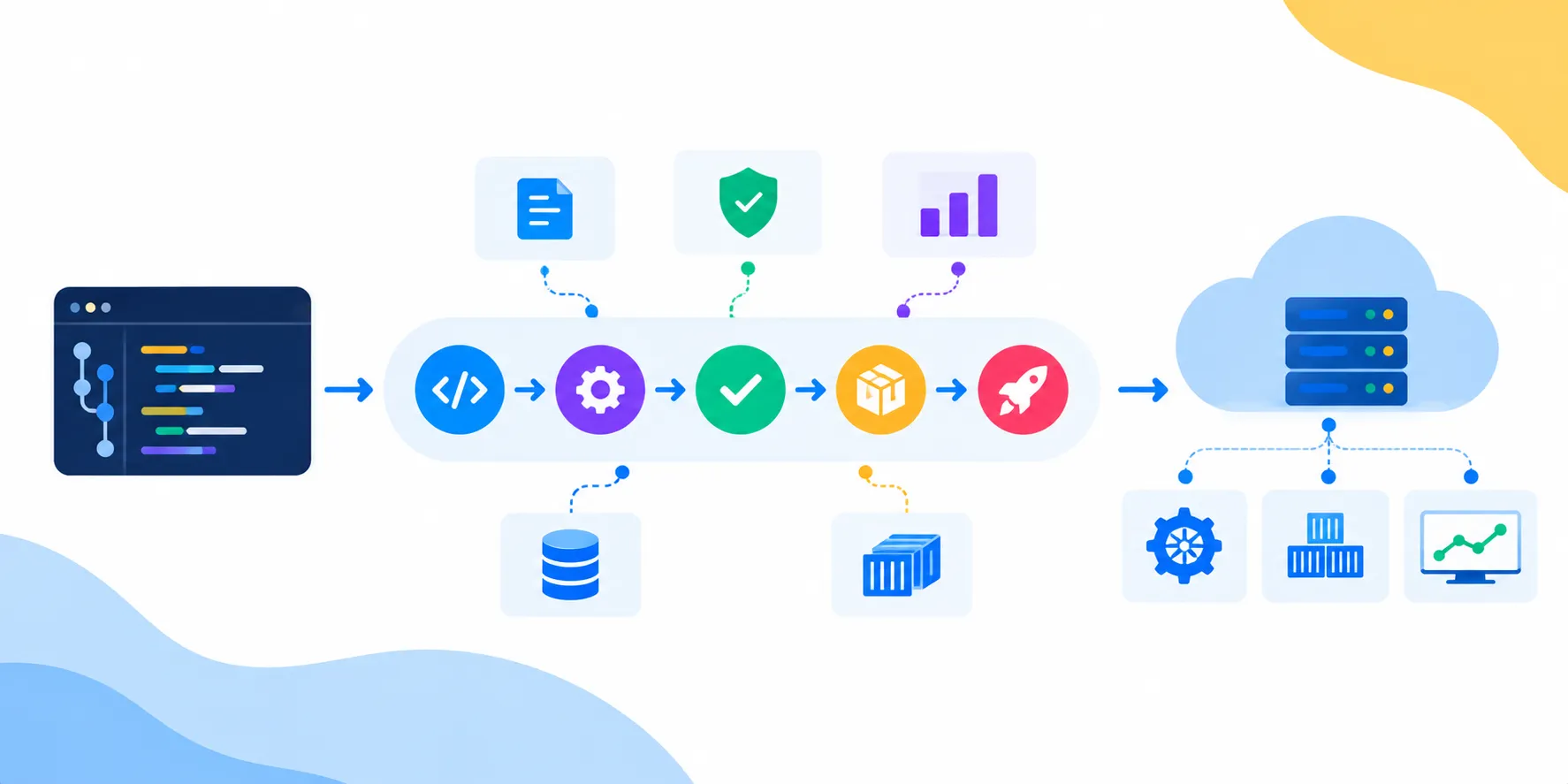
DevOps Is the Engineering System Behind Reliable Delivery
DevOps connects software development with the infrastructure, automation, security, testing, monitoring, and operational practices required to run software in production. The goal is not simply to add more tools. It is to create a delivery system that makes releases repeatable, environments consistent, failures visible, and recovery predictable.
Our DevOps services help teams remove manual deployment steps, reduce configuration drift, shorten feedback loops, improve release confidence, and establish better visibility into production systems.
We work across application engineering and cloud operations so the delivery platform reflects how your software actually runs. That can mean building a first CI/CD pipeline, modernizing legacy infrastructure, introducing containers, establishing Kubernetes, implementing infrastructure as code, improving observability, or providing an ongoing DevOps engineering team.
Business & Engineering Needs
Who Our DevOps Services Help
DevOps priorities differ depending on product maturity, infrastructure complexity, release frequency, and internal engineering capability
- ✓Growing SaaS TeamsCreate reliable CI/CD, environments, observability, and cloud foundations before infrastructure complexity slows product delivery.
- ✓Enterprise Engineering TeamsStandardize delivery across applications, teams, environments, cloud accounts, security controls, and operational processes.
- ✓Legacy Application OwnersModernize deployment processes and infrastructure without requiring a complete application rewrite.
- ✓Cloud-Native ProductsBuild container, Kubernetes, GitOps, autoscaling, observability, and platform engineering foundations.
- ✓Teams With Manual ReleasesReplace SSH-based, ticket-heavy, or error-prone deployment processes with automated and auditable delivery.
- ✓Companies Without Platform CapacityAdd an experienced DevOps engineering team for infrastructure, pipelines, reliability, security, and ongoing operations.
End-to-End DevOps Capabilities
DevOps Services We Offer
Our DevOps services cover the delivery pipeline, infrastructure, security, reliability, and operational layer around modern software products
DevOps Consulting & Strategy
Assess delivery workflows, infrastructure, reliability, security, and team practices to create a prioritized DevOps roadmap.
CI/CD Pipeline Development
Automate build, test, artifact management, environment promotion, deployment, approvals, and rollback workflows.
Infrastructure as Code
Provision repeatable cloud and infrastructure environments with version-controlled Terraform, CloudFormation, Bicep, or similar tooling.
Cloud DevOps Services
Automate and operate AWS, Azure, and Google Cloud environments with secure, repeatable infrastructure and delivery workflows.
Docker & Containerization
Containerize applications and standardize build, configuration, deployment, networking, and runtime behavior.
Kubernetes Consulting & Engineering
Design, deploy, secure, scale, monitor, and operate Kubernetes platforms when orchestration complexity is justified.
DevSecOps Services
Integrate security scanning, secrets management, dependency checks, policy gates, and security controls into delivery pipelines.
Monitoring & Observability
Implement metrics, logs, traces, dashboards, alerts, health checks, and actionable production visibility.
SRE & Reliability Engineering
Improve reliability with SLOs, SLIs, error budgets, incident practices, capacity planning, and recovery engineering.
GitOps & Continuous Delivery
Manage application and infrastructure delivery through declarative, version-controlled workflows and controlled promotions.
Cloud Cost Optimization
Improve cloud economics through rightsizing, autoscaling, resource governance, storage optimization, and FinOps practices.
DevOps Managed Services
Provide ongoing cloud, infrastructure, pipeline, monitoring, maintenance, and incident-response support.
DevOps Modernization
Replace fragile deployment and infrastructure patterns with automated, observable, secure, and maintainable operating models.
Platform Engineering
Create reusable internal platforms, environment templates, deployment patterns, developer workflows, and self-service infrastructure.
Continuous Integration & Delivery
CI/CD Pipeline Automation
A good CI/CD pipeline creates a repeatable path from source code to production with the right validation and controls at every stage
Source & Trigger Management
Connect repositories and define branch, pull-request, tag, and release triggers that match your engineering workflow.
Automated Builds
Build applications and container images consistently using repeatable pipeline environments.
Automated Testing
Run unit, integration, API, security, and quality checks before changes are promoted.
Artifact Management
Build, version, scan, store, and promote deployable artifacts across environments.
Environment Promotion
Move validated releases through development, staging, and production using controlled promotion rules.
Rollback & Recovery
Automate safe rollback paths and health checks so failed releases can be reversed quickly.
Repeatable Infrastructure
Infrastructure as Code & Environment Automation
Infrastructure as code replaces undocumented manual changes with version-controlled, reviewable infrastructure definitions
- ✓Terraform InfrastructureCreate reusable modules for cloud networking, compute, databases, storage, IAM, monitoring, and application infrastructure.
- ✓Environment ProvisioningCreate consistent development, staging, production, and temporary environments from repeatable definitions.
- ✓Configuration ManagementManage application and infrastructure configuration while reducing drift between environments.
- ✓Policy & GuardrailsApply standards for identity, networking, tagging, regions, resources, security, and operational controls.
- ✓Infrastructure ReviewsUse version control and pull-request workflows to review infrastructure changes before they reach production.
- ✓Disaster Recovery FoundationsMake infrastructure reproducible so critical environments can be rebuilt and recovery procedures can be tested.
Cloud-Native Operations
Containers & Kubernetes Engineering
Containers can standardize application packaging, while Kubernetes can provide orchestration when workload scale and operational requirements justify its complexity
Docker Containerization
Create production-ready images with consistent dependencies, configuration, security, and runtime behavior.
Kubernetes Architecture
Design namespaces, workloads, services, ingress, storage, configuration, and resource policies for Kubernetes platforms.
Managed Kubernetes
Work with managed Kubernetes services such as Amazon EKS, Azure AKS, and Google GKE.
Helm & Deployment Templates
Package and manage repeatable Kubernetes application configurations across environments.
Autoscaling & Resilience
Configure appropriate scaling, health checks, resource limits, and workload recovery behavior.
Kubernetes Operations
Support upgrades, cluster health, workloads, networking, security, monitoring, and operational troubleshooting.
Security in the Delivery Lifecycle
DevSecOps & Security Automation
Security controls are most effective when integrated into engineering workflows rather than added only before release or audit
Dependency & SCA Scanning
Identify vulnerable application dependencies and container packages as part of the delivery process.
Static Security Testing
Add code analysis and security checks to identify issues before applications reach production.
Container Security
Scan images and establish policies around trusted base images, vulnerabilities, and runtime configuration.
Secrets Management
Protect credentials, API keys, certificates, and sensitive configuration through managed secret stores and controlled access.
Identity & Least Privilege
Apply role-based access and least-privilege principles to infrastructure, pipelines, services, and cloud accounts.
Audit & Compliance Automation
Create repeatable evidence, logging, policy checks, and access controls that support security and compliance requirements.
Production Visibility
Monitoring, Logging & Observability
Observability turns production behavior into actionable information so teams can identify issues, understand impact, and recover faster
Infrastructure Monitoring
Monitor compute, memory, storage, network, database, and platform health.
Application Monitoring
Track application errors, latency, throughput, availability, and critical business workflows.
Centralized Logging
Aggregate and search logs across applications, containers, infrastructure, and cloud services.
Distributed Tracing
Trace requests across services and dependencies to identify bottlenecks and failure paths.
Alerting & Incident Signals
Create meaningful alerts based on service health and operational thresholds instead of noisy event volume.
Dashboards & SLOs
Connect dashboards to service-level objectives, error budgets, and operational decisions.
SRE Practices for Reliable Production Systems
DevOps automation improves delivery, but production reliability also requires a deliberate operating model. Site Reliability Engineering practices help teams define what reliability means, measure it, and balance feature delivery with operational risk.
We can establish service-level indicators and objectives, error budgets, incident response workflows, capacity planning, health checks, recovery procedures, and post-incident improvement practices.
The objective is not to eliminate every failure. It is to make failures observable, contained, recoverable, and useful for improving the system.
Internal Engineering Platforms
Platform Engineering & Developer Experience
For larger engineering teams, DevOps can evolve into a self-service platform that gives developers safer and faster ways to provision environments and ship applications
- ✓Self-Service EnvironmentsLet engineering teams create approved environments without repeating infrastructure setup manually.
- ✓Reusable Infrastructure ModulesProvide standardized infrastructure building blocks for common application and platform requirements.
- ✓Golden PathsCreate recommended application and deployment patterns that reduce cognitive load while preserving engineering flexibility.
- ✓Developer PortalsCentralize service ownership, deployment information, documentation, environment status, and operational links.
- ✓Policy-Based Self ServiceAllow teams to move quickly within approved security, networking, cost, and compliance boundaries.
- ✓Platform MetricsMeasure platform adoption, deployment performance, reliability, developer friction, and operational outcomes.
Cloud Platforms
Cloud DevOps Across AWS, Azure & Google Cloud
We build DevOps practices around the cloud platform and existing engineering ecosystem rather than forcing every team onto one toolchain
AWS DevOps
Automate AWS infrastructure, CI/CD, containers, networking, IAM, monitoring, and operational workflows.
Azure DevOps
Build delivery and infrastructure workflows around Azure services, Microsoft environments, identity, and enterprise requirements.
Google Cloud DevOps
Implement CI/CD, containers, infrastructure, observability, and platform workflows across Google Cloud environments.
Hybrid Cloud DevOps
Create consistent deployment and operational practices across public cloud, private infrastructure, and on-premise environments.
Multi-Cloud Operations
Standardize practices that need to remain consistent across providers while keeping provider-specific services where useful.
Cloud Governance
Apply identity, tagging, policies, budgets, security controls, and operational standards across cloud environments.
Operational Efficiency
Cloud Cost Optimization & FinOps
DevOps teams influence cloud cost through architecture, infrastructure automation, resource sizing, scaling, storage, and operational governance
Cost Baseline
Understand where cloud spend is coming from across accounts, environments, services, and workloads.
Right-Sizing
Align compute and database capacity with actual workload demand instead of copying oversized infrastructure.
Autoscaling
Scale workloads with demand while protecting performance and availability.
Idle Resource Control
Identify unused environments, unattached resources, oversized services, and unnecessary storage.
Budgets & Ownership
Use tagging, budgets, alerts, and ownership models to make cloud spending visible to teams.
Ongoing Optimization
Review usage and architecture continuously as workloads and product requirements change.
DevOps Modernization for Legacy Delivery
Many DevOps transformations start with a practical problem: deployments depend on manual server access, environments drift, infrastructure changes are undocumented, or production issues take too long to diagnose.
We modernize incrementally where possible. A typical path may introduce source-controlled infrastructure, automated builds and tests, containerization, environment standardization, deployment automation, monitoring, security checks, and controlled production releases.
This approach improves the delivery system without requiring every application to be rewritten. Modernization priorities are based on release risk, operational pain, business impact, and the constraints of the existing system.
Common Engineering Goals
DevOps Use Cases
DevOps work should connect to a measurable engineering or business problem
Faster Release Cycles
Automate repetitive delivery steps so teams can release more frequently without adding manual operational work.
Safer Production Deployments
Add automated testing, health checks, approvals, progressive delivery, and rollback paths.
Infrastructure Standardization
Replace manually configured environments with reproducible infrastructure managed through code.
Kubernetes Adoption
Build an operationally sound container platform when application scale and architecture justify orchestration.
Production Reliability
Improve monitoring, alerting, SLOs, incident response, and recovery practices.
Cloud Cost Reduction
Make infrastructure spend visible and optimize resources without compromising required reliability.
Security Automation
Integrate security controls into development and delivery instead of relying on late manual checks.
Developer Self-Service
Create approved paths for teams to provision environments and deploy applications with less operational friction.
Production Workloads
DevOps Services Across Industries
DevOps practices adapt to the reliability, compliance, data, and release requirements of each business domain
SaaS & Technology
Support frequent releases, multi-tenant infrastructure, scalable APIs, observability, and cloud-native platforms.
E-commerce
Build resilient deployment and scaling systems for commerce applications, APIs, databases, and traffic spikes.
Financial Services
Strengthen security, auditability, access controls, release governance, monitoring, and recovery.
Healthcare
Support controlled deployments, protected environments, audit trails, availability, and secure infrastructure.
Logistics
Operate real-time tracking, APIs, integrations, dashboards, and operational applications with reliable infrastructure.
Manufacturing
Support connected applications, ERP integrations, analytics, operational systems, and hybrid environments.
Professional Services
Automate delivery for business applications, portals, integrations, analytics, and client-facing systems.
Education
Operate learning platforms, content systems, portals, and analytics workloads with scalable infrastructure.
Our DevOps Delivery Process
We improve DevOps in measurable stages instead of changing every part of the engineering system at once.
Assess
Review repositories, environments, infrastructure, deployment workflows, incidents, security controls, cloud spend, and team practices.
Baseline Metrics
Capture useful measures such as deployment frequency, lead time, change failure rate, recovery time, infrastructure health, and cost.
Define Target State
Design the target delivery, infrastructure, security, observability, and operational architecture around business priorities.
Tooling Strategy
Select practical tools based on the existing stack, team skills, cloud environment, security requirements, and operating model.
Infrastructure as Code
Create repeatable infrastructure and environment definitions with version control, review, and policy controls.
CI/CD Automation
Automate build, test, artifact, deployment, environment promotion, and rollback workflows.
Security Integration
Introduce dependency, code, container, secrets, identity, and policy checks into delivery workflows.
Observability
Implement metrics, logs, traces, dashboards, alerts, health checks, and reliability signals.
Production Rollout
Release changes progressively with validation, monitoring, approvals, and recovery procedures.
Reliability Hardening
Address capacity, resilience, incident response, backup, disaster recovery, and SLO requirements.
Team Handover
Document infrastructure, pipelines, runbooks, ownership, troubleshooting, and operational procedures.
Continuous Improvement
Review delivery metrics, cloud costs, incidents, developer feedback, and architecture to prioritize the next improvements.
DevOps Technology Stack
We select tools according to the workload and existing engineering environment rather than introducing technology for its own sake.
Flexible Delivery
DevOps Engagement Models
Choose the model that fits your immediate DevOps problem and internal engineering capability
DevOps Assessment
A focused review of infrastructure, deployment, security, observability, reliability, and cloud costs with a prioritized improvement roadmap.
DevOps Implementation
A fixed-scope engagement to build CI/CD, infrastructure as code, containers, observability, security automation, or other defined capabilities.
Dedicated DevOps Team
Add DevOps, cloud, platform, and SRE engineering capacity to your product or enterprise engineering team.
Managed DevOps Services
Ongoing infrastructure, pipeline, monitoring, maintenance, incident support, optimization, and operational assistance.
When DevOps Services Make Sense
DevOps becomes a priority when engineering teams spend too much time on manual releases, infrastructure changes are difficult to reproduce, environments behave differently, production incidents are hard to diagnose, or cloud costs and operational complexity are growing faster than the team.
You do not need to adopt every DevOps tool to improve delivery. A small product may benefit most from CI/CD, infrastructure as code, monitoring, and secure deployment practices. A larger platform may need Kubernetes, GitOps, platform engineering, SRE, and multi-environment governance.
The right DevOps roadmap starts with the bottlenecks that affect delivery speed, reliability, security, cost, and developer productivity.
Why Axora Infotech
Why Businesses Choose Axora for DevOps
Our DevOps work is connected to application engineering, cloud infrastructure, APIs, data systems, and the software products those environments run
- ✓Application-Aware DevOpsWe understand the application, not just the infrastructure, so pipelines and environments match real runtime dependencies.
- ✓Automation FirstWe replace repetitive operational work with version-controlled, repeatable workflows wherever automation creates clear value.
- ✓Security ThroughoutSecurity checks, access controls, secrets, network boundaries, and auditability are considered across the delivery lifecycle.
- ✓Production VisibilityMonitoring and observability are designed around useful operational signals rather than dashboards that nobody acts on.
- ✓Practical ModernizationWe improve legacy delivery systems incrementally instead of assuming every product needs a complete infrastructure rewrite.
- ✓Handover & OwnershipDocumentation, runbooks, infrastructure code, pipeline definitions, and knowledge transfer keep your team in control.
DevOps Should Make Engineering Easier, Not More Complicated
Good DevOps creates a smoother path from code change to production. Developers should know how to validate their work, release it safely, see what happens after deployment, and recover when something goes wrong.
We focus on reducing operational friction rather than measuring transformation by the number of tools installed. The platform should be understandable, maintainable, secure, and appropriate for the team's actual maturity.
That means documenting ownership, keeping infrastructure and delivery configuration in source control, creating repeatable environments, measuring outcomes, and continuously improving the system as the product grows.
Related Services
Services to Support Your DevOps Environment

Cloud Services Company
Design, migrate, secure, optimize, and operate cloud environments across AWS, Azure, Google Cloud, and hybrid infrastructure with architecture, automation, DevOps, cost control, resilience, and managed cloud services.
Learn more
Cloud Migration Services
Move applications, databases, infrastructure, and data to AWS, Azure, or Google Cloud with workload assessment, migration planning, secure execution, tested cutovers, modernization, validation, and post-migration optimization.
Learn more
Data Engineering Company
Build reliable data pipelines, warehouses, lakehouses, integrations, streaming systems, and governed data platforms that turn fragmented business data into trusted foundations for analytics, reporting, automation, and AI.
Learn more
API Development Services
Build secure, scalable, and high-performance Web APIs, custom microservices integrations, and RESTful structures. Enterprise API development company delivering premium connector solutions.
Learn moreFrom Our Blog
DevOps & Cloud Engineering Insights
Frequently Asked Questions
Ready to Transform Your Business?
Get started with our intelligent digital solutions. Our team is ready to help you unlock the power of AI-driven technology.
Send us a message
Fill out the form below and we'll get back to you within 24 hours
Contact Information
Reach out to us through any of these channels