Cloud Infrastructure Services Company
Design, build, secure, and operate cloud infrastructure for applications, data platforms, APIs, and AI workloads with scalable architecture, infrastructure as code, networking, security, observability, high availability, and cost control.
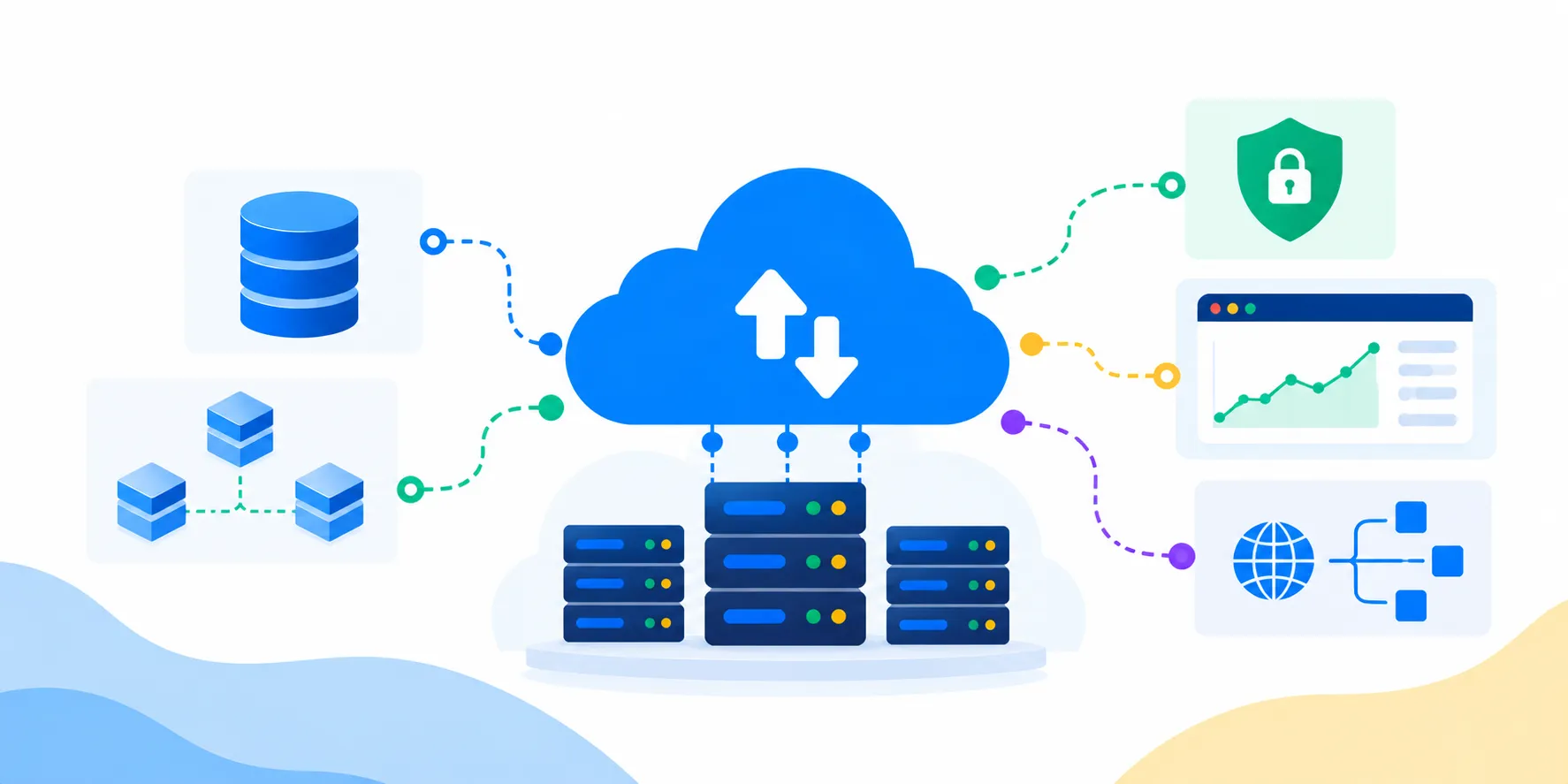
Cloud Infrastructure Is the Foundation Your Software Runs On
Cloud infrastructure is more than virtual machines and a cloud account. A production environment depends on networking, identity, compute, storage, databases, load balancing, security controls, monitoring, backup, recovery, and clear operational ownership working together.
Our cloud infrastructure services help businesses design and operate that foundation around the actual needs of their applications and teams. We can build a new cloud environment, improve an existing architecture, standardize infrastructure through code, or provide ongoing infrastructure operations.
The objective is practical: infrastructure should support product growth without becoming a source of unnecessary cost, outages, security risk, or manual operational work.
Business & Engineering Needs
Who Our Cloud Infrastructure Services Help
Cloud infrastructure requirements change with workload scale, product maturity, compliance, traffic patterns, and internal engineering capacity.
- ✓SaaS & Product CompaniesBuild reliable infrastructure for APIs, web applications, multi-tenant platforms, background jobs, and data services.
- ✓Growing BusinessesMove from ad-hoc cloud resources toward a structured, secure, observable infrastructure foundation.
- ✓Enterprise TeamsStandardize infrastructure, identity, networking, governance, environments, and operational controls.
- ✓Data & AI TeamsCreate scalable compute, storage, databases, and platform infrastructure for analytics and AI workloads.
- ✓Legacy Modernization ProgramsImprove infrastructure patterns, resilience, observability, automation, and operational ownership incrementally.
- ✓Teams Without Cloud CapacityAdd cloud infrastructure engineering and managed operations without immediately building a large internal team.
End-to-End Infrastructure Capabilities
Cloud Infrastructure Services We Offer
Our cloud infrastructure services cover architecture, compute, networking, storage, security, resilience, monitoring, cost, and ongoing operations.
Cloud Infrastructure Consulting
Assess architecture, reliability, security, capacity, cost, and operational needs to create a practical infrastructure roadmap.
Cloud Infrastructure Architecture
Design compute, networking, storage, databases, identity, availability, and recovery foundations around real workloads.
AWS Infrastructure Services
Build and operate production infrastructure across AWS compute, networking, storage, databases, IAM, and monitoring.
Azure Infrastructure Services
Design secure Azure infrastructure around compute, networking, storage, identity, governance, and enterprise requirements.
Google Cloud Infrastructure
Build Google Cloud environments for applications, APIs, analytics, data platforms, and AI workloads.
Infrastructure as Code
Manage infrastructure through version-controlled Terraform, CloudFormation, Bicep, or similar configurations.
Cloud Networking
Build secure VPC/VNet architecture, routing, gateways, load balancing, private connectivity, DNS, and network controls.
Cloud Compute & Containers
Design VM, container, serverless, and Kubernetes infrastructure around workload requirements.
Cloud Storage & Databases
Architect object storage, databases, caching, backup, and data lifecycle policies.
High Availability & Disaster Recovery
Build redundancy, backups, recovery procedures, failover architecture, and tested recovery paths.
Cloud Security & IAM
Implement identity, least privilege, network controls, secrets, encryption, policies, and audit logging.
Cloud Monitoring & Observability
Create infrastructure monitoring, logging, alerting, dashboards, health checks, and operational visibility.
Cloud Cost Optimization
Improve infrastructure economics through rightsizing, autoscaling, resource governance, storage optimization, and FinOps.
Managed Cloud Infrastructure
Provide ongoing infrastructure operations, maintenance, monitoring, patching, optimization, and technical support.
Architecture & Design
Cloud Infrastructure Architecture
We design infrastructure around workload behavior rather than choosing services first.
Compute Architecture
Select virtual machines, containers, serverless, or specialized compute based on workload requirements.
Network Architecture
Design VPCs/VNets, subnets, routing, gateways, load balancers, DNS, and private connectivity.
Data Architecture
Choose managed databases, object storage, caching, backup, replication, and lifecycle strategies.
Availability Architecture
Design redundancy, failover, health checks, and multi-zone or multi-region patterns where justified.
Identity Architecture
Structure users, roles, service identities, permissions, secrets, and least-privilege access.
Operational Architecture
Define monitoring, logging, alerting, backups, runbooks, ownership, and recovery procedures.
Secure Network Foundations
Cloud Networking & Connectivity
A reliable network design keeps workloads connected while controlling how systems communicate.
VPC & VNet Design
Create logical network boundaries and subnets for application, database, management, and supporting workloads.
Routing & Gateways
Configure routing, NAT, gateways, transit patterns, and controlled traffic paths.
Load Balancing
Distribute application traffic and support health checks, availability, and scaling.
Private Connectivity
Connect services securely through private endpoints, VPNs, dedicated connectivity, or internal networking.
DNS & Service Discovery
Manage DNS, internal service names, certificates, and service discovery.
Network Security
Use security groups, firewalls, segmentation, and controlled ingress and egress.
Application Runtime Infrastructure
Cloud Compute, Containers & Kubernetes
Choose the right runtime model for each workload instead of adding infrastructure complexity without a clear need.
Virtual Machines
Design scalable VM infrastructure for applications requiring operating-system control.
Docker Containers
Standardize application packaging and runtime dependencies through containers.
Kubernetes Infrastructure
Build managed Kubernetes environments for workloads that benefit from orchestration.
Serverless Infrastructure
Use managed serverless compute for event-driven and burst-oriented workloads where appropriate.
Autoscaling
Configure scaling based on workload demand, performance requirements, and cost objectives.
Runtime Optimization
Tune compute, resources, networking, startup behavior, and deployment patterns.
Data Foundations
Cloud Storage & Database Infrastructure
Reliable infrastructure depends on storage and database choices that match access patterns, scale, durability, and recovery.
Object Storage
Design durable storage for media, documents, backups, data lakes, exports, and application assets.
Managed Relational Databases
Architect managed PostgreSQL, MySQL, SQL Server, or compatible database environments.
NoSQL Databases
Use managed NoSQL services when flexible schema or high scale justifies them.
Caching
Introduce managed caching for sessions, frequently accessed data, queues, and performance-sensitive workloads.
Backup & Retention
Define backup frequency, retention, encryption, recovery points, and restoration procedures.
Data Lifecycle
Control storage tiers, retention, archival, deletion, and lifecycle automation.
Secure Infrastructure by Design
Cloud Security & Identity
Security is built into cloud infrastructure through identity, network boundaries, encryption, secrets, policies, and auditability.
IAM & Least Privilege
Design roles, policies, service identities, and access boundaries around minimum permissions.
Secrets Management
Store and rotate credentials, API keys, certificates, and sensitive configuration securely.
Encryption
Protect data in transit and at rest with appropriate encryption and key-management controls.
Network Segmentation
Separate public, application, management, and data paths to reduce unnecessary exposure.
Security Monitoring
Collect security events and infrastructure logs for detection, investigation, and response.
Governance & Policies
Apply resource, region, identity, tagging, configuration, and compliance policies consistently.
Repeatable Infrastructure
Infrastructure as Code & Automation
Infrastructure as code makes cloud environments reviewable, reproducible, and easier to recover.
Terraform
Build reusable modules for networks, compute, databases, storage, IAM, and monitoring.
Cloud-Native Templates
Use CloudFormation, Bicep, or provider-native deployment approaches where appropriate.
Environment Automation
Create consistent development, staging, production, and temporary environments.
Configuration Management
Reduce configuration drift through controlled infrastructure workflows.
Change Review
Use version control and pull requests to review infrastructure changes.
Automated Provisioning
Connect infrastructure definitions to delivery pipelines for consistent changes.
Resilience Engineering
High Availability, Backup & Disaster Recovery
Critical infrastructure needs defined recovery objectives, redundancy, backups, monitoring, and tested recovery paths.
Multi-Zone Architecture
Distribute critical components across availability zones where resilience requires it.
Failover Design
Create health checks and failover paths for applications, databases, and networking.
Backup Strategy
Define backup frequency, retention, encryption, ownership, and restoration testing.
Disaster Recovery
Design recovery environments and procedures around realistic business recovery objectives.
Recovery Testing
Validate backups, infrastructure definitions, dependencies, and runbooks.
Business Continuity
Connect infrastructure recovery decisions to service criticality and acceptable downtime.
Production Visibility
Cloud Monitoring & Observability
Infrastructure should make failures and capacity problems visible before they become prolonged incidents.
Infrastructure Metrics
Track compute, memory, storage, network, database, container, and service health.
Centralized Logging
Collect and search logs across applications, infrastructure, containers, and cloud services.
Alerting
Create meaningful alerts around availability, saturation, errors, latency, and capacity.
Dashboards
Create operational views for infrastructure health, dependencies, capacity, and service performance.
Distributed Tracing
Trace requests across application services and infrastructure dependencies when required.
Operational Runbooks
Document alerts, recovery actions, ownership, escalation, and troubleshooting.
Infrastructure Economics
Cloud Cost Optimization & FinOps
Cloud infrastructure should scale with business demand without allowing waste to accumulate.
Cost Visibility
Break down cloud spend by account, environment, workload, service, and ownership.
Right-Sizing
Match compute, database, and storage capacity to actual workload requirements.
Autoscaling
Scale resources according to demand while maintaining required performance.
Idle Resource Cleanup
Identify unused environments, unattached storage, oversized resources, and unnecessary services.
Budgets & Governance
Use tagging, budgets, alerts, ownership, and policy controls to make cost visible.
Continuous Optimization
Review usage, architecture, workload growth, and pricing changes regularly.
Cloud Platforms
AWS, Azure & Google Cloud Infrastructure
We work across major cloud platforms and select services according to workload requirements and existing systems.
AWS Infrastructure
Build AWS foundations across VPC, EC2, ECS, EKS, Lambda, RDS, S3, IAM, CloudWatch, and load balancing.
Azure Infrastructure
Design Azure environments using virtual networks, compute, AKS, databases, storage, identity, and monitoring.
Google Cloud Infrastructure
Build Google Cloud infrastructure for applications, APIs, analytics, data platforms, and AI workloads.
Hybrid Cloud
Connect cloud environments with on-premise infrastructure where business or compliance requires it.
Multi-Cloud
Create consistent governance and operational practices across providers when justified.
Cloud Governance
Standardize identity, regions, tagging, security, budgets, and operational policies.
Application & Platform Types
Infrastructure for Modern Workloads
Cloud infrastructure should reflect the workload it supports, from business applications to data-intensive and AI platforms.
Web Applications
Build highly available infrastructure for websites, portals, dashboards, APIs, and customer applications.
SaaS Platforms
Support multi-tenant applications with scalable compute, databases, storage, queues, and monitoring.
API & Microservices
Create runtime infrastructure with networking, discovery, scaling, deployment, and observability.
Data Platforms
Provide compute, storage, databases, pipelines, warehouses, and lake infrastructure.
AI & ML Workloads
Design infrastructure for model serving, data processing, GPU workloads, vector systems, and AI backends.
Real-Time Systems
Support messaging, WebSockets, event processing, streaming, and low-latency workloads.
Modernizing Cloud Infrastructure Without Rebuilding Everything
Infrastructure modernization does not always require moving every workload to containers or rebuilding an environment from scratch. The right approach depends on application constraints, operational pain, security requirements, and expected business value.
We can modernize incrementally by introducing infrastructure as code, improving network boundaries, upgrading runtime services, moving databases to managed offerings, containerizing selected workloads, adding observability, strengthening backup and recovery, or redesigning specific high-risk components.
The modernization roadmap prioritizes changes that reduce operational risk and improve scalability, security, reliability, or cost without creating unnecessary migration complexity.
Common Business & Engineering Goals
Cloud Infrastructure Use Cases
Cloud infrastructure projects should connect directly to reliability, scalability, security, modernization, or operational objectives.
New Product Infrastructure
Create a production-ready cloud foundation for a new application or SaaS product.
Infrastructure Standardization
Bring inconsistent cloud resources and environments under repeatable architecture and infrastructure as code.
Application Scaling
Redesign compute, databases, networking, caching, and storage as traffic grows.
High Availability
Improve resilience for workloads where downtime has meaningful business impact.
Cloud Security Hardening
Strengthen IAM, networking, encryption, secrets, policies, logging, and security monitoring.
Cloud Cost Reduction
Identify infrastructure waste and optimize sizing, scaling, storage, and environment usage.
Legacy Infrastructure Modernization
Replace fragile infrastructure patterns with managed services, automation, and observability.
Managed Infrastructure
Provide ongoing cloud operations and engineering support when internal teams need capacity.
Production Workloads
Cloud Infrastructure Across Industries
Infrastructure architecture adapts to availability, security, data, integration, and operational requirements.
SaaS & Technology
Support scalable applications, APIs, multi-tenant systems, data services, and frequent releases.
E-commerce
Build resilient commerce infrastructure for catalog, checkout, payments, APIs, databases, and traffic peaks.
Financial Services
Strengthen identity, security, auditability, availability, recovery, and infrastructure governance.
Healthcare
Support protected data, controlled access, reliable applications, audit trails, and resilient infrastructure.
Logistics
Operate tracking, APIs, integrations, dashboards, and real-time operational systems.
Manufacturing
Support connected applications, ERP integrations, analytics, operational systems, and hybrid environments.
Professional Services
Provide infrastructure for business applications, portals, integrations, analytics, and internal systems.
Education
Operate learning platforms, portals, content systems, analytics, and supporting cloud workloads.
Our Cloud Infrastructure Delivery Process
We build infrastructure in controlled stages so architecture, security, reliability, and operations are addressed before production.
Assess Workloads
Review applications, dependencies, traffic, data, availability, compliance, current infrastructure, and operational pain points.
Define Architecture
Define target infrastructure around workload requirements, scalability, availability, security, cost, and operational simplicity.
Design Network & Identity
Design network boundaries, routing, connectivity, DNS, load balancing, identity, and access controls.
Select Compute & Data Services
Choose appropriate compute, containers, serverless, databases, storage, caching, and cloud services.
Create Infrastructure as Code
Turn approved infrastructure into reusable, version-controlled definitions that can be reviewed and reproduced.
Build Environments
Create development, staging, production, and other required environments with consistent configuration.
Implement Security Controls
Implement IAM, secrets, encryption, network controls, policies, audit logging, and security guardrails.
Configure Observability
Set up metrics, logs, alerts, dashboards, health checks, and operational signals before production.
Validate Performance & Resilience
Test capacity, latency, failover, backups, recovery, scaling, and important dependencies.
Production Cutover
Move workloads into production using controlled changes, validation, monitoring, and recovery procedures.
Document & Handover
Document architecture, ownership, infrastructure code, runbooks, access, recovery, and responsibilities.
Continuously Optimize
Review reliability, utilization, security, cloud spend, performance, and growth to prioritize improvements.
Cloud Infrastructure Technology Stack
We choose cloud and infrastructure technologies based on workload requirements and the existing engineering environment.
Flexible Delivery
Cloud Infrastructure Engagement Models
Choose the engagement that matches your infrastructure problem and internal cloud capability.
Infrastructure Assessment
Review architecture, security, reliability, performance, cost, and operational maturity with a prioritized roadmap.
Infrastructure Implementation
Build a defined cloud foundation, networking architecture, infrastructure as code, or resilience capability.
Dedicated Cloud Team
Add cloud infrastructure engineers to your application, data, platform, or modernization team.
Managed Cloud Infrastructure
Provide ongoing monitoring, maintenance, optimization, security support, and operations.
When Cloud Infrastructure Services Make Sense
Cloud infrastructure services become especially valuable when a cloud environment has grown organically, applications are difficult to scale, infrastructure changes are manual, cloud costs are unclear, security controls are inconsistent, or production reliability depends on a few people who understand how everything works.
A small product may only need a clean network, managed database, secure compute, infrastructure as code, backups, and monitoring. A larger platform may need multi-account governance, Kubernetes, private networking, disaster recovery, platform engineering, and centralized observability.
The right infrastructure is the simplest architecture that reliably meets the application's business, security, performance, availability, and growth requirements.
Why Axora Infotech
Why Businesses Choose Axora for Cloud Infrastructure
Our cloud infrastructure work is connected to the applications, APIs, data systems, and product engineering teams that depend on it.
- ✓Application-Aware ArchitectureDesign infrastructure around application dependencies, traffic, data, integrations, and operational needs.
- ✓Infrastructure as CodePrioritize repeatability and controlled change so environments are easier to reproduce, review, and maintain.
- ✓Security Built InIdentity, networking, secrets, encryption, logging, and governance are considered as part of architecture.
- ✓Operational VisibilityMonitoring, alerting, backups, recovery, and runbooks are treated as production requirements.
- ✓Cost-Conscious EngineeringConsider sizing, scaling, storage, environment usage, and operational overhead alongside performance.
- ✓Practical ModernizationImprove infrastructure incrementally instead of forcing unnecessary platform rewrites.
Cloud Infrastructure Should Support the Product, Not Become the Product
Good cloud infrastructure gives engineering teams a reliable foundation without making every developer an infrastructure specialist. Environments should be understandable, changes should be reviewable, production behavior should be observable, and recovery should be planned.
We focus on clear ownership, repeatable infrastructure, appropriate managed services, secure access, useful monitoring, tested recovery, and continuous improvement.
The result is infrastructure that can evolve with the product while keeping operational complexity proportional to the business need.
Related Services
Services to Support Your Cloud Infrastructure

Cloud Services Company
Design, migrate, secure, optimize, and operate cloud environments across AWS, Azure, Google Cloud, and hybrid infrastructure with architecture, automation, DevOps, cost control, resilience, and managed cloud services.
Learn more
Cloud Migration Services
Move applications, databases, infrastructure, and data to AWS, Azure, or Google Cloud with workload assessment, migration planning, secure execution, tested cutovers, modernization, validation, and post-migration optimization.
Learn more
DevOps Services Company
Build faster, safer, and more reliable software delivery with DevOps services covering CI/CD automation, infrastructure as code, containers, Kubernetes, cloud operations, DevSecOps, observability, SRE, and continuous optimization.
Learn more
Data Engineering Company
Build reliable data pipelines, warehouses, lakehouses, integrations, streaming systems, and governed data platforms that turn fragmented business data into trusted foundations for analytics, reporting, automation, and AI.
Learn moreFrom Our Blog
Cloud & Infrastructure Insights
Frequently Asked Questions
Ready to Transform Your Business?
Get started with our intelligent digital solutions. Our team is ready to help you unlock the power of AI-driven technology.
Send us a message
Fill out the form below and we'll get back to you within 24 hours
Contact Information
Reach out to us through any of these channels