Performance Testing Services Company
Validate application speed, stability, capacity, and scalability with performance testing services covering load, stress, spike, endurance, API, database, and real-world traffic scenarios.
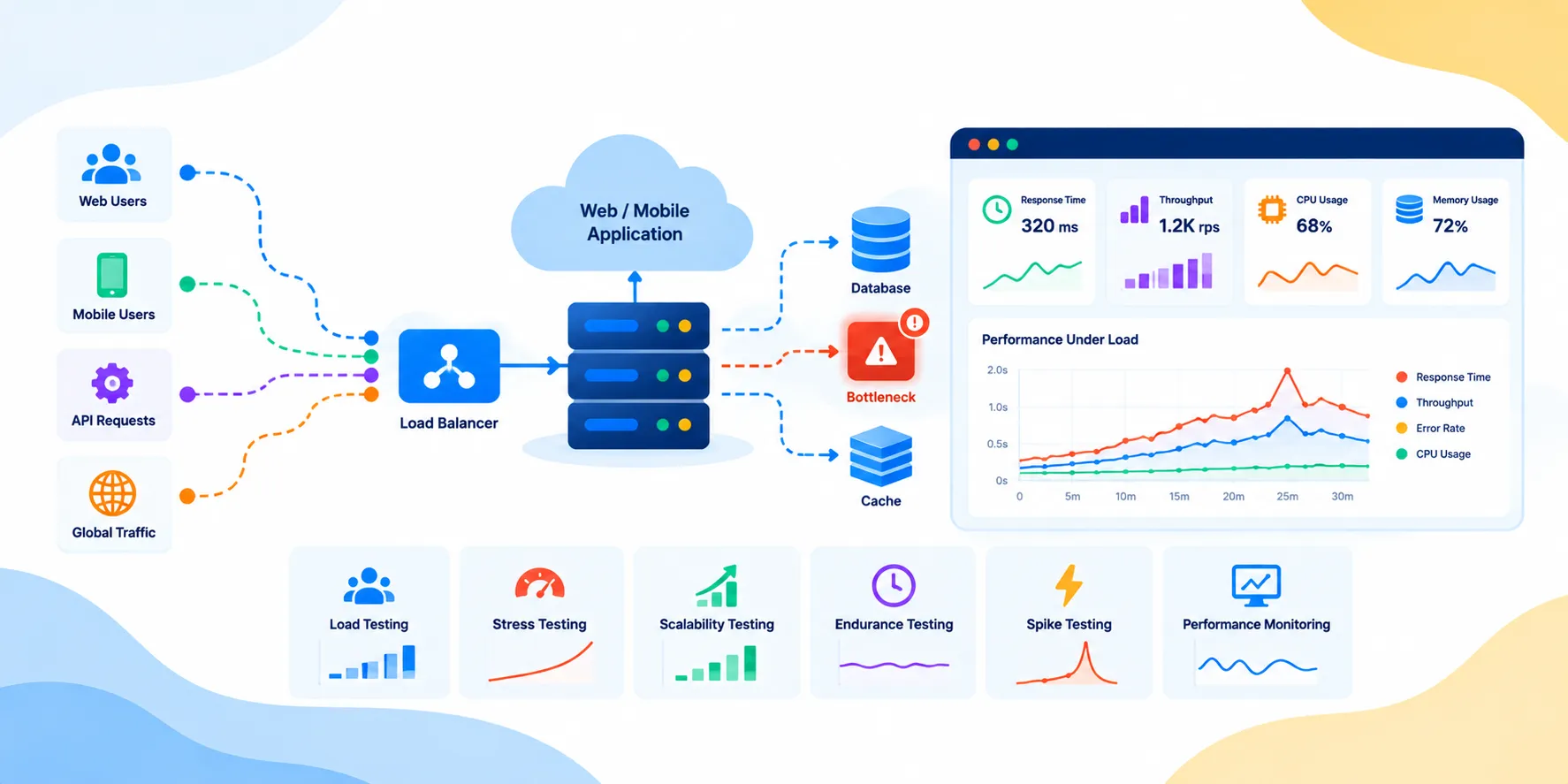
Performance Testing Should Answer What Happens When Demand Changes
An application can perform well with a few users and still fail when traffic, transactions, data volume, or concurrency increases. Performance testing creates controlled workloads so teams can measure how the system behaves before those conditions arrive in production.
Our performance testing services focus on realistic workload modeling, repeatable execution, observability, bottleneck analysis and practical optimization guidance. We look beyond one response-time number to understand throughput, errors, resource utilization, saturation and stability.
The goal is not simply to produce a report. It is to give engineering and business teams evidence about capacity, risks and the changes needed to deliver a reliable experience at the workloads that matter.
Performance Testing for Digital Products
Who Our Performance Testing Services Help
Performance testing is especially valuable when customer experience, revenue or operational continuity depends on predictable system behavior.
SaaS Platforms
Validate critical workflows and capacity as customers, tenants and usage grow.
E-commerce Products
Test traffic peaks, catalog, search, checkout, payments and orders.
APIs & Platforms
Measure service latency, concurrency, throughput and dependency behavior.
Enterprise Applications
Evaluate business-critical workloads across application and database layers.
Mobile Backends
Test services supporting high-concurrency mobile usage.
Data & AI Workloads
Assess processing behavior and infrastructure under realistic demand.
End-to-End Performance Validation
Performance Testing Services We Offer
Our performance testing services cover workload modeling, execution, diagnosis and continuous optimization.
Performance Testing Consulting
Assess architecture, workload risks, existing metrics and performance goals before defining a focused test strategy.
Load Testing Services
Simulate expected and peak traffic to measure response time, throughput, errors and resource behavior.
Stress Testing Services
Push systems beyond planned capacity to understand limits, failure modes and recovery.
Scalability Testing
Evaluate how application performance changes as users, transactions, data and infrastructure grow.
Endurance Testing
Run sustained workloads to identify memory leaks, resource exhaustion and gradual degradation.
Spike Testing
Simulate sudden traffic increases and measure system response and recovery.
Volume Testing
Evaluate application behavior with large datasets, records or transaction volumes.
API Performance Testing
Measure latency, concurrency, throughput and error behavior at the service layer.
Database Performance Testing
Investigate slow queries, connections, locks, indexes and database resource constraints.
Performance Monitoring & Observability
Correlate test results with application and infrastructure metrics during execution.
Bottleneck Analysis
Trace performance constraints across application, database, cache, network and infrastructure layers.
Performance Optimization
Turn performance evidence into prioritized engineering improvements and validate the result.
Capacity Planning
Use measured workload behavior to inform capacity thresholds and scaling decisions.
Performance Regression Testing
Repeat important performance scenarios after releases and architecture changes.
Test More Than Just Peak Load
Types of Performance Testing
Different workload models answer different questions about application behavior.
Load Testing
Validate response and throughput under expected or planned demand.
Stress Testing
Understand behavior when demand exceeds planned capacity.
Spike Testing
Evaluate sudden traffic surges and recovery behavior.
Endurance Testing
Find long-duration degradation and resource exhaustion.
Scalability Testing
Measure how performance changes as workload and capacity increase.
Volume Testing
Evaluate behavior with large data or transaction volumes.
Test What Your Business Actually Experiences
Workload Modeling & Test Design
Useful performance testing starts with realistic scenarios rather than arbitrary traffic numbers.
Critical Journey Mapping
Identify customer and business workflows that matter most.
Traffic Patterns
Model normal, peak, seasonal and burst traffic where relevant.
Concurrency Modeling
Represent realistic concurrent sessions and request patterns.
Transaction Mix
Model realistic proportions of reads, writes, searches, orders and other operations.
Representative Data
Use meaningful data volumes and variation so tests expose real constraints.
Acceptance Criteria
Define measurable response, throughput, error and capacity targets before testing.
Performance Observability & Bottleneck Analysis
Performance testing tells you that a system slowed down; observability helps explain why. During tests, we correlate response time and throughput with application logs, infrastructure metrics, database behavior, cache performance and other available signals.
This helps distinguish application bottlenecks from database constraints, connection limits, infrastructure saturation, network conditions, caching problems or slow external dependencies.
Performance reports should connect symptoms to evidence and recommendations. We focus on findings that engineering teams can act on rather than dashboards without context.
Turn Test Runs Into Measurable Evidence
Performance Metrics We Track
The right metrics depend on the workload, but several signals consistently help explain system behavior.
Response Time
Measure latency across critical requests and journeys.
Throughput
Track requests, transactions or jobs processed over time.
Error Rate
Identify failed requests, timeouts and degradation under load.
CPU & Memory
Observe resource saturation and abnormal utilization.
Database Metrics
Correlate queries, connections and resource behavior with latency.
Latency Percentiles
Use p50, p95 and p99 views where they provide better insight than averages alone.
Measure the Experience Users Feel
Web & Application Performance
Evaluate critical web journeys alongside the backend systems supporting them.
Page Response
Measure response behavior for important pages and workflows.
Dynamic Workflows
Test authenticated and stateful journeys, not only static requests.
Concurrent Sessions
Evaluate application behavior as active users increase.
Frontend Dependencies
Include important APIs, assets and third-party dependencies where relevant.
Server Processing
Correlate user-facing latency with server-side processing.
Performance Budgets
Turn important journeys into measurable performance expectations.
Find Bottlenecks Below the Interface
API, Database & Backend Performance
Backend behavior often determines whether an application remains responsive as traffic grows.
API Latency
Measure endpoint response times across realistic concurrency.
Throughput
Measure sustainable requests or transactions per second.
Error Behavior
Track failures, timeouts and saturation as workload changes.
Database Queries
Investigate slow queries, locking, connections and data access.
Caching
Evaluate cache effectiveness and behavior under changing workloads.
Queues & Workers
Assess asynchronous processing, queue depth and worker capacity.
Validate the Infrastructure Supporting Your Product
Cloud & Infrastructure Performance
Correlate application results with infrastructure behavior.
Compute Utilization
Track CPU, memory and process behavior during workloads.
Network Behavior
Observe latency, bandwidth and connection behavior.
Auto Scaling
Validate whether scaling policies respond appropriately to demand.
Load Balancers
Evaluate traffic distribution and connection behavior.
Storage Performance
Assess storage dependencies where they affect workload behavior.
Cloud Cost Signals
Identify workload patterns that may create avoidable infrastructure cost.
Performance Is More Than Speed
Performance, Stability & Resilience
A fast response under light load does not guarantee stable behavior under sustained or changing demand.
Resource Stability
Look for growing memory, connections or resource consumption during long runs.
Recovery Behavior
Observe recovery after overload, errors or traffic spikes.
Saturation Signals
Identify which resource reaches capacity first.
Dependency Limits
Understand how external services affect capacity.
Failure Isolation
Determine whether localized bottlenecks create wider degradation.
Repeatability
Re-run scenarios to confirm results are consistent and actionable.
From Baseline to Optimization
Our Performance Testing Process
A structured process turns performance testing into repeatable engineering evidence.
01. Discovery & Architecture Review
Understand product architecture, critical workflows and known risks.
02. Workload Definition
Translate business usage and traffic expectations into scenarios.
03. Performance Criteria
Define response, throughput, error and capacity expectations.
04. Test Environment Planning
Prepare environments, data, observability and dependencies.
05. Test Script Development
Build maintainable workload scripts for selected scenarios.
06. Baseline Testing
Establish a repeatable baseline before changing workloads.
07. Load & Stress Execution
Run planned workloads and controlled stress scenarios.
08. Observability & Diagnosis
Correlate results with application and infrastructure metrics.
09. Bottleneck Analysis
Prioritize constraints that materially affect experience or capacity.
10. Optimization Recommendations
Translate evidence into practical improvements.
11. Re-Test & Compare
Repeat scenarios after changes and compare against the baseline.
12. Capacity & Release Guidance
Document findings, thresholds, risks and recommendations.
Performance Testing Technology Stack
Tooling is selected according to workload type, application architecture, execution scale and observability requirements.
Catch Slowdowns Before Production
Performance Regression Testing
Performance can degrade gradually as code, data and infrastructure evolve.
Baseline Comparison
Compare new runs with established performance baselines.
Critical Journey Checks
Repeat important workflows after significant changes.
API Regression
Track important endpoint latency and throughput over time.
Database Regression
Detect query or data-access changes affecting performance.
CI Performance Gates
Add selected checks to delivery workflows when practical.
Trend Monitoring
Track recurring performance changes across releases.
Move From Findings to Measurable Improvement
Performance Optimization Support
Performance testing creates the evidence; optimization work turns it into better system behavior.
Application Optimization
Investigate inefficient code paths and resource use.
Database Optimization
Address query, indexing, connection and data-access bottlenecks.
Caching Strategies
Evaluate caching opportunities and invalidation behavior.
Infrastructure Tuning
Review compute, networking, scaling and resource allocation.
Architecture Improvements
Identify changes that can improve throughput, resilience or scalability.
Validation After Changes
Re-run representative workloads to confirm improvements.
Where Performance Testing Delivers the Most Value
Performance Testing Use Cases
Support launches, growth, modernization and operational reliability.
Peak Traffic Readiness
Validate systems before campaigns, launches or seasonal demand.
SaaS Growth
Understand how multi-tenant usage affects capacity.
E-commerce Peaks
Test search, catalog, checkout, payments and orders under high demand.
API Scale
Validate service capacity before usage increases.
Cloud Migration
Compare behavior before and after infrastructure changes.
Major Releases
Detect performance regressions before significant releases.
Performance Testing Around Industry Workloads
Industries We Support
Workload models and performance criteria are adapted to the business processes that matter.
Retail & E-commerce
Peak shopping traffic, search, checkout and fulfillment workflows.
SaaS & Software
Multi-tenant usage, APIs, dashboards and customer workflows.
Fintech & Payments
Transaction-heavy services where latency and throughput matter.
Healthcare
Portals, scheduling and data-intensive workflows.
Logistics
Tracking, dispatch, booking and operational workloads.
Education
Enrollment, learning and high-concurrency portal scenarios.
When Performance Testing Makes Sense
Performance testing is worth considering when a product approaches a major launch, expects a traffic increase, moves to new infrastructure, experiences unexplained slowdowns, or supports workflows where latency and reliability directly affect customers.
It is also valuable for capacity planning. Controlled testing can expose practical limits and show which component becomes constrained first instead of relying only on infrastructure estimates.
Not every application needs a large performance program. The right scope depends on business risk, traffic profile, architecture, release frequency and the cost of performance failure.
Choose the Depth That Fits Your Risk
Performance Testing Engagement Models
Start with a focused assessment or build performance engineering into ongoing releases.
Performance Assessment
Review architecture, workloads and metrics to define a focused plan.
Peak Readiness Test
Validate a launch, campaign, seasonal event or traffic milestone.
Performance Engineering Sprint
Investigate a bottleneck, run controlled tests and validate improvements.
Ongoing Performance Testing
Maintain baselines and repeat important scenarios as the product evolves.
Performance Testing With Engineering Context
Why Businesses Choose Axora for Performance Testing
Our approach connects test execution with the application and infrastructure decisions that influence real-world performance.
Realistic Workloads
Model important business journeys instead of generic traffic patterns.
Full-Stack View
Consider application, API, database, cache and infrastructure together.
Actionable Analysis
Translate metrics into bottlenecks and engineering recommendations.
Cloud-Aware Testing
Account for cloud infrastructure and scaling behavior.
Repeatable Baselines
Create comparable runs to identify regressions over time.
Optimization Validation
Re-test after changes to confirm measurable improvements.
Performance Evidence That Supports Better Decisions
Performance testing is most useful when it changes a decision: whether to release, whether capacity is sufficient, where engineering effort should go, or whether an architecture can support the next stage of growth.
We focus on repeatable scenarios, measurable criteria and evidence that connects application behavior with infrastructure signals. This makes the output useful to developers, DevOps teams, product leaders and decision-makers.
Where optimization is required, performance testing becomes an iterative loop: establish a baseline, identify the constraint, make a targeted change, and re-test under comparable conditions.
Related Services
Services to Support Performance Engineering

Software Testing Services
Reduce release risk with structured software testing across web, mobile, APIs, integrations, workflows, compatibility, regression, UAT, and quality engineering—built around your product's real business-critical journeys.
Learn more
QA Automation Services
Accelerate software quality with maintainable QA automation across web, mobile, APIs, and critical workflows using modern test frameworks, CI/CD execution, reliable reporting, and a risk-based automation strategy.
Learn more
Cloud Infrastructure Services Company
Design, build, secure, and operate cloud infrastructure for applications, data platforms, APIs, and AI workloads with scalable architecture, infrastructure as code, networking, security, observability, high availability, and cost control.
Learn more
DevOps Services Company
Build faster, safer, and more reliable software delivery with DevOps services covering CI/CD automation, infrastructure as code, containers, Kubernetes, cloud operations, DevSecOps, observability, SRE, and continuous optimization.
Learn moreFrom Our Blog
Software Engineering Insights
Frequently Asked Questions
Common questions about performance testing services, load testing and scalability validation.
Ready to Transform Your Business?
Get started with our intelligent digital solutions. Our team is ready to help you unlock the power of AI-driven technology.
Send us a message
Fill out the form below and we'll get back to you within 24 hours
Contact Information
Reach out to us through any of these channels